Showing posts with label Tooker. Show all posts

Monday, May 9, 2011

Niles Martin Clark

Niles Martin Clark (1866-1911) was my great grandfather.  He was the second youngest of 12 children born to Leonard Sherman Clark and Esther Phelps Martin of East Haddam, Connecticut.

The name "Niles" features prominently throughout the Clark family of today and long ago.  Niles Martin Clark, for instance, was named after his great grandfather, Niles Phelps (1771-1848), who himself was named after his great grandmother, Abigail Niles-Tiffany (1675-1739) of Braintree, Massachusetts.  Abigail's grandparents (John and Jane Niles) had migrated to Mass. from England shortly after the Mayflower voyage, but John Niles' father's surname was written as Nyle, and this family were thought to have been from Dorset, England.

At age 19, Niles Clark had a short lived marriage to a Bertha Watrous, and just after his 21st birthday he married Lizzie Matilda Tooker of Lyme.  He lived in Suffield and Granby, and worked as a blacksmith and horseshoer all his life.

A brief history of Niles & Lizzie's 9 children:

EMMA LEORA CLARK-STOLL


-Emma Leora Clark (1889 – 1947) married Anthony Stoll, born to British immigrants.  They had six children and settled in the Kingston NY area.

Clark Family in 1934
Left to Right:
Isabelle Clark-Bartley, Ken Clark (children of Claude),
Claude Clark-Smith, Frank Bartley (holding his son Leonard "Bushel" Bartley),
Emma Leora Clark-Stoll
1934 Studebaker Dictator 3W Coupe in the background


LEONARD (BUSHEL) BARTLEY, CLAUDIA CLARK-SMITH-BELL, LEN BELL (CLAUDIA'S HUSBAND), UNKNOWN NEIGHBOR, ANNE (FRANK BARTLEY'S GIRLFRIEND),
FRANK BARTLEY (FATHER TO BUSHEL, AND FORMERLY MARRIED TO CLAUDIA'S DAUGHTER ISABEL),
ANNE'S DAUGHTER (SEATED)
THANKSGIVING 1942
NEWBURGH, NEW YORK
 
-Claudia Cressie Clark (1892 – 1961) (nicknamed 'Claude') married Charles B. Smith, and lived in Beekman, NY, and later Union Vale, NY.  In 1927 she moved to Newburgh, NY (later to Fishkill).  She had four children:  Kenneth, Isabel, Harold (who also went by "Jim") and Ruth.  Claude divorced Charles around 1939, and immediately remarried to a well driller named Leonard "Len" Bell, and remained in Newburgh, on Gardnertown Road, then later on Fostertown Road.  After her divorce from Charles, it appears that the kids stayed closer to Charles (who claimed he was widowed on the 1940 Census, so it's clear there were hard feelings - in fact, for the 1930 Census, Claude claimed to be widowed as well, and she wasn't even divorced yet).  Claude and Len moved to Montgomery NY in 1949, where she worked as an operator at a dress manufacturer (similar to her mother's work), and Claude died a widow in 1961.  Claude and Len are buried together at Cedar Hill Cemetery in Newburgh, NY.

-Niles Carrol Clark (1894 – 1918) was named for his father, and grew up in a Home for Boys in Hartford, CT, settled in Hartford, but then was drafted to serve in WWI, only to die of pneumonia in France after the war was over, while he was waiting to be picked up.  It took THREE YEARS for Lizzie to get his body shipped back to the USA, and he is now buried next to his mother in Forest City Cemetery, South Portland, Maine.  He served in the Army in the Connecticut 102nd Infantry Regiment from 1917, and was severely wounded in July 1918 in Aisne Marne, and further wounded in Oct 1918 in Meuse Argonne.  According to Niles' nephew, the family lore has it that young Niles was "shot by German soldiers whilst rescuing Captain Eddie Rickenbacker from his downed airplane during WWI and died in France from complications of his wounds, probably gangrene."  This runs afoul of the more boring death record in City of Portland's vaults, and military records, stating he simply died of lobar pneumonia.  Spanish Flu was the common culprit during 1918, especially during the last battle Niles fought in (Meuse Argonne).  Besides, Eddie Rickenbacker's tenure in France did not line up with Niles' battle record in France with his regiment.  Niles was a hero to the Clark family, and his younger brothers Leonard and Frank each had sons they named after him.

-Clifford Nordell Clark (1896 – 1963).  "Cliff" was put in the Meriden, CT Home for Boys for most of his youth.  He ended up serving as in WWI, and after the war lived in Hamden, CT, where he worked as a bookkeeper at a gun factory in 1920.  Later on he lived in Newburgh near his brother Leonard during the 40s.  He traveled the world as a seaman, lived in Mississippi for a while, and ultimately settled in Galveston, Texas just two years prior to his death, when he was working as a messman for a shipping company.  From what I hear he was quite shellshocked from the War, and according to those who knew him, he would cower on the ground into a combat crawl anytime a loud noise occurred.  His brother Leonard ("Red") spoke of him as crazy, and that he would always be saying he was just coming from Cleveland, or just about to go to Cleveland, no matter where he was.  Cliff's obituary in the Galveston paper stated that his brother Leonard lived in Corpus Christi, TX, yet Leonard had retired 3 years prior to that to Phoenix, AZ (but according to Leonard's son, he had moved to AZ a bit later than that).  According to one of Red's children, Red talked about Cliff quite a bit and yet they hardly ever saw each other.  It's a shame that for a brief moment in the early 60s, both brothers were living very close to each other before Cliff died.  Cliff had only one child, Johnny Clark, who was living in Scarborough, Maine at the time of Cliff's death at the USPHS (military hospital) in Galveston in 1963.  According to Cliff's nephew, Cliff had fought in WWI, but I don't see a draft card for him at present.  

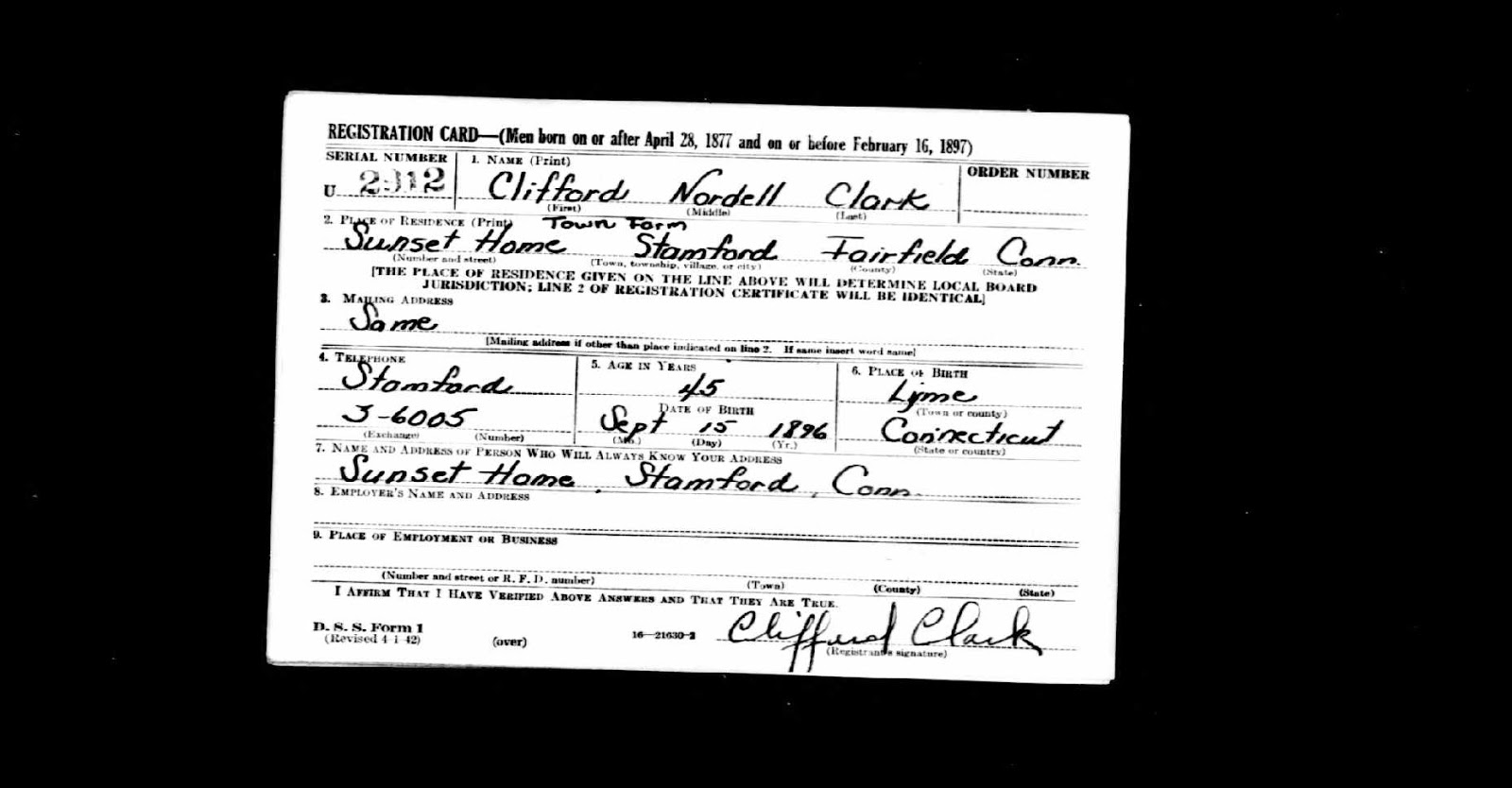
Cliff was drafted into the "Old Man's Draft" of WWII in 1942, at which time he was staying at the Stamford "Sunset Home Town Farm", a poor farm, and had already one toe removed due to diabetes.

Here is Cliff's WWII draft card:


Also regarding Cliff, on a 1955 ship register from Southampton England to NYC, Cliff had only checked one bag, while the rest of the passengers had checked between 3 and 7 bags.  Cliff died of a heart attack in 1963, just a couple of years after settling in Galveston TX, but had suffered from diabetes for a long time, and it was later told to me by a distant cousin that Cliff had had a leg amputated due to his illness.  Cliff is buried at Lakeview Cemetery, in the Marine Section.  

As for the Galveston house that Clifford lived in with Margaret (1415 Avenue N), it appears that they moved in at some point after September 1961, as per newspaper records showing others living there.

Further, it appears that his veterans headstone application cards below that he was dishonorably discharged in 1927, and perhaps went by a pseudonmym (William J. Nolan):


It's unclear when his wife, Margaret H. Clark died, or where she's buried, but she was alive as of 1966.  The 1920 Census record shows Clifford having a wife named Mona, age three years younger than him.  I'm not sure if this Mona is the same person as Margaret H. Clark who was his widow.  It's apparent that after Clifford's death in Galveston in 1963, she moved to nearby Texas City by 1966. I researched this address, and apparently it had ben turned into a park by 1995.

Also, there is another Margaret H. Clark of Galveston who was married to a painter by the name of Edward C. Clark.  She lived from 1910 to 1986, so this is not the same lady.  This was confusing to me, but I'm putting that information here for myself or other potential researchers to be aware of.

There are some records of a Mrs. Margaret H. Clark living in Connecticut after 1966, so it's possible she moved back to CT after Clifford died.  It would make sense, given they only lived in Galveston a few years.


JOHNNY CLARK
SAILOR
SON TO CLIFFORD CLARK

My hope is that someone researching the Clarks might know the whereabouts of Johnny, and if he's still alive.


LEONARD SHERMAN "RED" CLARK
ABT 1946


-Leonard Sherman Clark (1899 – 1974) was named after his grandfather Leonard Sherman Clark, yet was nicknamed "Red", due to his red hair.  In his later years, he simply went by "LS Clark".  Red was raised partly in the Temporary Home for Boys in Haddam, CT.  He had five children, lived most of his adulthood in Texas, and retired in Phoenix as an industrial engineer.  He was one of the few Clarks of his time to have ever gone to college, and one of the few who didn't work in blue collar trades.  His very interesting story can be read here.

-Ethel Dorothea Clark (1903 – 1981) first married in 1920 to German immigrant Oscar Hellmuth, and had one daughter Cecelia (1921-1991), who had two daughters of her own in the 1940s (Celia and Agnes), and worked with her stepdad Cyril in his tree surgeon business.  They divorced in 1930, and she immediately married a tree surgeon named Cyril Adams (originally from San Francisco), and while they had no children, they did live in Hull, Mass during the 1940s, and were living in El Monte, CA (Los Angeles County) for the 1950 Census, and then later in San Francisco and Richmond, California.  Ethel did a lot of factory work, including as a sorter in a tobacco factory (1930 census), and was also a housekeeper.

FRANK CLARKE

-Herbert Francis Clarke (1905 – 1982) was my grandfather, and was nicknamed "Frank".  He lived most of his life in Scarborough, Maine and worked as a stonemason.  His youth was spent at Opportunity Farm in New Gloucester, Maine.  He had 12 children (three more than his father), and many descendants.

-Geraldine Frances Clark (1908 – 1987) grew up in Granby, CT and Scarborough, ME.  She married Fred Meserve, moved to Rochester, NY, and later married William C. Smith.  At some point between 1965 and 1979, she and William moved to Bailey, Mississippi to be closer to her nephew Bill's family and her niece Florence's family, where they lived in side by side trailers on Grissom Road.  No descendants.  Geri's ashes are buried on top of her brother James' body in Ossian, NY.

GERALDINE CLARK SMITH
WITH HER HUSBAND WILLIAM SMITH
AND HER NEPHEW BILL CLARKE


AUNT GERALDINE'S TRAILER
GRISSOM ROAD
BAILEY, MISSISSIPPI


JAMES RAYMOND CLARKE

-James Raymond Clarke (1910 – 1979) also spent some of his youth in Opportunity Farm, with his brother Frank.  He moved to western NY and was married with seven children.

***

The Death of Niles Martin Clark

Niles had been battling tuberculosis, whether he knew it or not, and died of it at age 45 in the hot summer of 1911 in a barn in North Lyme, with a contributing factor of heat exhaustion.  During the time of his sickness and death, Lizzie dispensed of her sons to various orphanages, took the family fortune and remarried three more times.


SITE OF DEATH OF NILES MARTIN CLARK (JULY 1911)
NORTH LYME, CT

While the above story of Niles' death rings true when reading available records, there was another, much more entertaining story passed down regarding Niles (through the children of his son Red).

According to one account, Niles was a very powerful man; and that he could hold the hind leg of a mule in his hand while someone coaxed the mule to kick and, he was that strong, that he could hold the mule's leg and it could not kick him. At the same time, he was a man who liked to drink and gamble a lot. One night, drunk, someone bet him that he couldn't do it but, being drunk and a bettor, Niles accepted the bet. The mule kicked, his hand slipped, he got kicked in the chest and died under a big tree in the backyard days later of a stove-in chest.

Now given that Niles' death certificate has him dying of tuberculosis, and given that his father, Leonard Sherman Clark was a man with the height of 5' 5 1/2", I'm having trouble believing this entertaining version of old Niles.  Besides, given that Niles' wife, Lizzie, was a controlling and very tough woman, it would stand to reason that she would only marry gentle and easy going, hard working men, which most of the Clark men were.  It's difficult to imagine one of the old Clarks being a 'powerful man' of physique and temperament.

Pedigree Chart for Niles can be found below.  He is of 100% English colonial descent, from all research done to date.


Monday, September 6, 2010

John & Nancy Tooker


As mentioned in other blog posts, the Tooker family of Connecticut was vast and spread out well over the State.  They frequently intermarried with the Hall, Clark and Bogue families, among other families in 19th Century Connecticut.  Many of these marriages were of first and second cousins.

John Harvey Tooker, Jr. (1819-1904) was one of the many Tookers of Lyme.  As mentioned in other blog posts, his father was born John Harvey Tucker (1790-1874), but changed the family name due to not wanting the family to be confused with a delinquent Tucker family, who also had similar first names.  John's mother was Olive Dart (1793-1872) , whose father, Samuel Dart had migrated from Devon, England (need to verify).  John Sr. died of cystitis, and Olive died of palsey, both in the family home in Lyme.

John Jr. was married to Adelia Slate from 1844 to 1849.  Delia divorced him based on "intolerable cruelty" and him being "habitually intemperate".

John conceived a child named Alice Tooker with Nancy Ann Hall (1836-1917) before ultimately marrying Nancy in February of 1854.  Nancy was one of the many Halls of Lyme.  Her father, Harvey Hall (1805-1859) was from England but lived in Colchester, Connecticut much of his life.  Her mother, Sarah "Sally" Hewlett-Mott-Hall (1805-1895), lived on the Glover farm in Newtown (Fairfield County Connecticut) after Harvey died.  The Glovers were not relatives, so I'm not sure why the move, when she might have been able to live with any of her seven children's families in Lyme.  Sally was daughter to Stephen Hewlett and Mary Daniels.  Her sister Abby married William Bogue and had 11 children.  Her brother Edwin Hewlett married Francina Mott (must have been some relation to Sally's first husband.

Nancy's brother Charles married a Clark.  Her brother Harvey married a Tooker.  It was the way things went, apparently.

Below is a brief account John & Nancy's family:

-Alice (1853-1920) married George Thomas Bogue (of the Lyme Bogues - who was also descended from Clark and Dart cousins of Alice), and had two daughters:  Alice and Nellie.  Nellie married her first cousin, Willis Manley Clark, who was Francina's son, and they lived in Essex, CT.  Nellie and Willis had six children together.  In 1911, at age 36, only three years after having her sixth child, Nellie was hit by a train in Willimantic, CT, while she was walking on the tracks by herself.  The train apparently tried to signal a warning whistle, but Nellie hadn't heard it since she was deaf.  She eventually turned around and saw the train, and was struck.  She died in the hospital from skull fracture.  Full article of this sad event, as written in the Willimantic Chronicle, October, 1911, is transcribed below:

WOMAN HIT BY TRAIN NEAR TURNERVILLE

A Woman was walking along the track and paid no attention to the warning whistle, turning however just as the engine strikes her.  A woman about 50 years old whose name could not be learned was struck this afternoon by the three o'clock train from New Haven, just this side of Turnerville.  She was walking along the track and was seen by the engineer.  He blew the whistle and she did not seem to hear it, he then applied his brakes but could not stop his engine quick enough to avoid striking her, the woman turned around and as she did she was struck in the shoulder and thrown to the ground.  The train was soon stopped and the woman placed on a stretcher and taken aboard the train.  Word was sent to St. Joseph's hospital in this city and the ambulance called, it met the train and took the woman to the hospital where she was treated for her injuries.
The woman was poorly dressed and looked as though she was in great pain. She had to be held down on the stretcher by the railroad man, until brought to this city and when taken in the ambulance to the hospital had to be held down on the stretcher by the attendant.

DIES IN HOSPITAL

A short time after being taken into the hospital the woman died from fracture of the skull. Word was immediately sent to Dr. Louis I. Mason, the medical examiner, later it was learned that the woman was Mrs. Willis Clark of Hopeville which is about a mile from Turnerville.
The funeral of Mrs. Willis Clark of Turnerville who died in St. Joseph's hospital yesterday afternoon from injuries received in being struck by a train a short time before will be held Friday at 12 o'clock.  The service will be in the Episcopal Church of Hebron and internment will be in the Hebron Cemetary.

The deceased was about 45 years old and leaves a husband and six children.  The engineer felt much grieved at the woman's death.  He said that Mrs. Clark was walking on the tracks and apparently did not hear the whistle.  He put on his brakes, but not soon enough.  The woman, just as the engine approached her turned to one side and as she did the brake beam of the engine struck her.

Mrs. Clark was deaf and had the left the train at Turnerville.  Her home was about a mile and a half this side of Turnerville.

After her death yesterday afternoon medical examiner Dr. Louis I. Mason, who was called and after viewing the remains, turned them over to Elmore and Shepard to be prepared for burial.


-Francina Czarina (1855-1919) was given her middle name due to a Russian woman living with them at the time.  She moved to Montville, CT, and married William Edward Clark (brother to her sister Lizzie's husband Niles).  They had eight children.  Their youngest, Richard William Clark, married his own niece, Viola West, and went to jail for it.  They changed their last names to Williams and moved up to Keene, New Hampshire for a while.  Richard and Viola were married for over 50 years, and had five children together, all of whom lived to be happy normal adults.  I guess the heart wants what it wants...

-Ephraim Norman (1856-1858) died just a few days shy of his 2nd birthday.

-John F. (1860-1913) married twice (Ida Beers & Mary Mitchell), and had 5 children.  When he died in 1913, Mary married Gilpin Clark, a cousin to all the Clarks everyone else was marrying.

-Ralph Saunders (1862-1939) married Lillian Bogue and had two sons, Arannah and Ralph Jr.  They both married Clarks.

-Charles Carrol (1864-1942) was a building carpenter.  He married Minnie Allen and had five kids.  His eldest son Horace married Charles' sister Musette's eldest, Josephine.

-Lizzie Tooker (1870-1942) married Niles Clark (brother to Francina's husband William), and had nine kids.  Lizzie and Niles were my great grandparents.

-Sarah Lucretia (1872-??), I can't find anything beyond the 1880 Census.  She wasn't named on her father's will, probated in 1917, so she must have died prior to then.

-Musette Cressie (1874-1948) married Augustus Ferdinand Snow, who was 30 years her senior.  They had eight children together.  Augustus had a son Albert (1880-1949) from a prior marriage (well actually Albert's mother was the neighbor during his prior marriage), who lived with his father and stepmother Musette.  When Augustus died, Albert (being only 6 years younger than his stepmother) married Musette, and adopted the eight children as his own.  Albert was married to Musette for 30 years, twice as long as his father was married to her!

-Samuel Israel (1875-1951) was a stone mason.  He married twice and had a daughter named Flora.

-Mary Tooker, the youngest, married George W. Lovely, and had two boys, George Jr. and John.  John married a girl named Fanny...which means that her married name was Fanny Lovely!

John Harvey Tooker fought in the Civil War from 1862-1863 in the CT 26th Regiment, Company F.   He enlisted on 30 August 1862, and mustered out November 10 of that year.  He finished up in August 1863, completing a nine month enlistment, and was paid $44.78 for clothing/money advanced.  Below is an account of the 26th Regiment, which saw its only Civil War battles in Louisiana:

Regimental History
CONNECTICUT TWENTY-SIXTH REGIMENT
C. V. INFANTRY (Nine Months)
WRITTEN BY CAPTAIN LOREN A. GALLUP, LATE OF COMPANY F, TWENTY-SIXTH CONNECTICUT VOLUNTEERS.
THE Twenty-sixth Regiment was organized in September, 1862, under General Orders No. 99, dated August 13th. Recruiting occupied from about August 20th to September 10th, when ten companies assembled at Camp Russell, Norwich, coming from New London and Windham Counties. The officers of the line were elected by each company after its enlistment, before they were commissioned. On September 19th the field officers were elected by the line officers. The staff was appointed by the Governor. On September 25th the regiment was formally mustered in by a United States mustering officer, but the rolls were not signed. From this time to November 13th the regiment remained in Camp Russell, and became quite proficient in company and regimental drill.
On November 10th and 12th the regiment was again mustered in by United States Mustering Officer Lieutenant Watson Webb, who signed the rolls. Orders were received on November 12th to break camp, which was done on the 13th, and at 3 P. M. the regiment, with full ranks, eagerly left its first camp and marched through the crowded streets of Norwich, viewed by thousands of spectators and friends, and embarked on the steamer "Commodore" for New York. On November 14th it was disembarked at Brooklyn, and marched to Centerville Race Course, where it made its second encampment until December 4th. This camp was known as Camp Buckingham. On December 4th this camp was evacuated, and at 4.30 P. M. the regiment arrived in Brooklyn, and the same evening embarked on the steamer "Empire City." Remaining in New York Harbor until the morning of December 6th, the steamer put to sea under sealed orders. It was not divulged until several days later that this regiment was a part of an expedition to rendezvous at New Orleans, under Major-General N. P. Banks. On December 13th, arrived in the Gulf of Mexico; on the 14th, at Ship Island; and on the evening of the 16th, at New Orleans. On the 18th disembarkation was made at Carrollton, a few miles above New Orleans, and tents were again pitched, at Camp Parapet, a large enclosure from the Mississippi to Lake Pontchartrain. Here for the first time arms were issued to the regiment, and officers and men eagerly studied and practiced the manual of arms. In common with all Northern men going into camp so far south, much malarial sickness appeared, and soon the hospital was more than full, and many died. The influence upon the men of these frequent and sudden deaths was somewhat dispiriting.
On January 21 and 22, 1863, the regiment was paid off in full.
On or about March 13th, when Commodore Farragut passed up the Mississippi with his magnificent fleet and successfully passed the Port Hudson batteries, the cannonading of which could be distinctly heard in the regimental camp, it became quite evident that the Twenty-sixth was soon to participate in more active warfare at the front. For this change the men were impatient. On May 20th the regiment embarked at Carrollton, on board the steamer "Crescent," for Baton Rouge, where it arrived on the morning of May 22d, and during the forenoon it disembarked some six miles above, at Springfield Landing, in full view of the river works of Port Hudson, which, like Vicksburg, was a high bluff at a bend in the Mississippi, and strongly fortified on the river front; also with a parapet several miles in length in the rear, passing over and across ravines, gulches, and woodland, enclosing a rebel camp of many acres, and garrisoned by 6,000 to 7,000 men under Major-General Frank Gardner. The Twenty-sixth regiment was at this time attached to the First Brigade (General Neal Dow), Second Division (General T. W. Sherman), Nineteenth Army Corps (Major-General N. P. Banks).
Upon disembarkation at Springfield Landing the regiment was ordered immediately to the front to report to division headquarters. "Grim-visaged war" was now apparent. The mortar fleet below Port Hudson kept up a continual shelling of the rebel works, the missiles passing directly over the regiment. On May 24th the regiment joined the left wing of the corps investing Port Hudson, which had progressed from right to left. The enemy were driven into their inner works during the afternoon of this day, abandoning their rifle-pits and outer works, ten in number, in front of Sherman's Division. During the evening communication was ordered to be established at the extreme front, between Sherman's and Augur's divisions on our right. A detachment from the Twenty-sixth was selected for this purpose, and by 10 o'clock its object was accomplished, and Port Hudson was completely invested. May 25th, 26th, and 27th were days of preparation for the first assault by the entire corps upon the enemy's works, which were as strong as skill and time could construct. At 10.30 A. M. the bugle called into line Sherman's Division, but not until 1.30 P. M. was all in readiness for the charge. The Twenty-sixth occupied the right center of Dow's Brigade, and it so happened that at this point, by the "Slaughter" plantation house, were assembled Generals Dow, Sherman, and Andrews (Chief of Staff to General Banks), when General Dow ordered his brigade to the charge. With great enthusiasm General Sherman also in person ordered "Forward!" and led the column until he lost his leg and his horse by a shot.
Charging over an open field upon a protected enemy is a story that has been told and written in the blood of thousands. Impetuosity, bravery, and skill accomplished the same here and no more than at Fredericksburg and many other historic fields. An advanced position was secured and held. When the Twenty-sixth called its rolls after the battle, 107 were dead and wounded. Among the number were all ranks, from colonel to private. This regiment had received its first baptism of fire and blood, but only to prepare it for better service. The picket line that night was held in front of Dow's Brigade by the Twenty-sixth.
From May 27th until June 14th the entire command was under continual fire, night and day. On the afternoon of June 13th a heavy skirmish line was thrown out on Sherman's front, in which the Twenty-sixth performed a conspicuous part, losing one man killed and seven wounded. On June 14th a second general assault was ordered. Sherman, who had lost a leg May 27th, had been succeeded by General Dwight, who selected a position more to the left, and on the extreme right of the enemy, near the Mississippi River. The result of this assault was similar to the first. It was made in the early morning. No troops could have been better handled, or acted with more gallantry. In this charge the Twenty-sixth numbered 235 men, and its total casualties were sixty-one. Of this number four were killed and sixteen wounded by a single shell. After this battle the brigade commander said in his report: "The nine months troops have demonstrated by their gallant conduct that they can be relied upon in any emergency."
From June 16th to July 8th the siege was continued. On July 7th news was received of the surrender of Vicksburg, and on the next day Port Hudson surrendered, with 6,408 prisoners. General Banks's total casualties during the siege were 500 killed, 2,500 wounded (official). That the Twenty-sixth had borne a conspicuous part was acknowledged by its being selected as one of ten regiments to receive the capitulation of the garrison on July 9th, and was assigned to the left of the line-the second post of honor. From July 10th to 25th this regiment performed provost and guard duty at Port Hudson. On July 25th orders were received to break camp and embark on the steamer "St. Maurice," and return to Connecticut for muster out, by reason of expiration of term of service. The regiment left Port Hudson on the 26th, via Mississippi River, Cairo, Chicago, and New York; thence by steamer to Norwich, where it arrived August 7th. Upon its arrival it was received by the Mayor and city authorities, who bestowed upon the organization every attention and honor. The Mayor delivered an address of congratulation and welcome, and the citizens turned out en masse and provided a sumptuous collation on the public park. On August 19th the regiment again reassembled in its original Camp Russell, and was mustered out and paid off.
ENGAGEMENTS.
Port Hudson, La., May 27, 1863.
Port Hudson, La., June 13, 14, 1863.

John died of chronic bronchitis in April of 1904 in their Lyme home.  Nancy died of stomach cancer in the summer of 1917.  At the time of John's death, his house in Lyme was valued at $200, his 30 acres of land at $200, and his 4 head of cattle at $120.


Here are a few assorted pictures of the Tooker family, including children of John & Nancy Tooker (Francina, Musette, Charles, and Lizzie):

SNOW/CLARK FAMILY (1945)
Fannie Stoll-Snow, Richard Snow, Winona Snow
Emma Clark-Stoll, Musette Tooker-Snow (unknown baby)

CHARLES CARROL TOOKER
& WIFE MINNIE LOUISE ALLEN-TOOKER

 FRANCINA CZARINA TOOKER-CLARK

LIZZIE TOOKER-CLARK-FOLGER-BRAGDON-RENNO


Thursday, September 2, 2010

Leonard Sherman Clark (1821-1899)

Leonard Sherman Clark was born in Hadlyme, CT to James & Ann Clark at some point between 1 Nov 1820 and 5 June 1821.  He grew up largely without his parents, as they had taken land patented to them in Quincy Illinois and left the children with the Howell family, trusted neighbors and friends.

Leonard was a carpenter and house builder.  He was quite short in stature, 5'5 1/2", blue eyed, with sandy brown hair, and played the fiddle.  He was left handed.

Leonard was baptised at 21, at the Congregational Church in East Haddam, on 3 July, 1842.


On 26 Feb 1843, he married Esther Phelps Martin, daughter to Joseph Martin, who operated a saw mill in East Haddam.  Esther was a 16th generation descendant of King Edward III (whether she knew it or not).

After living in Chester (across the CT River) for a time, Leonard and Esther inherited land from Joseph Martin on what would be soon known as Clark Hill Road, named after him, since he built several houses on that road, including the house the family lived in for most of Leonard's life.  Family lore has it that Joseph Martin was so glad to get rid of Esther, who was deemed to be 'the ugliest girl in East Haddam', that he gladly gave up a lot of land to Leonard as dowry.

One of the houses Leonard built was in Chester for a friend, Henry Shipman.  Henry never paid him for the building, and Leonard had to take him to court, eventually winning the house he built in 1849.

In August of 1862, Leonard enlisted in the Union Army during the Civil War, serving about three years in Company C of Connecticut's 20th Infantry Regiment, alongside his eldest sons Charles and John Ozias. They fought in many battles for the Union:  Chancellorsville, Gettysburg, Tracy City, Boyd’s Trail, Resaca, Cassville, Peach Tree Creek, Siege of Atlanta, Silver Run, Bentonville, and Raleigh.

Leonard & Esther had 12 children over a period of 27 years, 9 of whom survived infancy.  The children and their grandchildren lived in and around East Haddam all their lives, with few exceptions:

-Ellen (1843-1844) died very young and is buried all by herself at Hungerford Cemetery.

-Charles L. (1845-1906) married Harriet Hall, cousin to Lizzie Tooker, who married Charles' brother Niles.  Charles and Harriet had 8 children and many grandchildren.  He worked as a house joiner, served as a Sergeant in the Civil War with his father, and lived his later years in Colchester, CT.  His death certificate states he was born in East Haddam.  He is buried in Linwood Cemetery in Colchester.

-John Ozias (1847-1926) fought in the Civil War with his father, married at least twice, and had at least fifteen children.  More about John can be read on his own blog page (linked in this paragraph).  John was 5'9", blue eyes, auburn hair.  A descendant from his first marriage, Jerry Clark, has been very helpful to me in learning about the Clark heritage.


JERRY CLARK
(AT GRAVE OF HIS GREAT GRANDFATHER, JOHN OZIAS CLARK)
Parker Hill Cemetery, East Haddam, Connecticut

JOHN OZIAS CLARK (ABT 1920)
WITH YOUNGEST DAUGHTER SUSAN ELECTA CLARK-DUBE-RUSHLOW
 
-Leonard S. (1849-1850) also died very young, unknown burial location.

-Harriet E. (1850-1850) another young death, unknown burial location.

-William Edward (1850-1921) was a farmer and a butcher.  He married Francina Tooker (sister to Lizzie Tooker, who married William's brother Niles).  They settled in Montville and had 8 children.  There is some discrepancy on this birth record. Some records state that he was born less than 9 months prior to his sister Harriet. I'm going with other records that state he was born in 1851.


Top Row L to R:
William Edward Clark,
his daughter Esther Clark-West holding William West Jr.,
Bottom Row L to R:
Two unidentified boys,
Twins Violet and Viola, and Esther's husband William West, Sr.
(about 1912)

-Catherine Isabelle (1853-1931) married Henry Emmons, and had 4 children.  When Henry died, and she lived with her youngest daughter Anna and her family in Middletown in her final years.

-Marietta L. (1855-1917) married Henry Gates (grandson to East Haddam founder George Gates), and had three children.  She later married Richard Boardman and lived in San Bernardino, CA for a time, but she died in Hartford, CT.

-Francis Eugene (1858-1948) married Mary Gilbert and had 7 daughters.  He worked as a farmer and lived his whole life in East Haddam.  He inherited the house on Clark Hill Road when his father died.

-Harriet C. (1861-1938) married John Egan, then John Huntley.  She and John Egan had four children, Albert, Agnes, Mabel and Catherine.  Catherine Egan was found in the 1940 Census at the Preston State Hospital for Mentally Insane in Norwich.

-Niles Martin (1866-1911), who was my great grandfather.  He worked as a blacksmith and married Lizzie Tooker.  Niles' brother William married Lizzie's sister Francina.

-Joseph Sherman (1870-1954) was the youngest child.  He worked as a day laborer, married Harriet Gavette, and had 6 children.  Towards the end of his life the entire family was living in Massachusetts, and some of these descendants ended up in New York City.

Leonard & Esther are buried in Parker Cemetery, which is located up on a hill behind someone's backyard on Clark Hill Road (likely the house was another Leonard Clark construction).  They are buried there with several of their children, and Esther's parents.

GRAVES OF LEONARD SHERMAN
& ESTHER P MARTIN CLARK
Parker Cemetery, East Haddam, Connecticut


Below are pedigrees for Leonard & Esther.

Leonard's ancestry is 100% English colonial.  His 6th great grandfather, John Clarke, from Cambridgeshire, England, was an original settler of Jamestown Colony, Virginia.  His grandmother, Sarah Warner, had ancestors who had settled the town of Haddam, all of whom originally came from Essex, England).  His other ancestors came from Suffolk, England.

Esther's ancestry is also 100% English colonial.  Her roots came from Somerset, Sussex, Buckinghamshire, Lancashire, Gloucestershire, Hertfordshire, London and Warwickshire.  A small trace of Irish blood appears 8 generations back, through the Harvey line.  Her 4th great grandfather, John Coult, fought in the Revolution.


Monday, June 14, 2010

James Raymond Clarke

James Raymond Clarke
1910-1979


James Raymond Clarke was the youngest child of Niles & Lizzie Clark.  When James was only 8 months old, his father Niles died, and not long thereafter Lizzie placed James in the Opportunity Farm for Boys in New Gloucester Maine where his elder brother Herbert Frank Clark was living. These two brothers were the only members of the family that spelled their names Clarke with an "e", which leads me to believe that the orphanage made the name change.  Lizzie's nickname for James was "Jamesie", according a nephew of James.

The 1920 and 1930 Censuses show that Lizzie had moved from Connecticut to Scarborough, Maine, and had James living with her again, as well as his sister Geraldine Clark.  He stayed in Scarborough until around 1939.


James & Geraldine Clarke
(1930's)

The 1940 Census shows James living and working as a hired hand in Walworth, NY at the home farm of Murray Brian, who was originally from Pennsylvania.  Murray's farm also contained a steel mill upon it.  The census record indicates that James had been working there for half a year in 1939 as well, and that he earned $436 dollars in that half year ($7,421.38 in 2015 dollars).

According to James' son, James also worked as a farmhand at Wadsworth farm in Geneseo, and Tracey Farms near Ossian, NY.

In 1941, James enlisted in the Navy for WWII, while living in Rochester, NY.  He was stationed in Brazil for a portion of his service.  He saw no battles, and returned in late 1942.  James may be the same person who enlisted in the Navy from Buffalo NY, and who mustered out on the following Naval ships:  USS Fierce (August 1943), USS PC-491 (August 1944), and USS Livermore (June 1945).

James had missed the passing of his mother Lizzie in the summer of 1942.  He began work as a farmhand, and at some point in the mid 1940's he moved to Allegheny County, in western New York State, for work.  Through his friend and co-worker Howard Kemp he met Howard's sister (and his future wife), Jennie Mae Kemp from Ward, New York.  The Kemp family had previously lived in Hubbard, Ohio before moving to NY.

James & Jennie Clarke
(1950's)

Jennie was pregnant with another man's child at the time, but James married her and named the child as his own, James Jr.  Jennie also had six children of their own in their new home in nearby Livingston County, New York.  Each of the children had names beginning with the letter "J".  In February of 1960, James began working with the NY State Department of Transportation, where he stayed until he retired in July 1975.  He was also a member of the Dansville Moose Lodge.

Like his brother Herbert Francis, James was a natural musician.  Just like his grandfather, Leonard Sherman Clark (whom he never met), he could play the fiddle and harmonica.  He could also play piano, and accordion.  He had a very lighthearted disposition, and was much loved and admired by his children.

James passed away in 1979, and Jennie in 2000.  It's thanks to Facebook that I have been able to connect with James and Jennie's children, so that I could get more information.  His family is all still living in Livingston County as of 2015, and I had the distinct pleasure of meeting them.

James and Jennie are buried together in the family plot at Westview Cemetery in Ossian, NY.  James' sister Geraldine's ashes are interred on top of him (although the stone isn't marked).

JAMES AND JENNIE CLARKE
WESTVIEW CEMETERY
OSSIAN, NY


Thursday, April 29, 2010

Descendants of James A. Clark

When James Clark and his wife Ann left Connecticut in 1825 to accept the family land grant in Illinois, they left behind their three children, Delia, James A. Clark (1816-before 1870), and Leonard Sherman, even though the three children were left behind with the Howell Family in East Haddam, with whom they were very close.

In 1839, James married redheaded Sophia Tooker of Lyme, the eldest child of John & Olive Tooker. Sophia was born a Tucker, but that's another story. They settled in Lyme, and had five children:

-James Clark (named after his grandfather), born 1841. No information on him past the 1860 Census.

-Ann E. Clark, born 1850. No information found on her past the 1860 Census.


CHARLES HIRAM CLARK
AND DELIA ANN CLARK (LATE 1920s)

-Delia Ann Clark, born 1851. For unknown reasons, she moved at age 19 into the family home of the Peckhams in Windham, CT. Alice Peckham was around her age, so it's possible they were friends. No boys her age lived in that household, so it's clear that the move wasn't for a boyfriend. Delia never married, couldn't read or write, and spent the remainder her lifetime working as a live-in housekeeper for a rich widow in East Haddam by the name of Mrs. Hungerford. She spent her final years at a nursing home called East Haddam Town Farm. The 1930 Census for that facility declared that Delia could read and write at that point in her life. She died in 1931.

-Charles Hiram Clark, born 1855, also didn't learn to write until after 1900. He was a fisherman who lived in Lyme all his life. He married Sarah Irene Whipple in 1877, who was a daughter of Amos and Laura Bogue Whipple (Laura's brother George Bogue married Alice Tooker, Lizzie's elder sister). Here is a picture of Laura and her second husband, Henry Banning:


HENRY AND LAURA BOGUE BANNING (ca. 1900)


Charles and Irene settled on the Old Hamburg Road in Lyme. They had five children: Florence (whose albino husband abused her, and she lived most of her life in the State mental hospital), Agnes Besse (who abandoned her husband/cousin, Everett Rose Clark, and the kids - Everett was so mad he threw a state child welfare worker out the window), Alice, Ansel (who married Lizzie Tooker's cousin Bertha), and Harold. Harold Clark (nicknamed "Gilpin", perhaps a nod to fanciful politician William Gilpin), was an avid fisherman in his later years and would carve animals out of wood. Below is a picture of Gilpin just before shipping off to France for WW I:


HAROLD FENNER MONROE CLARK (1917)

Charles Hiram died in 1932, and Sarah died much later in 1953.

-James and Sophia's youngest child was Norman Ely Clark (1859-1945). He lived in Lyme all his life and also never married.

By the 1870 Census, James A. Clark had died (he was a fisherman and had drowned in the Connecticut River) and Sophia Tooker Clark had moved in with her parents, bringing her two youngest with her (Charles and Norman).

Monday, April 19, 2010

Keep it in the Family!

There are several instances of the Tookers, Clarks, and Halls intermarrying in the 1800's in Lyme and East Haddam, Connecticut.

To name a few:

• Lizzie Tooker married Niles Clark in 1887. But her elder sister, Francina, had already married Niles’ elder brother, William, in 1869!

• Niles Clark’s elder brother Charles married Harriet Hall, whose father Harvey was married to Lizzie’s aunt Francis Tooker!

• The parents of Nancy Hall (Lizzie’s mother) were Sarah Mott and Harvey Hall. Nancy’s brother Charles Hall married Hattie Clark (Lizzie’s niece through her sister Francina).

• Lizzie Tooker’s father, John, had a sister named Sophia Tooker. She married James A. Clark, son to James Clark (Leonard Clark’s father).

• Leila Belle Clark (granddaughter to Leonard Clark) married Denison Hall, grandson to Harvey Hall and Frances Tooker.

• Rachel Clark and Laura Clark (sisters, and granddaughters to Leonard S. Clark) married Ralph and Arannah Tooker (brothers, and grandsons to John Harvey Tooker).

• Olive Tooker, daughter to John Harvey Tucker (Lizzie Tooker's grandfather), married Joel Clark (unknown parentage).

The Tookers


My Grandfather, Frank Clarke's mother was born Lizzie Tooker.  Her father was John Harvey Tooker, of Lyme, CT, who fought in the Civil War in Company F, 26th Connecticut Regiment.

John Harvey Tooker's father was born John Harvey Tucker (1790-1874)...and therein lies an interesting tale...as told by Sarah Bogue Tooker...

John's oldest son was born Oliver Tucker, 1817 in Lyme, CT. Apparently, at some point prior to 1839 there was another boy living in Lyme by the name of Oliver Tucker, who was reputed to be a thief. Rather than endure further speculation from the town rumor mill that it was his own son doing all the stealing, John changed the entire family's name to Tooker...which has always been a variation of the Tucker name. The following generations all carried that spelling as a result.


Now, according to church records above, John Harvey Tooker was baptized with that last name in 1793 (where Vashty and John are mentioned as parents). According to the church records, John was baptized as a Tooker, of course many years before he had his own son Oliver.

...so I'm not sure how much weight old Sarah's story holds.  It is entirely possible that the church simply kept the names Tucker and Tooker as interchangeable for many reasons back then.

The first Tucker to arrive on US soil was John Tucker, born 1632 in England. He arrived in Boston sometime before 1677 (when his son Noah was born in Barnstable, MA).

The furthest I could trace the Tucker line to was John Tucker born 1520 in England. This is the same problem all genealogists face. The next earliest indication of an English Tucker was a series of Tuckers that lived during the Norman Invasion and fought alongside William the Conqueror. But there is a gap between the 1100's and 1520. Tucker was a name given to a person who was deemed courageous in battle, as to "tuck" was to beat raw cloth in water in order to thicken it.

The Tookers, Clarks, Halls, and Bogues all intermarried in CT in the 1800s.

SOURCES:

Connecticut Town Church Abstracts (Lyme), Vol. 032

Thursday, April 15, 2010

The Tale of Lizzie Tooker

ELIZABETH MATILDA TOOKER

CLARK FOLGER BRAGDON RENNO

(1869-1942)


My Grampy Clark's mother, by all accounts so far, was reputed to be a 'mean old bitch.'

Lizzie Tooker of Lyme, Connecticut (daughter to John & Nancy Tooker) worked as a dressmaker from the tender age of 13. She married Niles Martin Clark, a young blacksmith from East Haddam, Connecticut (just up the river from her) in 1887.  Like most people of her class in that era, she never attended high school.  She and Niles had nine children...five boys and four girls. All was well, I guess, until 1910/1911, when she placed three of her boys in orphanages:

-Her son Leonard S. Clark (named after his grandpappy), was nicknamed "Red".  He lived at the Middlesex County Home for Boys.

-Another son, Clifford Clark, lived at a different Home for Boys, in Meriden, CT. He ended up serving in WWII, traveled the world, and settled in Galveston, Texas. 

-The eldest son, Niles Carrol Clark (whom my uncle Niles was named after), lived at still a different Home for Boys in Hartford, CT, settled in Hartford, but then was drafted to serve in WWI, only to die of pneumonia in France in November 1918, a few months after the War was over.  It took THREE YEARS for Lizzie to get his body shipped back to the USA.

When her husband Niles M. Clark died in 1911 (at only 45 years of age), Lizzie was in the process of getting all her boys off to the work farms.  The youngest two boys (Herbert Francis, my grandpa, and James Raymond) to live at "Opportunity Farm" in Maine, where we know they weren't treated so well.  Herbert Francis was named after Lizzie's nephew Herbert, born to her big sister Francina (who was named after their aunt, Frances Tooker-Hall of Lyme, CT).

After three years as Niles' widow, in New Haven, September of 1914, Lizzie married Albert Drummond Folger (also written in some records as "Fogler") and relocated to Round Pond and later Bristol, Maine, where Folger grew up.  This man was old enough to be her son, according to family legend, and it was a big scandal at the time, that she would ship off her five boys to orphanages, and take the family money and move in with this young man and move north.  Her children looked down on her as a result.  Bert Folger, mentioned above, was indeed 13 years younger than Lizzie.

7 PARK AVENUE
SOUTH PORTLAND, ME

The 1919 Portland directory has Lizzie listed as a housekeeper under the name "Mrs. Lizzie M. Folger", at 7 Park Avenue, South Portland.  In February 1919, though, she married a Scarborough teamster named Daniel L. Bragdon (her residence at the time of marriage was Bristol, Maine).  Dan was her age at least.  At a certain point, however, she did allow James, her youngest son, to move in with her and Daniel in Scarborough, Maine, until James enlisted in the Navy for WWII, and ultimately moved off to NY State as an adult.

In 1920, Lizzie Bragdon bought properties in the Red Bank district, 115-123 Park Avenue, South Portland, the same property once owned by Daniel's previous wife Fannie.  She let her son Leonard ("Red") live with her a bit during this time in South Portland.  In 1922, she bought the nearby lots on 124-127 Park Avenue.  She turned those four properties around in 1924.  Also in 1924 she swapped the 115-123 group with John Kimball in exchange for a 60 acre lot on Two Rod Road in Scarborough, where she lived for about 14 years.  Her Red Bank properties were later razed and are now a parking lot for the Hannaford Distribution Center.

It was during her time in Scarborough that she appeared to open up to family being in her presence.  Her son, and my grandpa, Frank Clarke, lived in Scarborough too (a five minute drive away), so my mother and her siblings were occasionally brought to Lizzie's house.  The rule was, boys stay outside, girls can come inside.  True to form, but I wonder if her move to Scarborough was at all intentional to be closer to her son.

150 TWO ROAD ROAD
Scarborough, ME
Home of Lizzie Tooker from 1924-1941

In 1938, eight years after Daniel Bragdon died, she married Philemon Ellery Renno, a French Canadian from Bend, Oregon.  She was 68 years old at this wedding, and Renno was five years younger.  In 1941, she sold the Scarborough house, and moved to Plymouth, Connecticut.

She died in Plymouth in March of 1942.  Her death certificate lists various causes:  Cardiac Decompensation, general arterisclerosis, chronic myocarditis, hypertension, and pernicious anemia.

P.E. Renno moved back to Oregon, ultimately dying back in Ontario where he was born.

It took me months to discover where she was buried...thanks to all her surnames. It turns out she's buried at Forest City Cemetery, in South Portland Maine, next to her son Niles, Jr. (who had died in France of pneumonia at the end of WWI), and also next to 3rd husband, Daniel Bragdon. Her name in the cemetery records is "LIZZIE M. REMEA" which is a pretty bad misspelling of Renno. It took some creative digging to figure out she was buried next to Bragdon and with that misspelled name. Special thanks to City Clerk's office of Portland for their help in unraveling the mystery.

As an aside, the Tookers and the Clarks intermarried all throughout the 1800's in Central Connecticut, right next to the river (something in the water?). Lizzie's sister Francina married Niles' brother William, for instance. There are many more stories like this.

Below is the Forest City gravesite of Lizzie, her 3rd husband Dan Bragdon, and her son Niles Clark (who died in WWI).  My grampy, a stonemason, built this, and my mom wrote the inscription many years ago.  It has since faded.  Grampy also had created a metal flag holder on the left side of the stone.  This stone took a long time to relocate.

GRAVE OF LIZZIE TOOKER,
HER 3RD HUSBAND DANIEL BRAGDON
AND HER SON NILES CLARK, JR.

Pedigree Chart of Lizzie.  She was of 100% English colonial descent.