Tuesday, December 2, 2014

The Beans of Carroll County NH

WONALANCET
SANDWICH, NEW HAMPSHIRE

My 6th great grandparents, David Bean (1717-1770) and his wife Mary Judkins (1715-1774) (who were 2nd cousins), came from the very large Bean family of Rockingham County, New Hampshire, which established a strong military history, descending from John MacBean, Scottish prisoner of the English Civil War who was sold into slavery upon arrival in the New World.

David was born in raised in Brentwood, son to John Bean of Exeter, and great grandson to the aforementioned John MacBean.  He and Mary Judkins (his 2nd cousin) had ten kids in Brentwood, and around 1768 they moved to Sandwich, in Carroll County (then part of Strafford County).  I wonder what precipitated the move to Sandwich (which was 75 miles north, and an over 12 hour horse and buggy ride).

Upon arrival in Sandwich, they discovered it was mostly forest at the time, and no roads.  It required much labor to get through it, and David's 18 year old son, Moody, was reportedly the one to carry 90 pounds of seed (wheat and corn) on his back.  The Bean family joined the Free Will Baptist Church.  They built their homes with logs that they used once cutting down the trees in the forest.

When David died in 1770, his children were ranging in ages of 11 to 30.  All seven of his sons fought in the Revolutionary War (Josiah, James, David Jr., Samuel, JohnMoody and Benjamin).

After the War, only a few of David's children stayed in Sandwich, and the rest moved to neighboring Moultonboro, and some descendants ended up in neighboring Tuftonboro.  Several Bean Cemeteries are located in these towns, and they are the final resting places to David's many descendants, although I'm not sure where David and his wife Mary are buried - likely somewhere in Sandwich, so I've created FindAGrave memorials for each of them with burial unknown, for now.

Below are handy FindAGrave links to the various cemeteries named for the Bean family:

Bean Cemetery, Bean Road, Moultonboro (David's sons David Jr., Moody, John and families)
Bean Burial Ground, Sodom Road, Tuftonboro  (David's son Josiah's son Andrew and family)
Bean Graveyard, Tibbetts Road, Tuftonboro (David's youngest son Benjamin and family)

Their son, David, Jr. (1743-1817), was my 5th great grandfather.  He stayed in Sandwich, where his wife Abigail Moody and he had eleven children, including my 4th great grandmother, Sally Bean-Fuller (1781-1840), who moved south to Lowell Massachusetts with her husband John Fuller, indirect descendant of Edward Fuller of the Mayflower, and also including Nicholas Bean, whose wife Lydia Brown may have been related to my Brown family of Moultonboro, and whose daughter Rebecca most likely married into my Elliott family of Sandwich.  Some oral histories claim that Sally's father was actually Moody Bean, and not his brother, David, Jr.  I don't see records going in either direction, so I'm assuming that it's David Jr., given that more oral histories point in that direction.  The FindaGrave link for David Jr. has a biography that omits Sally, and instead declares that his daughter was Mary Bean that married John Fuller (which error stems from other family tree histories which also erroneously state that Sally was Moody's daughter).

Given that David Bean, Jr. is buried in Bean Cemetery of Moultonboro, he is believed to have been the same David Bean that was an early town founder, and grantee of property when the first lots were being divided up, even though David appears in Sandwich Census records in 1790, 1800 and 1810:

Moultonborough First Town Charter
1763 Votes for Land Grants
David Bean & John Adams

Moultonboro Lot Map of 1763
David Bean and John Adams shared a 100 acre lot

Cleared Acreage by David Bean 1769
State Papers Volume 29
Masonian Papers General p 393

Below is a pedigree chart I created, showing descent from John MacBean of these various Bean families of New Hampshire (some people have been omitted for ease of visual):


Monday, December 1, 2014

Rumored Indian Blood in the Clarke, Morgan and Morrill families

WONALANCET
SANDWICH, NEW HAMPSHIRE

18TH CENTURY ILLUSTRATION OF ALGONQUIAN PEOPLE

Does Emily Temm-Clarke have Indian Blood, stemming from family stories about this, and witnessing her high cheekbones and large body?

Short Answer:  No, not at all.  This family link does not have Indian roots, after running DNA tests.  My family story of being linked to Indians is nothing more than fiction, and a very common story among most White American families.

Long Answer below, with all research...

This blogpost is a place for my research on the rumored Indian ancestry in my family, coming through my maternal grandmother, Emily Temm-Clarke, and my theory at one time that it might lie with my grandma Emily's maternal great grandmother, Sally Elliot-Morrill, born to Benjamin Elliot and Susannah Drew of Sandwich, New Hampshire in 1805, wife of Jonathan Smythe Morrill of Tuftonboro, and later of Portland MaineJonathan and Sally are the forefathers of a large number of Greater Portland Morrills.

As mentioned in an earlier post, if you ask any White American about his ancestry, they will most definitely tell you that they are "part Native American".  I've had fun with these people, trying to get proof for their claims, but the best that most can offer is that Grandma told them there was a "Cherokee Indian Princess" in there somewhere.  Occasionally someone offers up some DNA proof, and I've even helped some people find verifiable links to Indian census rolls .  It can happen, of course, but not nearly as much as we might wish.

The story I always heard in my family while growing up was that somewhere on Grandma Emily's side of the family, we are from the "Blackfoot Tribe".   As a child, it sounded interesting enough to me.  As a moody teenager searching for validation, I began to adopt the idea as fact, and believed myself to be special in some way, given that I already had been told that my dad's side of the family had Mayflower roots (a rumor I was able to prove true - many times over - with a lot of help from cousins, and digging through many old records).  As a teenager, though, I found it fascinating to imagine myself as descending both from native people and from those who colonized.

At some point after I began college in NYC, I was at the public library, where I was approached by a very obvious looking American Indian, who told me that I appeared to have some measure of Indian features, and that I should join the YMCA Thunderbirds, who could supposedly help me determine the truth of it all...with the ultimate goal of my being able to apply for government scholarships for college, since American Indians can apply for grants for that purpose, of course depending on how much native blood you can prove to posess.

I never took the kind man up on his offer, and my own independent research later led me to learn that Blackfoot Nation is located in Montana.  Was some ancestor of mine from Montana?  Did they later 'drift' to New England??  Was there even a connection?  Or, more likely, was this all an exotic story that had been passed down many generations?  I didn't know or care enough at the time to pursue it further.  However, while still in college, in one last ditch effort to try and secure government cash for my schooling, I went to my 86 year old Grandma Emily, and asked her, "Hey Gram, what tribe of Indian are we anyway?"


EMILY TEMM-CLARKE
HOLDING BABY ME (1970)

"INDIAN??  I ain't no GAWWWD damned Indian!!" was her reply...and that was that!

Now, this is quite contrary to what she had supposedly told my mother growing up.  So, blame it on a bit of senility, or exaggerated family folklore, but I was still left to sit on that for several years, until it became a pet project of mine as a family researcher.

Many have looked at the picture above and have said "How can she deny being part Indian?"  Those tough features, high cheekbones and all...but the woman above was born to parents who were deemed "WHITE" on all available records.  Her father, John Henry Temm, was half German, half Scottish, and I have records backing that up.

Her mother, Hattie Morgan Temm, was, as far as I could tell from my research, purely of English/Welsh stock.  However, she does appear quite dark in the below sepia-tone photo, but that could be easily blamed on photography:


HATTIE MORGAN-TEMM

Hattie's father, William Sanford Morgan, looks white (and is clearly the source of my gramma's high cheekbones).  He is proven to be of English and Welsh blood by many dozens of available records:


WILLIAM SANFORD MORGAN

Hattie's mother (and William's spouse), Emily Morrill, daughter to Sally Elliot, looks white too...but perhaps there's a small amount of something else there?


Hattie's sister, Adelaide Morgan-Simpson, also looks white, but carries that same 'big rough face and high cheekbones' as the other ladies:


Adelaide's only child, Emily Simpson-Pease, actually looks kind of dark (but perhaps it's also the tone of the photo?), when HER father was white and of direct British descent:


I had my mother do a maternal DNA (mtDNA) test.  This would serve to show a link to ancient racial migration patterns, but only to her direct maternal line...which would include all the ladies pictured above.

Her group came up as "Haplogroup X2b4".  Now, A, B, C, D, and some of X are all associated with migratory Siberian Asian people that settled in the Americas as the first, "Native Americans"...for lack of a better term.  But some women in Haplogroup X are also linked to European people, so much research had to be done to create the above group X2b4, to narrow this down (this occurred in 2015).

Now, the Ossipee Nation (one of the 12 tribes of Algonquian/Eastern Abenaki Indians) was located on Lake Winnepesaukee tributary known as the Melvin River.  My thought was that Sally may have been associated with this tribe, given the proximity.  A poem by John Greenleaf Whittier describes the famous Indian Grave by the Lake where they found the bones of a seven foot Indian and placed a memorial stone.

I've been satisfied, though, with the DNA research above, completed in 2015, that there is most definitely no Native American blood in my family.  Looks like my Grandma Emily was correct after all.  She wasn't no "GAWWWD Damned Indian".

Saturday, November 22, 2014

The Parentage of Catherine Brown-Morrill of Moultonboro

My 4th great grandmother, Catherine Brown, was born in 1769 or 1770 in New Hampshire, but I've yet to locate a birth record for her.  I had no luck looking in Moultonboro or Tuftonboro records, unfortunately.

Census records began in 1790 (and the Strafford County area containing Moultonboro would 50 years later be annexed into a new Carroll County).  Heads of household were the only people named on all census records prior to 1850, and the surname Brown is of course ubiquitous in 18th century New England.

But as always with these blog posts, I will lay forth what I understand about her, and who the potential relatives might be, based on available records and online trees and sources.

Catherine first appears in recorded data as bride to Jotham Morrill of Moultonboro in February 1799:


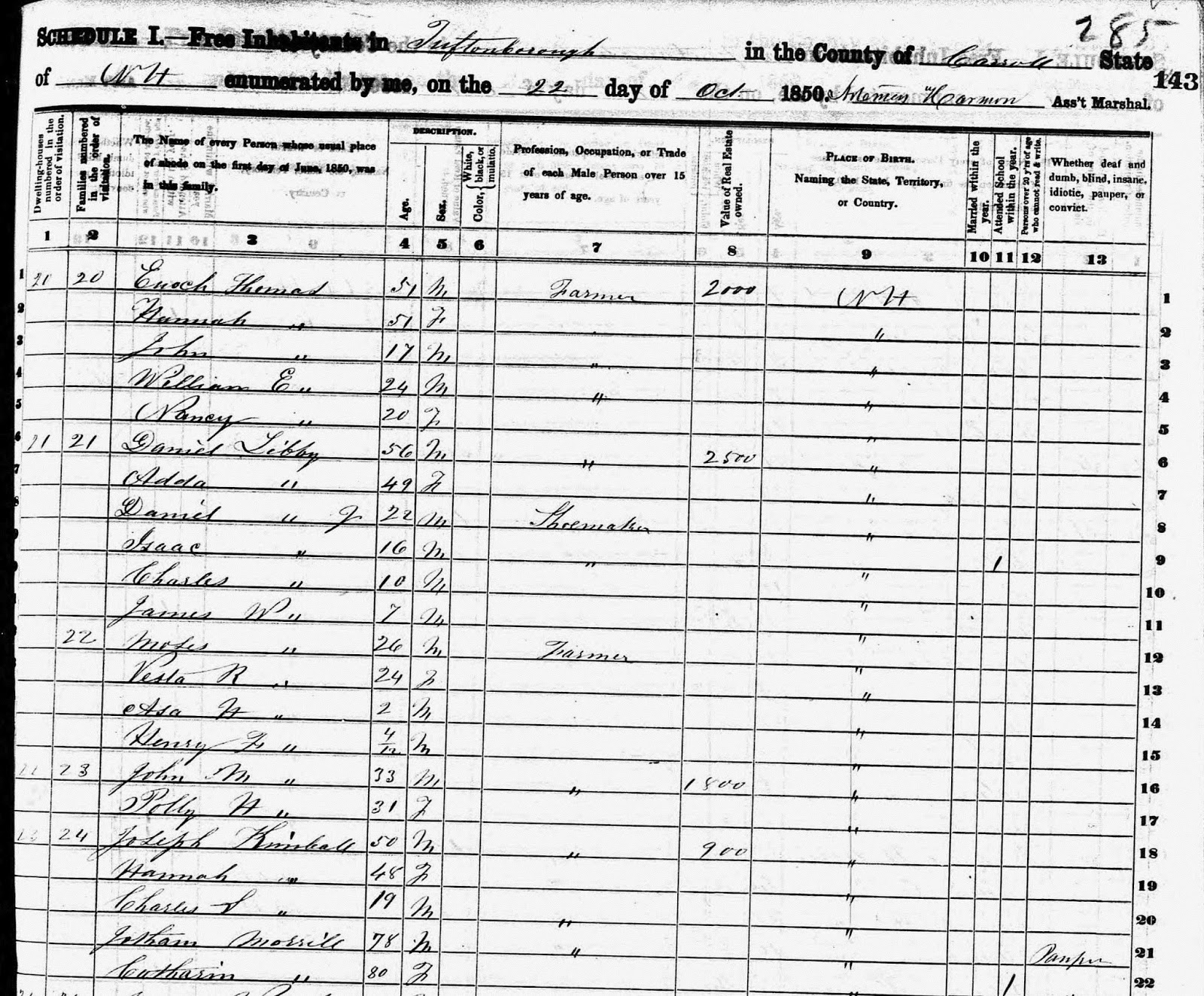
She and Jotham appear on the 1850 Census, living as paupers under the care of the Kimball family of Tuftonboro, and Catherine is listed as being unable to read or write, at the age of 80:


She appears listed as mother "Katie Brown" to Statira Morrill in a Moultonboro 1890 death record, and from here we learn that Statira was born in Tuftonboro (where Catherine and Jotham had moved soon after the wedding);


According to an email I received from Tuftonboro Town Hall, Catherine, listed as "Mrs. Jonathan Morrill" died in November of 1851.  I'm not sure what source they are using to provide that information.  I see no death record for her online anywhere.  Perhaps another trip to Tuftonboro is warranted.

There is a death record and a probate record for a Catherine Merrill, in 1852, died age 84, in Exeter, NH.  Given the different location, spelling and the couple of years difference in age, I'm inclined to believe this isn't her, but it's close enough to reality to be worth noting here.


I took a trip to the Concord State Archives, and found this birth record.  It says this Catherine Brown was born in Dec of 1773.  That's close enough to 1770 (the birth year calculated from her 1850 Census) to be of interest.  But it's stamped by the Clerk of Newport, NH, which is about 70 miles southwest of Moultonborough.  I would love to believe that this is her, and that these are her parents, but that's an awful long horse and buggy ride to move a family in that era.  I researched this family a bit more, and discovered that this Catherine married a James Colby and moved westward to Vermont, so this isn't her.

There are many census records for her husband Jotham, where she appears as the elder female in the household.

Now, it's a worthy attempt to comb through the Brown families of Moultonboro during that period to attempt to learn possible relations for the unfortunately illiterate Katie, so here goes:

1790 Moultonboro Census:  The only census taken prior to Catherine's marriage, is a good starting point for looking at Brown heads of household, and if any of these men were age 35-40 by the time of this census, they would be more the likely:
  • Benjamin Brown (1 male under 16, 2 males over 16, 4 females).  Benjamin appears in many other subsequent censuses, and appears to have lost 2 net females for the 1800 census.  He seems to no longer be accounted for after the 1820 Census, and there appears to be a Benjamin Brown buried in Moultonboro in 1828, who was born in Ipswich, Mass in 1755, and was of appropriate age.
  • John Brown (1 male under 16, 1 male over 16, 4 females).  John appears to have been born in 1750, and has census records continuing through 1820.  There appears to be a John Brown the 2nd born in 1792, according to burial records.  This could have been John's son, I suppose.  Now, in the next census, 1800, Catherine is living with her new husband Jotham Morrill (next door to his possible brother William Morrill), and John Brown appears to be living very close by, so perhaps this gives John a bit more potential as her father?  Who knows, really. 
  • Blanchard Brown (1 male under 16, 1 male over 16, 4 females) - Blanchard appears in no other records, but one census backup record appears to indicate that he was born in 1750 for this census.
  • Daniel Brown (3 males under 16, 1 males over 16, 3 females).  Daniel stayed in Moultonborough, and the 1800 census also includes three females (but as of Sept 2022, I've discovered that Daniel had a wife Betty, and two daughters, Betsey and Nabby, living with him at the time).  In 1820, he was housing a non-naturalized foreigner, and doesn't appear in any subsequent censuses.  Based upon his military profile (found at Moultonborough Public Library), he was 75 years old on Sept. 12, 1832 (which means he was born in 1756 or 1757), which makes him about 13 or 14 years older than Catherine, so I feel I can rule out Daniel.  Further, the three females on the 1800 census must have been Betsey, Nabby, and Betty, which would exclude Catherine.  
From Moultonboro pension records, I located a Nathaniel Brown, applying for pension, at 56 years of age, in April 24, 1818.  His wife's name was Jemima, and they married Feb. 17, 1785.   He died May 9, 1825.  If he was born in 1762, he is way too young to have been Catherine's father.

Also in pension records, I found a Charles Brown, who was 72 years old in Sept. 12, 1833.  Given that he was born in 1760 or 1761, he's only 9 or 10 years older than Catherine, so also not a father. 

In neighboring Tuftonboro, there appear to have been Browns as well:  heads of household with biblical names like Moses and Obediah.  Also, there appear to be Brown Family Cemeteries in neighboring Wolfeboro and Moultonboro.

So, the three underlined men above appear to be the most likely possible fathers to Catherine, with Benjamin, and John being the most likely candidates.

Town Vital Records (Moultonborough, NH)

On a trip to Moultonborough Library, and also Concord State Archives, I did find the marriage record of Catherine & Jotham, but unfortunately no mention of parents there.

It's interesting to me to note that a Lydia Brown (1779-1840) of Sandwich married Nicholas Bean of my Sandwich Beans, and had a daughter Rebecca Bean who married John Elliott, of my Sandwich Elliotts.  I wonder if this Lydia may have been related to Catherine?  They were of even age to have been sisters or cousins.

Further, there appear to have been a great number of Brown families in Berwick, Maine, the likely birthplace of Catherine's husband Jotham.  It is entirely possible they were both from Berwick originally.

Catherine and Jotham's son, Jonathan Smythe Morrill (my 3rd great grandfather), married Sally Elliot of neighboring Sandwich, and moved to Portland Maine, where my family is from, as are a large number of Portland, Maine Morrills.

Tuesday, November 18, 2014

John Sibley and Jane Pochard

John Sibley (1755-1835) and Jane Pochard (1760-1860) were my 5th great grandparents, and one of very few sets of my ancestors who migrated to the US after the Colonial period.

They had eleven children, and have many hundreds of descendants living today, and their arrival in Maine was more by chance than many other New England families.

John Sibley was born in Nova Scotia to Englishman and soap magnate Henry Sibley and Halifax native Sarah Haislup.  When John was only eight years old, his father Henry sailed home to England to settle his father's estate and died at sea.  This left John and his five siblings orphaned in Halifax, which Sarah couldn't handle, so she left her children to be raised by others and moved to England.  While his siblings appear to have stayed in Halifax, John joined the Revolution.

JONATHAN EDDY
In particular, John became involved with Jonathan Eddy's movement to make Nova Scotia the 14th American Colony, to break ties with England during the American Revolution. Jonathan Eddy made a failed attempt to siege Fort Cumberland in central Nova Scotia, in the fall of 1776, and John Sibley somehow ended up in Maine (then part of Massachusetts) following Eddy's retreat back to his native Massachusetts.

John later fought in the Battle of Monmouth in New Jersey, and also Saratoga with the Continental Army as a private in Captain Smart's company, Colonel Calvin Smith's regiment.  John was also at Valley Forge in 1778 and reported on command at Boston Neck in March and April 1779. He was reported deserted July 12, 1780, which many believe was the reason his pension application was later turned down.

John married Jane Pochard December 8, 1782 at Pownalborough, Maine.  Jane was born in Frankfort, Maine to Abraham Pochard, whose father was a French Huguenot who had arrived in Maine 1751 with his wife and four sons from Chenerbie, Haute-Soane in eastern France near the Swiss border. They arrived in Boston on the ship Pricilla, which sailed from Rotterdam,   Netherlands, and then proceeded directly to Frankfort Plantation (Dresden) in Maine   where they settled. Some of the family moved to Fairfield in 1775 and then to the Pittsfield area around 1814. The inability of the English speaking settlers to spell the Pochard family name correctly resulted in a variety of phonetic variations e.g. Pushard, Pushaw, Pushor, and Pushan.

They lived in Fairfield, Canaan, Warsaw (Pittsfield), and Passadumkeag, Maine.

John applied for a Revolutionary War pension on March 12, 1834, which reveals that he was born in 1755 in Halifax, N.S.  The pension application was denied due to his apparent desertion near the end of the War.

Passadumkeag, Maine incorporated as a town in 1835. When they did their first Town census after incorporation, Jane was listed as widow Jane Sibley.  So we know that John died about 1835.

John and Jane had twelve children, four girls and eight boys, including my 4th great grandmother Margaret Sibley-Burrill, who married Benjamin Burrill of Fairfield, who was 4th great grandson to John Alden of the Mayflower.

Jonathan and Sally Morrill of Portland Maine

My third great grandfather was Jonathan Smythe Morrill (1802-1881), a carpenter, ship builder, stevedore, and laborer born in Tuftonboro, NH to Jotham Morrill and Catherine Brown, both of Moultonboro, NH.


MORRILL FAMILY PLOT
FOREST CITY CEMETERY
(who else is buried there?)


Jonathan married Sarah "Sally" D. Elliot (falsely rumored in my family to be of Native American descent, and from Sandwich, NH) on 14 Dec 1826, in Moultonborough, NH by Isaiah Greene Orne, Esq. (Source:  Early Marriages of Strafford County - thanks to Google Books free previews!).  However, the Mormon FHL has a record of their marrying in nearby Moultonboro, which record states that they were both from Moultonboro.  It's possible that some more research there would be beneficial, to find if perhaps this record is more accurate (there are no Eliots in either the 1810 or 1820 Moultonboro census).

After marriage, they immediately moved to Maine, first living in Westbrook (then part of Deering) (1830 Census).  Next door to them was Benjamin Elliot's family.  See census below (not a great copy, by the way), where I've yellow highlighted the Elliot and Morrill heads of household:


By the 1840 Census, the Morrills had taken up a rental residence in the rear apartment at 62 Washington Avenue in Portland, where Jonathan worked as a pile driver and a bridge builder.  His family was one of the first Morrill families to arrive in Portland.


Jonathan & Sally lived in the East Bayside district of Portland the remainder of their lives, which was quickly becoming a diverse neighborhood, filled with African Americans and Irish, and was then the locale for the Cumberland County Jail on Monroe Street.  In 1854, their son, John HB Morrill, had purchased 62 Washington from Peter Andrews, but in 1861 he deeded the property to his mother Sally (not sure why it didn't go to his father!).  In 1878, they moved around the corner to a rear apartment on 15 Winthrop Street for the remaining few years of Jonathan's life, a place they rented from Irish immigrant family, the Maddens.  The Morrills were not counted here on the 1880 Census, for some reason.  Maybe the census taker failed to look at the rear apartment.  In any case, 1881, just after Jonathan passed away, Sally sold the Washington Street building saw the sale of the building for only $125.00, which would be over $4K today!  I wonder why Sally was taken to the cleaners like that?

In 1859, Jonathan's name appeared in the paper as Defendant of a criminal State lawsuit dated the prior year, for the amount of $3.67 ($111 in 2020 dollars).

For the 1866 City Directory, it appears that 62 Washington (rear) had another interesting dweller, one Smith Morrill, a dock builder living right in the same apartment as Jonathan.  Not a clue who that could be - the only male Morrill in the family besides Jonathan was his own son the hairdresser, living up the hill at 13 Melbourne. 


In March of 1868, during the high turnout election for Mayor, Jonathan was accused of voter fraud ("fraudulently voting in the name of another"), but was later cleared of the charge when it was determined that his name had simply been incorrectly transcribed by an election official.  Given the rampant voting fraud that year, tensions were high among the pollsters, and Jonathan was given undue extra scrutiny, it seems.

Ironically, the name he was accidentally given on the voter roll (and was then accused of using this as a fake name) was Jotham G. Morrill (which was his father's name!):

Eastern Daily Argus
Mar. 7, 1868


Jonathan & Sally had nine children in Portland.  Jonathan died in Portland in 1881.

Portland Daily Press
July 18, 1881


I believe at least three of Jonathan & Sally's kids died young.  Here is a best copy image of the birth roster from Portland archives, courtesy of the Mormon Library:


Transcribed below, with a brief history:

1. Abigail Morrill (1827 – ) doesn't appear in any later records.  She had died prior to the 1840 Census.

2. Sarah Jane Morrill (1828 – ) was a dressmaker.  She married at age 17 to a 52 year old Portugese sailor named Peter Andros (who Anglicized his name to Andrews, and his descendants were born with that name).  They had four children, and then divorced around 1862.  Sarah Jane remarried to Woodbury Morse in 1864, then had another four children.  She and Woodbury died sometime between the 1900 and 1910 Censuses.

3. Benjamin Morrill (1831 – ) doesn't appear in any later records.  He was definitely dead by the 1840 Census.

4. Statira G. Morrill (1831 – 1862) was named after her aunt Statira Graves of NH.  She lived in Portland for her entire, very short, life.  She worked as a seamstress, and at 17 she married a Samuel Tucker.  A few years later she married a Canadian named Joshua Carey.  They had one child, Naomi Carey, in 1858.  Naomi was only 4 when her mother died, and was therefore raised by her grandparents.  Joshua soon remarried a woman named Amelia, and had six more children.  I'm not sure why Joshua couldn't raise Naomi.  Naomi married Edward Hall, a carriage painter, and son to the British Halls of that neighborhood.  Edward Hall's brother Joseph was later a 2nd husband to Naomi's aunt Emily Morrill. Naomi & Edward had three children.

5. John Henry Brown Morrill (1834 – 1894) fought in the Civil War, and worked as a hair dresser in Portland.  He married Maria Beal from Freeport in 1863, and they had three children of their own:  Frederick, John & Nettie Morrill.  Maria also had three kids from a prior marriage, Ira, Phebe, and Bertha Chase.  Bertha was adopted by John, so she became Bertha Morrill.  This particular family has many descendants.  John was a very popular barber, and he is well mentioned in his former boss, John Todd's 1906 Book, "A sketch of the life of John M. Todd : sixty-two years in a barber shop, and reminiscences of his customers".   One particularly amusing anecdote from that book follows: 

John H.B. Morrill worked for me sixteen years.  He was a character, a man of impulse, not always governed by the highest principles, and also a genius.  After the great fire he moved over to the Cape, now South Portland.  He bought a cow and calf.  He took the cow over the ferry at noon, but the calf he sold to a butcher, who was to take it home at evening.  After the great fire in 1866, I bought a photograph saloon and hauled it upon the sidewalk in front of the post office.  The custom house at that time was in the post office building in the room now occupied by the United States Court.  Mr. Morrill hitched the calf to the wheel of the saloon until the butcher called for it.  Of course, as soon as the mother was taken away, the calf commenced its music, and such bleating and blarting was never heard in front of the post office before nor since.  One of the inspectors of customs came in a great rage and said: “Todd, I want that calf moved at once.” “That is not my property, Mr. Blank,” I replied. “Whose calf is it?” “Mr. Morrill did own it, but has sold it to a butcher.”  “Mr. Morrill, you remove that nuisance at once.” “You don’t like that music, I reckon,” Mr. Morrill replied.  “Mr. Blank, you will blart worse than that when the Federal tit is taken from you.” 
He kept the cow all summer, sold her, I think, to Captain Mareen.  “I see she has but one horn, Mr. Morrill.  She is not breachy, and broke her horn by hooking fences, I hope.” “She never troubled me any that way.”  In a few weeks the captain called on Mr. Morrill.  “Happy to see you, Captain.”  “I don’t know whether you will be happy or not to see me, I have come on business.” Morrill told me afterwards he knew what the business was he came to adjust.” You told me, Mr. Morrill, that cow was not breachy.  I can’t keep her anywhere.  She will toss over her head every fence she comes to.  She would break up a camp meeting.  Now what did you mean by telling me that she was not breachy?” “I never told you so.” “You certainly did, for I asked in particular if she was not and spoke of her horn being broken off.  Don’t you remember that?”  “Yes, I remember your speaking about that, and I told you in plain words, Captain, that she had never troubled me any on that account.  She would come home every night full of herd grass and clover she had got by breaking into the neighbor’s field, but it never troubled me any.  But it did trouble Neighbor Dyer, I have no doubt, some; but it never did me.” The captain burst out laughing, bade him goodby and went home.
In 1858 there was a closely contested election for mayor.  At that time there were no secret ballots and the voting was not as closely watched as now.  Everybody was supposed to be honest then.  Morrill was a great hustler.  He boasted that he could get more floaters to the polls to vote than any man in the city.  He belonged to fire engine number eight, and the company had as lively a set of boys at that time as any company in the city.  One of the boys hailed Morrill and said “We must get every voter out today that is on the voting list, or we shall get left.  I just looked over the list.  There is Patrick Ward’s name there.  He died about two years ago.  You can get someone to vote in his name.  There is a dollar to pay the fellow that you get.” John plants himself upon the sidewalk to look over the longshoremen as they go to dinner.  Mr. Blank was warden at that time.  He was a great politician.  Morrill did not have long to wait before an Irishman, a coal heaver, on his way to dinner, appeared.  John stepped up to him in a most familiar manner, reached out his hand with a “How are you, Mr. Ward?” “And who are ye talking to, young man? My name is not Ward at all, but Mike Flannagan.”  “Never mind that.  I have a dollar for you.”  “What for?”  “I want you to vote for me.”  “Faith, I can’t.  I’m not naturalized.”  “That makes no difference today.”  “Is that so, and how is that?”  “Why, there is a name on the voting list; I want you to vote in that name, and the dollar is yours.  Will you do as I want you to, for obedience is better than sacrifice in this case? Now listen; I want you to walk up to the desk over there, hold up your head, as though you owned the whole shooting match, and say, ‘Pat Ward, sir.  Speak up loud,’ and he will say, ‘What ward?’  Tell him * Ward one.’ “He marched up as big as Billybeblessed.”Mr. Ward, sir.’ He forgot to put in Pat.  Mr. Blank said, “What Ward?” “Ward one, sir.  Vote Mr. Ward.”  One of the Republican checkers said, “He did not understand you, Mr. Blank, when you asked for his given name.” “Well, I did,” said the warden, amid a roar of laughter.

6. Isaac Morrill (1837 – ) doesn't appear in the 1840 or 1850 Census. He must have died as a child.

7. Catharine Morrill (1838 – ) doesn't appear in the 1840 or 1850 Census.  She must have died as a child.

8. Martha W. Morrill (1840 – 1917) married James Hiram Curtis, and had at least 6 children: Charles F., James E., Annie J., Ida E., Florence Louise, and William E.  Martha was widowed by 1910.

9. Emily N. Morrill (1844 – 1900) was my 2nd great grandmother.  She married William Sanford Morgan, a Civil War veteran, on 28 Oct 1865, and had three daughters:  (1) Abbie (who never married), (2) Adelaide (who married George Simpson and later Presbury Dennison, and had one daughter, Emily Simpson-Pease), and (3) my great grandmother, Hattie Temm.  In 1887, William & Emily divorced (due to his constant drinking) and Emily moved to 27 Everett Street.  She remarried to neighbor and childhood friend Joseph G. Hall, a carriage painter (and brother to her niece Naomi's husband Edward Hall from the East Bayside neighborhood).  They married in 1891, and moved on 123 Cumberland Avenue, right around the corner from where her mother (then widowed) was living on 21 Cleeve Street.  

Emily's husband Joseph died in 1895, and then Emily died in 1900 of hemiplegia.  Her first husband William lived until 1920.  Everyone is buried at Forest City Cemetery in South Portland.


EMILY N. MORRILL-MORGAN-HALL
(ca 1890)


Many of the descendants of Jonathan & Sally can be found living in the Portland area today.

Monday, November 17, 2014

The Mysterious Jotham Morrill


Well, he's a mystery to me at least.  I don't know that an overworked farmer in post Revolution New Hampshire could have anything other than a straightforward life.  I'm grateful to have found several records for this 4th great grandfather of mine, but there are many unanswered questions.

Here's what I know about Jotham:
  • Born in Berwick, Maine, as per his War of 1812 military record, he was 45 years old as of April 1813, which would put him as being born around 1768.  I believe his elder brother was William Morrill of Berwick, who moved to Moultonboro, and lived next door to Jotham.
  • Married Catherine Brown (of unknown parentage) in Moultonboro, New Hampshire, Feb. 23, 1799.
  • Fathered a daughter, Statira Morrill-Graves in March of 1800.
  • Fathered a son, Jonathan Smythe Morrill in 1804.
  • Owned livestock in neighboring Tuftonboro, NH 1804 and 1806, according to the Town Clerk there.
  • August 1800 Census - Moultonboro, lived next door to a William Morrill (who had migrated there from Berwick around 1783).  Household included:  
    • one male aged 16-25 (who?)
    • one male 26-44 (Jotham), this means he was born between September 1755 and September 1773.
    • two females under 10 years old (one was Statira, but who was the other girl?)
    • one female 26-44 (Catherine), this means she was born between September 1755 and September 1773
    • one female 45 and over (who?)
  • August 1810 Census - Tuftonboro, listed here as Jonathan Morrill.  Household included: 
    • one male under 10 (my ancestor, Jonathan)
    • one male 26-44 (Jotham), calculating this with the above, he was born between September 1766 and September 1773.
    • one female under 10 (Statira)
    • one female 26-44 (Catherine), calculating this with the above, she was born between September 1766 and September 1773.
  • 1820 Census - Tuftonboro, destroyed.
  • June 1830 Census - Tuftonboro.  Household included:
    • one male age 50-59 (Jotham), calculating this with the above, he was born between July 1771 and September 1773.  This conflicts with his War Record, which tells me he may have lied on the War Record in order to appear older, and therefore unable to serve.
    • one female age 50-59 (Catherine), calculating this with the above, she was born between July 1771 and September 1773
  • 1840 Census - Jotham doesn't appear.  He doesn't appear on either of his children's censuses either.
  • June 1850 Census - Jotham and Catherine are living with the Joseph Kimball household, no apparent relation, given that Joseph's wife's maiden name was Hannah Ellsworth.  
    • Jotham is listed as a pauper farmer, at 78 years old.  This would mean he was born between July 1771 and July 1772.  Same conflict as with the War Record, just like with 1830 Census.
    • Catherine is listed as 80 years old.  This would mean she was born between July 1769 and July 1770, which is in conflict with the prior census records.
In the April 1813 entries of U.S. Army, Register of Enlistments, 1798-1914, a Jotham Morrill appears, to be rather close in age, and enlisted in NH's 4th U.S. Infantry.  This Jotham is listed as having black eyes, black hair, and dark complexion, and enlisted at 45 years of age on 4/24/1813, fighting in the War of 1812.


According to the Remarks section of this entry, he was present for roll call in Feb 16 & 28, 1815. He was sick in quarters on April 30, 1815. Presented sick in Regimental Hospital. William S. Foster's, Co. 5 " U.S. Infantry. Sacred Heart? June 30 1815. Book F Discharged June 14 or 15 1815 at Buffalo, on surgeon's certificate of disability, old age. Book 600 Appears to have served in Lieutenant Hoits, detachment 1st New Hampshire Volunteers prior to enlistment in the regular Army. 4" made 5".  So it appears he fought in the 1st Regiment and the 5th Regiment as well.

Given that the name "Jotham Morrill" was so unique, I am quite certain that this is his record, and that '4 made 5' means that he was given credit for his full five years of service, even though he was discharged for being sick.

As for his age, if he truly was 45 at the date of this record, it means that he was born between April 25, 1767 and April 24, 1768, which runs as a conflict against the 1830 and 1850 Census, as shown above.  Did Jotham say he was 45 on the enlistment papers when he was truly 40?  If so, he may have done so in order to meet a requirement age in order to get a more seasoned role in the War.

As for this Jotham's birthplace, I believe that the Town of Berwick Maine may have a clue that he was descended from the John Morrell of Kittery line, as was William Morrill of Moultonboro (who was of close enough age to be a sibling, and the two men were living next door to each other on the 1800 Census!).  William happens to be buried at the Bean Cemetery in Moultonboro, alongside his daughter Charlotte, and her husband Jacob Graves (1803-1871).  Jotham's daughter Statira is also buried at Bean Cemetery, alongside her husband Ephraim Graves (1791-1845).  I can't help but believe there is a connection to these to Graves families somehow, but cannot find proof yet.  

Also, this William Morrill is well documented and was a Revolutionary War soldier, and enlisted in 1784, age 16.  I think Jotham was a year or two younger than William.

My current theory (2026) is that William and Jotham were brothers from Berwick, and that Jotham & Catherine are indeed buried at Bean Cemetery in an unmarked grave on the left side (older burials).  I wasn't able to find their names in any Moultonboro cemetery directories.  I wonder if perhaps they were buried with their 1850 caretakers, Joseph & Hannah Kimball, in the Edgerly-Blake Cemetery, or otherwise in a Pauper's Lot somewhere?

Per the Moultonboro Town Clerk, there is no record of Jotham or Catherine at Bean Cemetery, and it's not clear if William's plot happens to have any 'extra space' that may contain an unmarked grave or two:

WILLIAM MORRILL FAMILY GRAVESITE
Bean Cemetery, Moultonboro, NH

In May of 2026, I began searching in Concord State Archives, through the many boxes of Strafford County Probate files, to see if I can uncover probates for either Jotham or Catherine.  I got only through one box (153532), and want to go through successive boxes:  153532 through 153538, to cover all of the 1850s.  I've asked the Archivists to go through the remainder boxes for me.

While there, I also looked through the Moultonboro town records, tax valuation, proprietor lists, meeting minutes from 1748-1902, no listings found for the Morrills at all. These were paupers, and Catherine couldn't read or write. I have not much faith I'll locate any more records for them.

Additionally, I went to the Strafford County Registry of Deeds, and searched for Jotham Morrill, and all permutations of his name. I couldn't find any mention of him as a Grantor or Grantee of real property during the time period of 1773-1850. Therefore, I don't believe he ever owned real estate.

I've written a study of the Tuftonboro Morrills, which can be read here.

Friday, November 14, 2014

Samuel Morrill Cemetery in Tuftonboro New Hampshire

Samuel Morrill (1779-1849) was born in Eliot Maine to Joel Morrill and Hannah Wilson of Eliot.  He was one of the Kittery Morrill/Morrell families.

In 1806, Samuel purchased 50 acres of land in Tuftonboro, New Hampshire from Edmund Pinkham for $345.00 (51/348, Strafford County Registry of Deeds).  I will discuss below how the old house he lived in sits on land of smaller size.  Perhaps he deeded off some of this land at some point.

At around age 30, in 1810, he met Mary "Polly" Hodgdon of Strafford County New Hampshire, and married her in Tuftonboro, and they remained there for the rest of their lives.  

In 1833, Samuel bought an additional 30 acres of land in Tuftonboro, immediately south to and neighboring the 50 acres mentioned above, and it was for $255.00.

In 1840, the portion of Strafford containing Tuftonboro and surrounding towns was incorporated into new Carroll County.


HOME OF SAMUEL MORRILL
1806-1849 (OR LATER)
FEDERAL CORNER ROAD
TUFTONBORO, NH

This family directly descends from John Morrell of Kittery (one of the two English founders of Morrill families in New England), and is one of many Morrill families to have moved to Strafford County, New Hampshire, including my own family of Jotham Morrill of Moultonboro and Tuftonboro, whom I believe is a cousin to Samuel.

In fact, other families made the move from York County Maine to Strafford County as well, and they are discussed in more detail here.

Even though the property Samuel purchased was 80 acres, the old red house sits on what is now a 23 acre lot, and, just south of the house, on a separate 2 acre lot (containing no house) sits a modest little graveyard surrounded by a stone wall and many maple trees, and contains 11 gravesites with very well kept head and footstones.  As is often the case with old New England towns, there were no public cemeteries until mid 19th century in Tuftonboro, and no churches, so people resorted to backyard burials.  There are 47 such family graveyards in the Town, according to Tuftonboro New Hampshire:  Cemeteries, Graveyard and Burial Sites 1800-1995, copyright 1997 by The Tuftonboro Association.

I've profiled everyone resting in Samuel's backyard on Find A Grave, but here is a summary of its inhabitants:


GRAVE OF SAMUEL MORRILL
(POLLY IS BURIED HERE TOO, I BELIEVE, BUT UNMARKED)

Samuel died in 1849 at home, and Polly died in 1876 in neighboring Rochester (perhaps the house was already sold by then?).

As for their eight children, one (or possibly two) died as babies, and the other six lived to adulthood:


-Sally Morrill-Foss (1810-1854) was Samuel's eldest.  She married John Foss (1797-1859) and they ran a small farm in neighboring Moultonboro with their five children, most of whom appear to be buried at Lee Cemetery in Moultonboro.

-Hannah W. Morrill (1812-1873) married William Copp Jr., had five sons and moved to Hennepin County, Minnesota.  When William passed away in 1857, she married a D.Y. Jones.  She passed away in Minneapolis.

-Joel Morrill (1815-1867) was clearly named after Samuel's father.  He married Almira Piper and ran a large farm in Newport, Maine with their three children.  None of this family is buried here.

-Almira Morrill appears in no records after her birth, so it's possible she may have been stillborn or might be buried in an unmarked grave here in the backyard.

GRAVE OF WILLIAM MORRILL
AGE SIX MONTHS


-William Morrill (1819-1819) lived only six months, and he has his own gravesite next to his father.  This is what leads me to believe the two older girls were stillborn.


GRAVE OF CARRIE MALLARD
AGE 8

GRAVE OF MARY JANE MORRILL-MALLARD

-Mary Jane Morrill-Mallard (1822-1861) married an attorney named John D. Mallard on Sep 12, 1847, and moved to Brookline, Massachusetts with their young daughter, Carrie (who died at age 8).  When Mary Jane's sister, Sally Foss, and her husband both died, their young daughter Sally moved in with them until she married and moved up to Epsom, NH.  John may have remarried after Mary Jane died, since I cannot seem to locate his burial place.

GRAVE OF ELIZABETH MORRILL-SMITH
THOUGHTFULLY REPAIRED AFTER SOME VANDALS GOT TO IT


-Elizabeth Morrill-Smith (1828-1866) married a John G. Smith, whom I cannot locate a single record for (perhaps the commonality of the name is to blame). 


-Julia Morrill-Leavitt (1830-1853) was the youngest of Samuel's children.  She married Woodbury Leavitt (1827-1863), son to Samuel Leavitt and Jemima Piper, and grandson to adjutant John Leavitt,  and they had one child, Samuel C. Leavitt (1849-1870) also buried here.  After Julia died, Woodbury worked as a farm laborer and then died during the Civil War from chronic diarrhea.

Also buried in the backyard is a Willie Hodgdon Smith (1861-1866), son to Elizabeth Morrill.

GRAVE OF WILLIE HODGDON SMITH

I believe that once Samuel died in 1849, his house and land must have been sold immediately, since everyone scattered to other places afterwards.  At least the new owner was kind enough to allow the subsequent burials to take place here.  I'd like to find out when the land was sold.  I believe the house is kept up nicely and is used as some kind of museum or meeting house, judging from my visit there in November 2011 (when I took these photographs).  It would be nice if a member of this family living today would stumble upon this post, and maybe have more info to share to help fill in the blanks.