Showing posts with label Morgan. Show all posts

Saturday, February 19, 2022

Emily Morrill of Portland


EMILY N. MORRILL-MORGAN-HALL
(ca 1890)

Emily N. Morrill (1844 – 1900) was my 2nd great grandmother.  She was born in Portland, the youngest of nine children born to Jonathan & Sally Morrill, who were originally from Tuftonboro, NH, but had relocated to Portland to be closer to family (who were the namesake of Morrill's Corner).

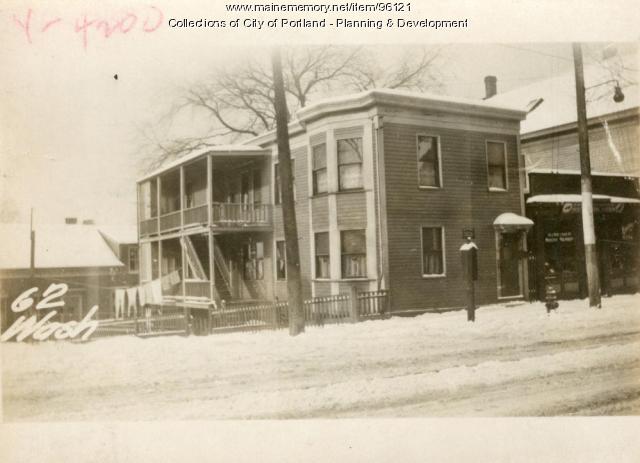
Emily grew up in the East Bayside District of Portland, living most of her youth at 62 Washington Street.


At age 21 in 1865, she married William Sanford Morgan, ("Sanford") a Civil War veteran from Winterport, Maine, who had just finished a storied turn of service in the Navy, working on the famed USS Kearsarge.  Just after the wedding, they moved to Peaks Island, and had their first of three daughters, my great grandmother, Hattie Temm, pictured left.


In 1869, Emily & Sanford moved back to East Bayside, settling in next door to Emily's family on Washington Avenue.  There they had their second daughter, Adelaide (pictured left, who married George Simpson and later Presbury Dennison, and had one daughter, Emily Simpson-Pease).


From 1873-1877, they owned a house on 8 Madison Street, around the corner from the previous house.  There they had their youngest daughter, Abigail, pictured left, who never married.


6-8 Madison Street
Portland, ME
(1924)
(Property was razed for newer residential development)

From 1877-1880, William owned property in Scarborough on West Beech Ridge Road.  Their daughter Hattie later moved to that area when she started her family with John Henry Temm of that area.  I wonder if this three year period is when Hattie met John.

In 1880, they lived at 22 Greenleaf Street.  The building is now a housing project (likely since Urban Renewal).

22 GREENLEAF STREET (2022)

In 1881, they didn't appear in Portland directories.  It's possible they moved back to Scarborough for the year or two, since they sold the property in 1883.  From 1883 to 1885, they lived at 26 Lowell Street and 49 Green Street in Portland.

By 1886, Emily and William appear to have separated.  City Directories have her living at 46 Hanover Street, with William living at 69 Danforth Street.

In 1887, William & Emily divorced (due to his constant drinking) and Emily moved Addie & Abbie to 27 Everett Street.  Hattie had already moved out a couple years prior, having married her first husband, James Downey, and they were living on 5 Vine Street at the time (now Pearl Street).  Upon divorce, William moved in with Hattie & James for a while.

27 Everett Street
(1924)

27 Everett Street
(2022)

Both William and she remarried at the end of the 19th Century.  Emily's 2nd husband was neighbor and childhood friend Joseph G. Hall, a carriage painter (and brother to her niece Naomi's husband Edward Hall from the East Bayside neighborhood).  They married in 1891, and moved on 123 Cumberland Avenue, right around the corner from where her mother (then widowed) was living on 21 Cleeve Street.  


123 Cumberland Avenue
(2022)


Emily's husband Joseph died in 1895, and then Emily died in 1900 of hemiplegia.  Her first husband William lived until 1920.  Everyone is buried at Forest City Cemetery in South Portland.

PEASE / HALL LOT
Forest City Cemetery
Left to Right:
Unknown Baby Grave
Abigail and Adelaide
Emily N. Morrill Hall
Joseph G. Hall

Below is a pedigree for Emily.


Unfortunately, due to New Hampshire's lack of records, I've yet to go back three generations for her.  She appears to be fully English.

Monday, December 1, 2014

Rumored Indian Blood in the Clarke, Morgan and Morrill families

WONALANCET
SANDWICH, NEW HAMPSHIRE

18TH CENTURY ILLUSTRATION OF ALGONQUIAN PEOPLE

Does Emily Temm-Clarke have Indian Blood, stemming from family stories about this, and witnessing her high cheekbones and large body?

Short Answer:  No, not at all.  This family link does not have Indian roots, after running DNA tests.  My family story of being linked to Indians is nothing more than fiction, and a very common story among most White American families.

Long Answer below, with all research...

This blogpost is a place for my research on the rumored Indian ancestry in my family, coming through my maternal grandmother, Emily Temm-Clarke, and my theory at one time that it might lie with my grandma Emily's maternal great grandmother, Sally Elliot-Morrill, born to Benjamin Elliot and Susannah Drew of Sandwich, New Hampshire in 1805, wife of Jonathan Smythe Morrill of Tuftonboro, and later of Portland MaineJonathan and Sally are the forefathers of a large number of Greater Portland Morrills.

As mentioned in an earlier post, if you ask any White American about his ancestry, they will most definitely tell you that they are "part Native American".  I've had fun with these people, trying to get proof for their claims, but the best that most can offer is that Grandma told them there was a "Cherokee Indian Princess" in there somewhere.  Occasionally someone offers up some DNA proof, and I've even helped some people find verifiable links to Indian census rolls .  It can happen, of course, but not nearly as much as we might wish.

The story I always heard in my family while growing up was that somewhere on Grandma Emily's side of the family, we are from the "Blackfoot Tribe".   As a child, it sounded interesting enough to me.  As a moody teenager searching for validation, I began to adopt the idea as fact, and believed myself to be special in some way, given that I already had been told that my dad's side of the family had Mayflower roots (a rumor I was able to prove true - many times over - with a lot of help from cousins, and digging through many old records).  As a teenager, though, I found it fascinating to imagine myself as descending both from native people and from those who colonized.

At some point after I began college in NYC, I was at the public library, where I was approached by a very obvious looking American Indian, who told me that I appeared to have some measure of Indian features, and that I should join the YMCA Thunderbirds, who could supposedly help me determine the truth of it all...with the ultimate goal of my being able to apply for government scholarships for college, since American Indians can apply for grants for that purpose, of course depending on how much native blood you can prove to posess.

I never took the kind man up on his offer, and my own independent research later led me to learn that Blackfoot Nation is located in Montana.  Was some ancestor of mine from Montana?  Did they later 'drift' to New England??  Was there even a connection?  Or, more likely, was this all an exotic story that had been passed down many generations?  I didn't know or care enough at the time to pursue it further.  However, while still in college, in one last ditch effort to try and secure government cash for my schooling, I went to my 86 year old Grandma Emily, and asked her, "Hey Gram, what tribe of Indian are we anyway?"


EMILY TEMM-CLARKE
HOLDING BABY ME (1970)

"INDIAN??  I ain't no GAWWWD damned Indian!!" was her reply...and that was that!

Now, this is quite contrary to what she had supposedly told my mother growing up.  So, blame it on a bit of senility, or exaggerated family folklore, but I was still left to sit on that for several years, until it became a pet project of mine as a family researcher.

Many have looked at the picture above and have said "How can she deny being part Indian?"  Those tough features, high cheekbones and all...but the woman above was born to parents who were deemed "WHITE" on all available records.  Her father, John Henry Temm, was half German, half Scottish, and I have records backing that up.

Her mother, Hattie Morgan Temm, was, as far as I could tell from my research, purely of English/Welsh stock.  However, she does appear quite dark in the below sepia-tone photo, but that could be easily blamed on photography:


HATTIE MORGAN-TEMM

Hattie's father, William Sanford Morgan, looks white (and is clearly the source of my gramma's high cheekbones).  He is proven to be of English and Welsh blood by many dozens of available records:


WILLIAM SANFORD MORGAN

Hattie's mother (and William's spouse), Emily Morrill, daughter to Sally Elliot, looks white too...but perhaps there's a small amount of something else there?


Hattie's sister, Adelaide Morgan-Simpson, also looks white, but carries that same 'big rough face and high cheekbones' as the other ladies:


Adelaide's only child, Emily Simpson-Pease, actually looks kind of dark (but perhaps it's also the tone of the photo?), when HER father was white and of direct British descent:


I had my mother do a maternal DNA (mtDNA) test.  This would serve to show a link to ancient racial migration patterns, but only to her direct maternal line...which would include all the ladies pictured above.

Her group came up as "Haplogroup X2b4".  Now, A, B, C, D, and some of X are all associated with migratory Siberian Asian people that settled in the Americas as the first, "Native Americans"...for lack of a better term.  But some women in Haplogroup X are also linked to European people, so much research had to be done to create the above group X2b4, to narrow this down (this occurred in 2015).

Now, the Ossipee Nation (one of the 12 tribes of Algonquian/Eastern Abenaki Indians) was located on Lake Winnepesaukee tributary known as the Melvin River.  My thought was that Sally may have been associated with this tribe, given the proximity.  A poem by John Greenleaf Whittier describes the famous Indian Grave by the Lake where they found the bones of a seven foot Indian and placed a memorial stone.

I've been satisfied, though, with the DNA research above, completed in 2015, that there is most definitely no Native American blood in my family.  Looks like my Grandma Emily was correct after all.  She wasn't no "GAWWWD Damned Indian".

Thursday, July 7, 2011

American Indian Ancestors: Fact or Fiction?


Having researched hundreds of American family groups at this point, and having spoken to many family researchers over the years, one conundrum seems to persist in most every white American family:  the tale of the mysterious "Indian" ancestor.

Try asking any white American what their heritage is, and I will bet you that most all of them will mention being part Native American.  It's a strange phenomenon, all these ivory skinned people claiming to be a small part of a rich native heritage. 

I've heard a number of variations on the story, with most of the stories involving one of the more famous Indian chiefs:  Geronimo, Sitting Bull, Massasoit, and even the famed and laughable tale of the "Indian Princess".  It sounds quite exotic, but Native tribes did not have titles like those of English Royalty.  A daughter of an Indian Chief might be referred to as a "Princess" in hindsight by an English Colonial, however, and I'm sure that's where the term originated and was then romanticized into infinity.

One blog about the famed fake Indian Princess named "Nicketti Powhatan", the supposed niece of Pocahontas, expertly hones in on the phenomenon revolving around one of the more enduring Indian Princess stories.

But stories are all that can be offered.  When you think about it, how could one actually prove a link (with true documentation) to a famous indigenous American from the 17th century?  It's not like they have their own vital records database going back that far.  What we have here are an assortment of family legends, nothing more.

Slate wrote a very thoughtful write up on this phenomenon as well, and the main thesis there was "To claim Cherokee blood is to authenticate your Americanness".  A very salient point captured here is that there is some basis for believing in a high frequency of Cherokee-Euro Settler marriages, in an effort to establish diplomatic ties, and to secure trading business between native and settler.  Further, Cherokees also were known to take on African slaves, which led to a certain amount of mixed blood offspring.

I think the connection is there, but it's been exaggerated over the generations.  A great many Hollywood celebrities make the claim to Indian ancestry, and many of these claims are simply unverified.  Former NFL player Emmitt Smith, like many African Americans, grew up hearing the story of having a significant amount of Indian blood, and DNA testing proved him wrong.

It's understandable though.  Growing up here, it's quite exotic to believe that one's family is rooted in anything other than European or African stock.  Speaking for myself, as a run-of-the-mill white person from New England, it's exciting to imagine that even the slightest touch of Spanish, Asian, African or anything other than the standard Irish/English/French blood could be involved.  I would view it as welcome news (not everyone shares that excitement, of course).

My opinion is that the true number of Americans with Amerindian blood is much lower than what has been claimed, and, outside of the folks who can easily prove this by having grown up on a reservation, or had recent ancestors who have done so, those few who truly have that famed "1/16th" Indian blood will find it near impossible to prove. 

Not all family researchers share my pessimistic viewpoint, however.  Many appear to like hanging on to the family story of the Cherokee Indian Princess, or other such stories, despite lack of available documentation.  But of course some families have a strong link.  I'm very curious about this process of proof, and would welcome feedback from those who have succeeded in bridging the gap between family lore and substantive documentation.

Many members of indigenous tribes of North America have expressed anger, outrage, and disgust over the fact that many white Americans claim to possess American Indian traits, understandably so.  Many other natives decry the rising interest in Amerindian genealogy as well.

"Indians" began being counted as a specific race on the 1870 U.S. Census.  During the prior census, taken in 1860, "taxed Indians who have renounced tribal rule" were the only ones to be counted (even though they were often still checked off as 'white').  After 1870, there is still some evidence that census takers (whether racist, coerced, or careless) would still list most people as "White" anyhow.  By 1885, many tribal nations started being counted on the U.S. Indian Census Rolls for those living on reservations.

The story I had always heard in my family while growing up was that somewhere on my mom's mother's side of the family, we are from the "Blackfoot Tribe".   As a child, it sounded interesting enough to me.  I began to adopt the idea as fact as a teenager, and believed myself to be special in some way, given that I already had been told that my dad's side of the family had Mayflower roots (a rumor I was able to prove true with a lot of help from cousins, and digging through a lot of old records).  I found it fascinating to imagine myself as descending from native people and also from those who colonized.  But this Tribe is from Montana, and my own research proved that I had no roots in Montana at all, so I quickly dismissed the story as family folklore.

There have been some great strides in genealogical DNA testing, whereby one can determine percentages of ancestry from just a cheek swab.  FTDNA is one such company, and such percentages can be revealed, along with the news that you may actually be part of some reputed Amerindian "Haplogroups".

My mother had her cheek swab done in 2010, for instance, and her group came up as "Haplogroup X".  Now, A, B, C, D, and X are all associated with migratory Siberian Asian (and Central Asian) people that settled in the Americas as the first, "Native Americans"...for lack of a better term.  There was some evidence at the time, however, that Haplogroup X also is potentially linked to European people, so the jury wasn't out yet.  In 2015, the Haplogroup got revised to a subclade of X, namely X2b4, which was confirmed as rooted in Western European ancestry, and NOT Native American.

I feel relieved to close this chapter on my family history - this story of the mysterious (and false) Indian, at least in my family, can finally be put to rest, along with the one about that guy who invented the telephone.

Thursday, April 28, 2011

Robert Morgan (1601-1675)

My 10th great grandfather was Robert Morgan, born in Tredegar, Monmouthshire, Wales, son of Thomas Morgan of Llanrumney and Catherine Herbert. 


PAINTING OF TREDEGAR TOWN CLOCK

It is believed that Robert migrated on his uncle Richard Morgan's ship The Phillip, which landed in Jamestown Virginia in 1635.  He soon migrated north to Salem.

Records of Salem first sees Robert in 1636 when he was given an allotment of 20 acres there.  He married on 27 Jan 1638 to Margaret Norman, b. abt 1620 Somersetshire, England, daughter of Richard Norman Sr and Margaret Alford. Together they had eight children:

Henry Morgan (the pirate and namesake of Captain Morgan rum) - to be verified
Samuel m. Elizabeth Dixey (Samuel was my ancestor)
Joseph m. Deborah Hart
Luke m. Susannah Clark
Robert died without issue
Arron died infantcy
Moses
Bethia m. Samuel Weed
Bejamin

Robert was admitted to the church of Salem in 1650, he baptized his sons 23 Apr 1650. In 1667 he was one of the founders for the First Parish Church of Beverly. In a deposition in 1671 he gave his age of being 70 years old.(1601 birth year fits with this). Robert died some time between 14 Oct 1672, when his will was written and signed, and 10 Dec 1672, when an inventory of his estate in Beverly was taken

In A History of Salem, Massachusetts, Vol II 1638-1670 by Sidney Perley (1926), Robert Morgan is listed in 1667 as one of the "leading men" helping to build a meeting house for a pastor named Mr. Hale before the town of Salem was founded. A Lieutenant Dixey (probably William Dixey, whose daughter Elizabeth married Robert Morgan's son Samuel) was also one of these men.

In 1685 Robert Morgan was fined 1 pound for "being overseen in drink."

Jan 29, 1637-38 Robert Morgan owned 25 acres
1652 Owned lot on Cape Ann Side
Dec 24, 1655. The court thought about putting a ne'er do well, John Talboy, as a servant to Morgan, but another victim was found who would supply him with a cot, some corn etc.

Robert's son Samuel (1637-1698) died in Beverly, and must have bore witness to the Witch Trials, even though he wasn't directly involved.  His son, Samuel Jr., and grandson Samuel III, were each my ancestors.

Sunday, November 21, 2010

William Sanford Morgan


William Sanford Morgan (1841-1920), also known as "Sanford Morgan" was born in Winterport Maine (then part of Frankfort) to Henry Gray Morgan and Harriet Holmes, both of Winterport.

In 1860, just before the outbreak of the Civil War, Winterport became its own town, annexed away from Frankfort.  William was 18 years old, and it's likely that he and his family were at the ceremony.

WINTERPORT, MAINE
CEREMONY CELEBRATING BIRTH OF NEW TOWN
MARCH 12, 1860
HOME OF HENRY GRAY MORGAN FAMILY
(BIRTHPLACE OF WILLIAM SANFORD MORGAN) 

1870s MAP OF WINTERPORT WATERFRONT RESIDENCES
HOME OF HENRY MORGAN SHOWING ON SOUTH SIDE OF WILLOW STREET

On 14 January, 1862, he enlisted in the Civil War and listed his occupation at the time as a mariner.

William served as Coxswain on the USS KEARSARGE, which deported from Portsmouth Naval Yard on 5 February 1862 for the coast of Spain to join in the blockade of Confederate raiders. Captain John A. Winslow took command of the KEARSARGE on April 8, 1863, while she remained in European waters searching for raiders.

The Battle of Cherbourg
Arriving in Cherbourg, France on 14 June 1864, she found the Confederate Ship ALABAMA in port. On June 19, ALABAMA stood out of Cherbourg Harbor for her last action. Careful of French neutrality, KEARSARGE'S new commanding officer, Captain Winslow, took the ship well clear of territorial waters, and then turned to meet the Confederate cruiser. ALABAMA fired first but the battle quickly turned against her and within an hour the ALABAMA had been reduced to a sinking wreck and her Captain Raphael Semmes struck his colors and surrendered. KEARSARGE rescued the majority of the ALABAMA's survivors; but Captain Semmes and 41 others were picked up by a British yacht. Captain Winslow was promoted to Commodore and the New York Chamber of Commerce honored him, the KEARSARGE, and her crew, mainly men from New Hampshire, for their victory.

According to the book "The Alabama & the Kearsarge - The Sailor's Civil War ", by William Marvel, copyright 1996 UNC Press, William, among many other sailors, was over contracted, as in, his contract had expired some time before the Battle of Cherbourg occurred. 

Coincidentally, the ALABAMA also had a shipmate named William Morgan, who was a foretop captain from Liverpool.


USS KEARSARGE


USS KEARSARGE (some crew on aft deck)

The battle in Boulogne France between the USS KEARSARGE and the ALABAMA was apparently very dramatic, causing many spectators to watch from the sidelines.  Edouard Manet was inspired by the battle and painted his classic masterpieces "Kearsarge at Boulogne":


In November of 1864, he was discharged from service.  When he returned to Maine, William settled in Portland and worked as a mechanic, a stevedore (ship unloader), a pile driver, and later a night watchman at Eastern Dredging Company, until about 1913, when he fell into poor health, and didn't work again.

In January of 1865, his future brother-in-law John Henry Brown Morrill, a prominent local barber, wrote a nice tribute towards Morgan in the Eastern Argus:

Daily Eastern Argus
Jan. 20, 1865

In October of 1865, William married John Morrill's sister, Emily N. Morrill, and they lived on Peaks Island briefly just after their marriage (but he would return to live on Peaks with his 2nd wife, Nellie, at the last 10 years of his life). 


EMILY MORRILL
(ca. 1890)

William & Emily had three daughters:

1. Hattie Emma Morgan, (1866-1927) my Grammy Clarke's mother, was born on Peaks Island in October of 1866.  She married James Downey and later married John Henry Temm.  Much more about Hattie can be read by clicking on her name here.

2. Adelaide A. Morgan (1869-1954) was married in July 1891 to George W. Simpson (1864-1912), just a few months prior to her mother's second marriage to Joseph G. Hall (who was a witness to Adelaide & George's wedding).  They had only one child, Emily Simpson-Pease (1897-1990).  About 10 years after George passed away, Adelaide married Presbury Luce Dennison (1865-1943).  Adelaide lived in Portland all her life.  She and her daughter Emily were well respected members of the Daughters of the Grand Army of the Republic, a Civil War Union Army membership group.  Hattie named her first born daughter after her sister Adelaide.

ADELAIDE AUGUSTA MORGAN-SIMPSON-DENNISON
(ca. 1930)

ADELAIDE AND PRESBURY DENNISON
On their wedding day, 29 Apr 1922

GEORGE SIMPSON
(1864-1912)

GEORGE SIMPSON
(with unknown boy)

EMILY SIMPSON-PEASE
(Daughter to Adelaide Morgan & George Simpson)
(1897-1990)

FRED PEASE
(1897-1970)
(Husband of Emily Simpson)

3. Abigail Louise Morgan (1873-1954) never married, but lived with her sister Adelaide, then later with her niece Emily Pease, in Portland.  She was affectionately known as "Aunt Lou".  She was a member of the "Daughters of Union Veterans".  During WWII she worked as a caterer for the local induction board, while living in a boarding house on Tolman Place on Peaks Island.  She died in 1954 in her home on 144 Washburn Avenue, on the West End, about three months after her sister Adelaide had died.


ABBEY LOUISE MORGAN
(ca 1950)

During 1886, William and Emily had separated, and William had his own place on 69 Danforth Street, in one of the three apartments on the left side of this building.

69 & 67 Danforth
Portland's West End
(2022)

Emily filed divorce against William on 19 May 1886, due to "gross and confirmed habits of intoxication".  The divorce became final on 12 Jan 1887, after the then customary six month waiting period.  Emily went to Chicago about five years later to marry her longtime Portland neighbor, Joseph G. Hall.  She died in Portland in 1900 of hemiplegia.  

After the divorce, William lived with his daughter Hattie and family on 5 Vine Street, and moved to Brooklyn New York at some point after 1891.  In 1900, he remarried to Nellie Ashton Libby-Drake in Eastport Maine.  William & Nellie moved around a lot their first 10 years of marriage.  They lived on Front Street in South Portland, 9 Brattle Street, and in 1910 Nellie purchased 12 Merriam Street on Peaks Island, where William spent his final years, and died there in 1920.  Nellie stayed on at Peaks until she died in March of 1928.  She had trouble receiving continued pension payments after his death.

Also, the book "The Alabama & the Kearsarge - The Sailor's Civil War", included a photograph from 1915 of all the Kearsarge survivors of Cherbourg. I wonder why William wasn't in the photograph, he didn't die until 1920. I wonder if he was too ill, or drunk, to bother, or if they tried to contact him.  In 1915, the survivors of the Kearsarge had a reunion, and twelve of them showed up.  I wonder why William wasn't there.  Was he invited?  Was he too drunk or ill to attend?

SOURCE:  The Alabama and the Kearsarge:  The Sailor's Civil War  by William Marvel, published 1996 by UNC Press

William had stayed briefly at Togus Hospital in 1917, below is his record, on which appears he had suffered a number of ailments.


WILLIAM MORGAN HOSPITAL RECORD
TOGUS HOSPITAL 1917

William’s older brother Albert fought in the Civil War in Louisiana in 1863, as part of the 26th Maine Regiment.  After the War he moved to Chicago and worked as a typesetter.

William’s younger brother Horace also fought for the last year of the War, as he had just turned 17. 

A look at the enlistment cards and hospital records for the Morgan brothers reveals an interesting tidbit. All the brothers were 5’6” or under in height. Young Horace was only 5’3”.

Real Estate Records in Cumberland County, Maine:

-13 Feb 1873 - For $106.00, William bought and mortgaged his home on 8 Madison Street, in the East Bayside district of Portland, from Thomas McGinnis.  He had succeeded to the prior mortgages of others on this property at the same time.  A note on the deed declares that William satisfied the mortgage by December of 1877. 

-27 Dec 1877 - For $600.00, William sold off the Madison Street property to Nicholas Anderson of Scarborough.  Nice profit!

WS MORGAN PROPERTY (CLOSE TO TEMMS)
APPROXIMATE LOCATION
26-42 WEST BEECH RIDGE ROAD
SCARBOROUGH MAINE

-27 Dec 1877 - For $600.00, William then bought 45 acres of property on West Beech Ridge Road in Scarborough from Nicholas Anderson and his brother.  Looks like a land swap.  I ran the chain of title forward, to learn the current addresses of this property, and it's portions of 26-42 West Beech Ridge Road (see above map for approximate location), which are interestingly close to where the Temms had recenty moved. The land was described as "from the Jewett Farm to the Plains" and on West Beach Ridge Road.  Although the Morgan family never lived on this farm lot, I believe this may have been how his daughter Hattie (age 11 when her father bought this property) ended up meeting John Henry Temm, who lived just around the corner.  Hattie grew up in Portland, and lived there up until the time she married Henry Temm in 1895.  Another interesting coincidence:  WS Morgan was a Civil War veteran working on a ship, and Marcus Timm was a sea captain.  Their children married each other.  Perhaps they knew each other after Morgan retired from the War in 1865 and before Marcus died in 1868?  

-13 Feb 1878 - For $312.00, William mortgaged the Scarborough property to George Beale of Chicago.  They must have hit some hard times in that winter. 

-10 Aug 1878 - George Beale discharged the mortgage.

-12 Sep 1878 - For $200.00, William did a 2nd mortgage on the Scarborough property, from his brother-in-law, Roger Rundlett, of Cambridge.  By the 1880 Census, William was renting property on Greenleaf Street, back in the old neighborhood of East Bayside Portland.

-6 July 1880 - Roger Rundlett discharged the 2nd mortgage once William paid him $200.00

-16 July 1880 - For $300.00,William did a 3rd mortgage on the Scarborough property to Ira Farrington of Portland

-7 May 1883 - For "$1.00 and other consideration", William sold the Scarborough property to his creditor Ira Farrington.  By this time the Morgans were renting property on 26 Lowell Street in the Libbytown district of Portland.

Now, the deeds in this chain say that the property was measured at 45 acres, more or less.  But the Scarborough Tax Valuation rolls show some inconsistencies here:

1882 - 25 acres valued at $400 ($13K in 2026 dollars - $33/acre)

Portland Properties

-22 Mar 1910 - For "$1.00 and other consideration", William's 2nd wife Nellie bought the house on Peaks Island known as "Lot 5 Oceanside Terrace", and a little research shows it to be 12 Merriam Street, the house that William died in in 1920 (not to be confused with 12 Merriam Street in Deering Center, Portland).  They lived next door to a large Danish immigrant family, the Wendts.  The Morgan property here was sold by Percy McCann to Lillian Johnstone in 1945, and Lillian Johnstone sold same to current owner, who runs a realty company from the residence.  

10-12 MERRIAM STREET
Peaks Island, Portland, Maine
Home of William & Nellie Morgan (1911-1928)
Courtesy of Tax Records held by ME Historical Society

I believe that the property is now known today as 23 Merriam Street, so I think they changed the street numbering since 1924.  Compare the pics above and below.  If I'm correct, then it appears that they expanded the top floor to match the porch width, and reduced some of the building in the back.  I would need to go on site again to research this again.  10-12 Merriam Street today is clearly not the same house as the above.

23 MERRIAM STREET (f/k/a 10-12 Merriam Street)
Peaks Island, Portland, Maine


Gravesite of William Sanford Morgan
Forest City Cemetery
South Portland, Maine

Below is a pedigree chart for William.

He has entirely English roots, but the direct Morgan line comes from Wales originally, so it's safe to surmise that he's 25% Welsh, 75% English.  While he has no Mayflower ancestors, he has some old colonial roots in Maine, Vermont and Massachusetts.


Friday, October 15, 2010

The Morrills of Tuftonboro New Hampshire

The Morrill/Morrell name stems from England, but since it's such a common name in New England, I discovered that it's tricky business to try and connect all my own known 1800s Morrill ancestors back any further without error.  My proven Morrill line goes back to Jotham Morrill (born in Berwick around 1770), father to Jonathan Smythe Morrill (born in Tuftonboro New Hampshire in 1804). 

This blog post is, more than anything, an outreach to other Morrill descendants.  It would be great to fill in the blanks here.  In communications with known Morrill descendants, I've been pointed to the very impressive website entitled Morrill Online, which tracks over 14,000 Morrills, but still doesn't account for many.  While many of my ancestors do indeed appear on here, they can't seem to trace back any further than I, and they don't include yet my oldest known ancestor Jotham Morrill of Moultonboro (born around 1768).  The owner of the site admits that there could be duplicative names, as in, my ancestors could appear twice in different forms.

One important and large branch of the Morrill family comes from colonial Salisbury, Massachusetts who descends from Abraham Morrill of Essex, England.  I'm quite doubtful that my line connects to that branch at all.

The other major branch of the Morrill family comes from John Morrell from England/Ireland, of unknown parentage.  This Morrill family established in Kittery in the late 17th Century, and John Morrell was a founder of North Berwick.  Many of these Morrills were early settlers of other towns in York County, like Berwick and Eliot.  Given that Jotham's War of 1812 record shows his birthplace to be Berwick, I'm inclined to believe that John Morrell is his ancestor.

A William Morrill, Jr. of Moultonboro had originally come from Berwick, Maine, like Jotham and descends from John Morrell.  William settled in Moultonboro (next town over from Tuftonboro) around 1785, when his first child was born.  William's age is close to that of Jotham.  On a 1907 Sons of the American Revolution record for a descendant of William named Wilmot Marden, and also on a War of 1812 enlistment record for Jotham (more on this below), they both state these men were of dark complexion.  So I feel there is a possibility that Jotham and William were brothers. However, this SAR record states that William was a descendant of Abraham Morrill of Salisbury, not John Morrell of Kittery/Berwick (I think this is an error, because there are other records which show the connection of the Berwick Morrills to John, not Abraham).  Further, the 1800 Census shows William Morrill of Moultonboro living next door to Jotham Morrill.  There are too many coincidences here to think otherwise.

In page 367 of a publication entitled Morrill Kindred in America, Vol. 2, an Account of the Descendants of Abraham Morrill by Annie Morrill Smith (republished in 1931, with new material, The Grafton Press), a letter written in 1925 by  Mrs. Ethel Morrill McCollister of Mechanic Falls, Maine, there appears to be some evidence that Morrills descending from John Morrill of Kittery (not necessarily related to the historical Salisbury line) are connected to the Tuftonboro Morrills:

"The estate founded in Kittery (now Eliot Maine) by John Morrell was handed down intact until about one hundred years ago, when it was divided between two sons, John and William.  John's seven children were unmarried and the last two were cared for during their declining years by their grandnephew, Charles, who was the grandson of William aforementioned.
"This Charles tells me that the last to die, 'Aunt Harriet,' often told tales of her trips by wagon to Tuftonboro, New Hampshire, to visit her cousins of the Betsey Morrill Spencer line, and I believe the Tuftonboro folks came often to Kittery to see their kinsmen. So I think that removes all doubt of the kinship of the two families."

-Mrs. Ethel McCollister

Now, this group of Morrills of Tuftonboro would have lived there after the Civil War era, and my research involves Revolutionary War Morrills of Tuftonboro who left the area just after the War.  This may be a coincidence.

I find several reasons, however, to discredit some of the information given in the above letter excerpt:

-Ancestry.com research shows that Ethel also descends from Abraham, not John.

-John Morrell of Kittery did not have a son named William, according to Morrill Online. Rather, he had three sons, John, Nicholas, and Abraham.

Further, in a publication called Morrill Genealogy:  Hibbard Morrill and His Descendants, written by Betsey Morrill Spencer, published in 1910 by Press of Seymour Brothers, it appears that the above claim could be backed up by the assertion that Betsey's great uncle William Morrill (born 1778) settled in Moultonboro, NH (next town over from Tuftonboro), and that William's brother was Hibbard Morrill, Sr. (the subject of this book).  Now, according to various other sources, this is not true.  Hibbard did not have a brother named William.

But, according to Morrill Online, Betsey Morrill-Spencer descended from Abraham Morrill, not John Morrell of Kittery.  The Tuftonboro Morrills, from my research so far, have all descended from John.

I wonder if any of these families were connected to my 4th great grandfather Jotham?

Another blog post I wrote details all the Morrill families who lived in Portland Maine.


MORRILL FAMILY PLOT
FOREST CITY CEMETERY
(who else is buried there?)


Jotham's son, my 3rd Great Grandfather, Jonathan Smythe Morrill (1804-1881), was a carpenter and bridge builder born in Tuftonboro, NH.

In reviewing the 1810 Tuftonboro Census, it appears that Jotham & Catharine also had one girl at the time under 10 years of age.  I found a death record for a Statira Morrill-Graves who appears to be the right age, and was married to an Ephraim Graves, who died young.  They had two sons, Albert (1820-1884) and Joseph (1830- ).  Jonathan named one of his daughters Statira as well.


Statira died of La Grippe just a few days shy of her 90th birthday.  She and her family are buried at Bean Cemetery in Moultonboro, quite close to the graves of William Morrill (born 1778, who is mentioned above), and his wife Betsey (of the Betsey Morrill Spencer line).


There was another prominent Morrill family in Tuftonboro headed by Samuel Morrill (1779-1849), who I believe was a distant cousin to Jonathan Smythe Morrill's uncle.   

HOME OF SAMUEL MORRILL
TUFTONBORO, NH


More about Samuel's family, and a profile on their backyard cemetery can be found here.

More about Jonathan Smythe Morrill's family life in Portland can be found here.

An additional family I'm researching is the Thomas Morrill family of Sandwich.  So far, my only discovery is that when he was living in Tamworth, NH, he purchased 135 acres of land in Sandwich from John Bean and David Bean of Sandwich in 1798 (32/9 and 32/12, Strafford County Registry of Deeds).  He appears in the 1800 Census in Sandwich as well, as over 45 years of age.  I haven't dug much deeper than that, but perhaps I'll learn one day that he is related to my Jotham as well, since it's a town neighboring to Tuftonboro.

Sources:

Morrill Kindred in America by Annie Morrill Smith published 1931, The Grafton Press
Morrill Genealogy:  Hibbard Morrill and His Descendants, written by Betsey Morrill Spencer, published in 1910 by Press of Seymour Brothers