Showing posts with label DeVine. Show all posts

Thursday, July 26, 2012

The Devines of Portland Maine

There were many Devine (Duibhin) families living in the Portland Maine area during the 19th and 20th centuries, and are all buried at Calvary Cemetery in South Portland.  This post will attempt to assemble them in some manner, for the purpose of sharing research with my Devine cousins.  Each family is listed separately below, and I have yet to find a proven link between any of them, but at the bottom of the page I'll attempt a few guesses.

The first seven families come from County Tyrone, Northern Ireland, as apparently do #10 and #14...

1.  James Devine (1828-1864) was born in County Tyrone to Bernard Devine (1784-1864) and his wife Margaret (Bernard is called "Bernard the Elder" here).  James arrived in 1847, married Ellen Norris, and had four children:  Catherine, Edward, Margaret and John.  John married my great grand aunt Elizabeth Leonard, daughter to Mathew Leonard of the Burrow of Portraine, County Dublin.  James died rather young, of consumption. His brother, Bernard Devine, Jr., married Susanna McGlinchey, of County Derry - part of the Portland McGlinchey clan that had a flourishing illegal liquor trade in Portland headed up by her own brother James.

2.  Hugh P. Devine (1842-1912) was born in County Tyrone, according to trees on Ancestry.  His parents were John Devine & Nancy Ward.  Hugh worked as a plasterer, and married Mary A. Feeney of Ireland (1849-1922), and had seven children:  John, Mary (who died at age 20 of liver cancer), William (who moved to Augusta), Margaret, George (who moved to Newcastle), Catherine and Francis (who moved to Cohasset, MA).  They lived on 92 Sheridan Street, in Portland's Munjoy Hill district.  This family is also buried at Calvary Cemetery, South Portland, although several of them had settled in Massachusetts.


3.  Bernard Devine (1847-1914) was born in County Tyrone (according to his naturalization record) to tenant farmer Patrick Devine and his wife Bridget Hegarty.  He emigrated to Portland in June of 1867 and worked as a merchant and a teamster.  I have to believe that he's some relation to James above, whose father and brother were also named Bernard.  Upon arrival, he stayed with the O'Connor family, and soon married Bridget Maney, and lived at 280 State Street, near St. Dominic's.  They had five children.  Only their youngest child, John James Devine (1886-1954), married.  John fought in WWI, and he later moved to South Portland with his wife Eulalia.  They had four sons, and at least eight grandchildren.  Several descendants remain in the Greater Portland area.

4.  Cornelius Devine (1827-1881) was born in County Tyrone (according to his naturalization record) and arrived in Portland in April of 1847.  He worked was a stonemason and lived on 3 Bond Street in Portland.  He and his wife Mary had seven children.  He fought in the Civil War, Company G, Cavalry.  For the 1870 Census, Mary and one of their children James were living in the City Alms House.  This particular family is hard to track, so I don't know if there were any descendants past the seven kids.  In 1865, Cornelius sold a house lot on Salem Lane in the West End to my great uncle, Thomas D. Leonard.  Now, Thomas' niece, Elizabeth Leonard had married James Devine (#1 above) about 20 years prior to this land sale.  I wonder if there was an established and known connection between these two Devines from Tyrone?

5.  Joseph Devine (1870-1950) arrived in Maine in 1889.  He worked as a bricklayer, and was the son of James Devine and Mary Glass of Ballinamallaght, County Tyrone Ireland.  According to some records, he came to Portland with siblings Catherine (who married a Patrick Devine - see #10 below) and John.  He married Bridget Slane in 1892, and had five children (John F., Joseph M., James Edward, Mary C., and young Margaret who died at age 3). None of them had any children to my knowledge, but there is an infant Mary A. Devine buried here, who died in 1998.  I wonder what her connection was.  John died in 1921 while serving in the Navy on the ship Hewitt.  Below is an article in the Portland paper which had declared him missing for five weeks (and reported dead soon thereafter).


GRAVE OF JOSEPH DEVINE AND FAMILY
CALVARY CEMETERY
SOUTH PORTLAND, ME

6.  George Devine (1834-1863) was born in County Tyrone.  He migrated to Portland in April of  1851, and then married Mary Ann McFarland in 1857.  He worked as a marble polisher and stone cutter.  George fought in the Civil War (Co. G, 5th Maine Infantry), and was wounded and captured at the Battle of the Wilderness in May 1864.  He died of dysentery in a POW camp in Georgia (a common affliction).  George and Mary Ann had two sons, James and Peter, just before George died at the young age of 29.  Only James married (according to his death record), not sure if he had kids.  Mary was present on the 1880 census living next door to Joseph Devine (#5 above).  I wonder if there was a known relation.  George is one of almost 13,000 individuals buried at the Andersonville National Cemetery in Georgia, and I believe the gravesite featured below memorializes him, but also contains the grave for Mary Ann. 

GRAVE OF GEORGE AND MARY ANN MCFARLAND
CALVARY CEMETERY
SOUTH PORTLAND, ME


7.  Michael J. Devine (1868-1908) was born in County Tyrone, son to Henry Devine.  He married Margaret Honan, and had one daughter, Bernadette, who died young.  It appears that Margaret may have had an additional child named Florence, prior to her marriage with Michael (see grave below).  No descendants remain.


8.  Patrick Devine (abt 1814-??) was born in Ireland and married a Catherine (1816-1875).  They had a son named James, who died at age 15 in Boston of pneumonia.  They lived on 12 Larch Street in Portland.  Catherine and young James are buried with James above (not sure of the relation, though).  Not sure what ever happened to Patrick.  No descendants.

9.  Coleman E. Devine (1870-1920) was born in County Galway to Martin Devine and Bridget Foley.  He emigrated to Portland in 1888.  He and his wife Bridget Joyce (who was from Northern Ireland) lived on 24 Sheridan Street and had at least ten children (several of them babies which died).  Coleman's brothers Brian and Martin Jr. emigrated to Portland in 1891.  This family lived briefly in Bangor (1910 Census).  Of the ten children of Coleman, only Helen Devine-Mitchell married and she had five children in Westwood, MA.

10.  Patrick Devine (1858-1932) was born in Ireland, arrived in Portland in 1883, and married Ellen Catherine Devine from Ballinamallaght Northern Ireland (daughter to James Devine and Mary Glass, and elder sister to Joseph Devine referenced above in #5, according to statements made by David Cronk on this thread in Genealogy.com).  Patrick and Catherine lived at 231 Danforth Street and had six children.  Patrick worked as an engine cleaner on the railroad.  When he died, Catherine and the children lived on Vesper Street, and later moved the family homestead to North Street.  Three of his six children married, and bore Patrick grandchildren, some of whom survived to adulthood, in addition to four children who died as infants, buried with Patrick's family.  Now, Patrick's gravesite is very close to Joseph's gravesite.  I haven't established a relationship, but they could be brothers.  If so, Patrick would also be from County Tyrone.  I have no idea who Mary A was (1895-1998), who is listed at the bottom of the gravestone below.  I can't find anyone in the family records who lived to be 103.  If she were a sibling to John, James and Joseph, why wouldn't she be in other records, and why wouldn't she be listed in birth order with the rest of them?


11.  George F. Devine was born in 1870 in Canada to Scottish parents.  He arrived in Portland in 1897.  He and his wife Alice had five children and lived on 469 Washington Avenue.

12.  Stephen Devine (1876-1898) was born in Ireland to tenant farmer Michael Devine and his wife Catherine Foley.  Stephen emigrated to Portland as a young adult, and worked as a longshoreman, but died of typhoid fever at age 22.  He is buried in Calvary Cemetery with an Ellen and a Frank, both of which were born around the same time as he, so they could be siblings.

13.  Stephen Devine (abt 1850-?) married a Sarah, and had two sons named Stephen, each of whom died as babies.  They also had a Sarah.  Not sure of this family's connection or origins.

14.  Richard Devine (1887-1972) was a bookkeeper from Stroanbrack, County Tyrone.  He was one of eleven children born to Bernard "Barney" Devine of Stroanbrack.  He left Ireland for the USA to find a better life, like so many others, and arrived in Portland in 1910, where he went to work for the Burrows Corp at 70 Free Street, where he worked until he went in the US Army in 1918, not long after his first wife Annie had passed from Spanish Flu.  They had wed in 1912, she having been a neighbor back in Ireland, born to Felix Devine of Ballinamallaght (close to Stroanbrack, but no known close relation).  In 1920, Richard remarried to Rose DeCoste, and had two daughters, Helen and Ruth.  He continued working at Burrows Corp as a foreman, after his discharge from the Army.
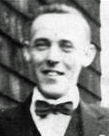
RICHARD DEVINE

As for the first seven families:  James (#1 above), Cornelius (#4 above), George (#6 above), Hugh (#2 above)'s father John, Michael (#7 above)'s father Henry, Joseph (#5 above)'s father James, and Bernard (#3 above)'s father Patrick I believe could all be brothers from County Tyrone, and that Bernard the Elder is father to all of them.  They all have proven links to County Tyrone, based on their naturalization records.  I also wonder about #14 having a father also named Bernard from Tyrone.  He may be linked to Bernard the Elder as well.  #8, #10, and #12 were all born in "Ireland" prior to 1922 when N. Ireland was separated, so they could also be connected to these families, and such proof could be obtained by digging through more Naturalization records.

One thing I find intriguing is the very low birth rate of these families.  It appears that only 20% of all of the descendants of the above discussed Devines ever married.

Monday, February 7, 2011

Alice Leonard-McLoughlin

The Dublin Leonards and the American Leonards had occasion to visit each other's families with some regularity during the 20th Century.  One such visit took place in the summer of 1964 from Alice Rosaline Leonard-McLoughlin (1917-2002), daughter to Francis Leonard of The Burrow of Portraine, Donabate, Ireland.  Both her parents had passed away in the past 4 years, so it's understandable she felt the need to reconnect with her father's past.  Alice traveled from Ireland to New England to see her American cousins, in particular the Devines, as well as the family of Matthew John Leonard, Jr.  A write-up was published in the Portland Press Herald for this occasion (click to enlarge):


Transcription:
Second Cousins Reunite

Mrs. Alice McLoughlin of Donabate, Ireland, renews her acquaintance with second cousin Francis J. Devine of High Street, South Portland, whom she has not seen for 19 years. While in the Portland area, the Irish visitor has been meeting for the first time several cousins and their families.

Maine Relatives Greet Irish Cousin
"She's just as I remember her," thought Francis J. Devine when he welcomed his Irish second cousin to Portland last week.

Although they had both aged some in 19 years, the South Portland man had no trouble recognizing his relative, Mrs. Alice McLoughlin, whom he had visited at her family's 400-year-old homestead in Donabate, Ireland while stationed in Europe at the end of World War II.

Devine gave Mrs. McLoughlin a property Irish welcome the night of her arrival. He opened his home on 294 High St. for a party for the Irish visitor, inviting seven of his eight sisters and their families. The eighth sister lives in Chatham, Mass.

During Mrs. McLoughlin's indefinite stay in South Portland, she is staying with another cousin, Mrs. Philip E. Daniels, also of High St.

She has only been here a little over a week, but already she had met more relatives than she probably knew she had.

For the first time, she had met first cousins: Mrs. Helen McKeough, Phillips Road, Falmouth Foreside; Matthew J. Leonard, Sewall St., Portland; and second cousins: Mrs. Daniels; Mrs. Edward Reagan, Portland; Mrs. John Dougherty, South Portland; Mrs. Leland P. Murray, Cape Elizabeth; Mrs. William A. Preston, South Portland; Mrs. Alfred E. Cormier, Cape Elizabeth; and Mrs. Robert Bothel, Cape Elizabeth.

Although this is her first visit to the United States, she has had a fondness for Portland for years.

Her father, at the age of 19, came here from Ireland looking for work. He found employment at a Portland sugar factory and remained here three years.

He had planned to become a permanent resident of Maine, Mrs. McLoughlin said, but he missed his family in Ireland too much to live apart from them.

The Irish visitor has become familiar with her father's old Portland ties during the past few days. She has visited the site of the old factory and the neighborhood where he used to live.

Her father, she said, used to tell her about the beautiful beaches and coastal area around Portland, especially at Cape Elizabeth.

She has now seen these same places herself and is convinced that her father didn't exaggerate their beauty. Cape Elizabeth, she says, reminds her of the shore front of her own town on the Irish Sea.

Mrs. McLoughlin has been in this country since Christmas visiting relatives in New York and Connecitcut before coming to Maine.

She'd like some day to return to Portland to make her permanent home, but she has two good reasons to return home to Donabate soon, - her husband and her 15 year old daughter, Ann.

Ann wanted to come with her on her American trip, but McLoughlin was afraid he'd be too lonesome with both of them gone.

But in the meantime, Mrs. McLoughlin's relatives here are making sure she won't be lonely.

Thursday, November 18, 2010

Descendants of James Devine (1829-1864)

James Devine (1829-1864) was born in County Tyrone, in Northern Ireland to Bernard Devine (1784-1864) and his wife Margaret.

James sailed for Portland Maine at some point prior to 1848, likely with his father Bernard, and his brother, Bernard, Jr.  James' wife, Ellen Norris (1827-1871), was also from Ireland.  James worked as a laborer, and enlisted in the Civil War in July of 1863, but died just over a year later of consumption at age 35.  His wife Ellen died seven years later at age 44.

James & Ellen had four children:

1. Catherine M. Devine (1848-1912) also known as "Kate", lived on Munjoy Hill in Portland all her life, and never married.  She had one son out of wedlock, James, when she was a young girl.  At the end of her life she was living with her niece, Helen Devine-McKeough on 24 Sheridan Street, but also working as a live-in cook to wealthy widow James McMullen on 121 State Street.

2. Edward Devine (1851-1873) died at age 22 in Portland.  He worked as a boilermaker.

3. Margaret Devine (1854-1908).  No further information.

4. John F. Devine (1858-1894), sometimes named John Thomas Devine, John H. Devine, John E. Devine, and Thomas J. Devine.  John worked as a fireman on the railroad.  He married Elizabeth Maria Leonard from Portraine Ireland ca. 1883 in Portland.  They moved to 47 Tyng Street (around the corner from St. Dominic's) and had three children:

--Helen Devine (1884-1966).  Helen married a baker named James ("Jim") Michael McKeough, a descendant of Nova Scotians originally from Tipperary, Ireland, and had four children:  Doris, Edward, Phlip (died at birth) & Philip.  James and his brother Duncan were both bakers, and at one time worked in different hotels across Congress Street from one another - Duncan worked at the Lafayette and Jim was at the Columbia - both located between High and State Streets.

--John Francis Devine Sr. (1885-1949).  "Frank" was a bricklayer from South Portland.  He married Mary Camilla Gill (a second generation Irish American), and had nine children.

--Agnes Devine (1889-1893) (died at age 4)

In January of 1894, not long after the death of her youngest child Agnes, Elizabeth Leonard-Devine died of consumption, at age 37.  Seven months later, her husband, John Devine, was drunk in Gorham's Corner in the West End, and was quarreling with a drunk barber (reportedly a jealous husband), and this fight caused John to fall and hit his head on the brick sidewalk  The paddy wagon came and got them, and John Devine died that night in jail of a brain inflammation, one day shy of his 36th birthday. The funeral was held at 14 Briggs Street, the home of his brother-in-law, Mathew John Leonard.


Daily Eastern Argus
Portland, Maine
25 Aug 1894

Portland Daily Press
August 25, 1894

His son, Frank Sr., at 9 years old, then being orphaned, sailed for Portraine by himself to live with his Aunt Annie Leonard-Quinlan.  Frank's sister Helen, at 10 years old, moved in with her aunt Catherine Devine at 48 Adams Street, whom Helen took care of in her later years.  It's interesting to me that the decision was made for Helen to stay in Portland, but that Frank had to sail back to the homeland.


WILLIAM QUINLAN & FRANK DEVINE, SR.
Dublin, ca. 1903

What I find even more interesting is the chain of causality stemming from this one drunken night.  It orphaned his son, who had to move to Ireland with his aunt Annie.  Later, Annie would then be named in the Will of her uncle Thomas D. Leonard as thanks for raising young Frank.  Annie then got the gumption to move to Portland, Maine herself, collect her inheritance, and stayed there.  This put her in a position to manipulate the Will of her older brother Mathew John Leonard, who was infirm of mind, and to shut out Mathew's own sons out of their due property and money.  The mention of old ugly Annie to any of the Leonard elders is still met with scorn to this day.

When Frank Sr. left Portraine, and returned to Portland in 1903 at age 18 (bringing with him his aunt Annie), he married Mary Gill from Maine (whose grandparents were also from Ireland), and had 8 daughters and 1 son (Frank Jr).  Frank Jr. (aka Frannie) also spent some time in Portraine with family during his WWII service.

Five of Frank Sr's nine children are still alive as of this writing (November 2010), and many descendants also remain in the area.  They had their annual reunion this August in South Portland.  The Devines have several plots in Calvary Cemetery in South Portland.

This is only a small accounting of the Devines of Portland.  There were at least ten other Irish Devine families living in Portland at the same time as my family, and I've attempted to further trace them and make whatever connections I can between them here.

Sunday, April 18, 2010

The Leonards of Portrane Ireland

Leonard is an English surname, which was used to Anglicize Germanic, Scottish and Irish surnames between the 1500s and 1700s.

In Ireland, the name Leonard was used for a variety of Irish surnames, like Glennon, Lennon, and Lennan, which in many instances originally came from the Gaelic name O Leannain (derived from the word leann, which denotes a cloak).

My Leonard ancestors began inhabiting the Burrow Townland of Portrane Civil Parish (Port Reachrainn) at some point between 1760 and 1804, based on historical maps.

Portrane is a portion of the larger Donabate Catholic Parish, located in the Balrothery Poor Law Union of North County Dublin (and North Dublin has been known as Fingal since 1994, for administrative purposes).  Portrane did not suffer as much as most of Ireland did during the Famine, due to proactive farming practices.  Nobody died of hunger there, and their literacy rate during the Famine was at about 50%, which was higher than average.  Neighboring Ballisk Townland, for a comparison, had a 12% literacy rate during that same period.

1760 Map
Portrane
(Burrow on the right known as The Warren)
(No houses located on The Warren, when other houses are noted elsewhere in Portrane)
1804 Map of Portrane
(Burrow on the Left)
Note Charles Leonard listed as tenant here

1821 Map
The Leonard House is among the earliest structures appearing in the Burrow

1829 Map
Burrow Townland of Portrane
North County Dublin
(Leonard House is Shown with Red Arrow)
Portrane was owned by the Archbishop of Dublin up until the late 18th Century, whereupon it was purchased (seized) by Irish landowners (the Evans Family).  Captain Hampden Evans and his sons, George and Joshua, were the area's landlords (and influential politicians) up until the early 20th Century, and were known as benevolent landlords to the tenant farmers.

GEORGE HAMPDEN EVANS
PORTRANE LANDLORD
During this time, the Evans Family inhabited a glorious estate known as Portrane House, located in southern Portrane (Portrane Demesne), and reportedly took relatively good care of the many tenants in the Parish, including the Leonards.  After the turn of the century, due to a variety of land acts benefiting the post-Famine tenants, the Leonards, along with their neighbors, each were able to purchase their individual lands from the Evans family, with some help from the federal government.

In 1903, the Evans family had died off, or moved away, and their massive land holdings in Portrane Demesne were acquired by the Health Service Executive (HSE) in order to install a satellite facility to handle the overflow of patients being admitted to Richmond Asylum at Grangegorman in Dublin City.  This new facility was called Portrane Asylum (now known as St. Ita's).  The Asylum has long been one of the main employers of Portrane, and is the workplace of many of the Leonards and their neighbors.  While St. Ita's stopped admitting inmates.

ST. ITA'S

The eldest Leonard ancestors I've traced to date are Thomas Leonard and his wife (maiden name Byrne).  Thomas was born in 1773, but it's unknown at present if he was born in the Burrow, or if he had moved there as an adult.  Given maps of 1760 showing no houses drawn on them, when houses were drawn in other parts of Portrane on the same map, it is understood that the Burrow was uninhabited in 1760 (and was then known as The Warren, due to the large number of rabbits living there).  Myxomatosis killed off the Burrow rabbits in the 1960's, however hares have made something of a return in recent time. 

Per the above map, certainly by 1804, the Leonard Homestead (aka Portrane Cottages), had been established and was being leased to Thomas' elder brother, Charles Leonard, along with a farm lot across the road (these lots were called Burrow Gardens).  While the Burrow was certainly hit by the potato Blight, it apparently wasn't as bad as it could have been.  Nobody in the Burrow died of hunger.

When Charles died (at some point before 1847), his nephew Patrick took over the leases (not sure why Patrick's father Thomas wasn't viewed as equipped for this).  In April of 1865, Thomas died of old age (92 years) at the Cottages, and in August of that year, his son Patrick died at the Balrothery Workhouse.  Patrick's eldest son, Mathew (my 3rd great grandfather) took over the lease and farm lot from his father, until his own death in 1904, whereupon the lease passed to Mathew's son Francis.  By the time of Francis' death in 1945, the Leonard family finally owned the Portrane Cottages, and are still owned by them to this day, marking a 7th generation of Leonard ownership, as of 2019.


Many of the Leonards and their neighbors of the Burrow are buried at Old Donabate Cemetery, and many of these burials are without memorial, as can be seen in this night time shot from 2019 (note the old Donabate Parish church (1803-1903) is next to the graveyard, and the new larger church (built 1903), looms in the background, across the street.


The view of this graveyard is taken from Smyth's Bridge House, a structure which has been here since 1842, and has long been the local watering hole of the Leonard kin.