Monday, August 1, 2011

Timothy Osborn (1805-1898)


Timothy Osborn (1805-1898), my 3rd great grandfather, was born in Winslow, Maine, located in Kennebec County, to sea captain Isaac Osborn & his wife Sarah Wyman

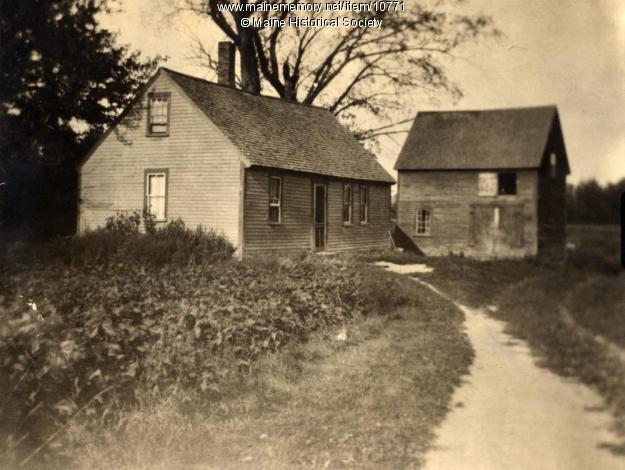
At some point after the 1820 Census, Timothy and his brother William moved to Fairfield and started a farm, where they had adjoining houses on the same homestead (now known as 189 Skowhegan Road, Fairfield, ME).  William never married, and lived in his house alone until he passed in 1880. 

Timothy, on the other hand, had a large family.

He married twice:

1.  First marriage was to his sister-in-law Lydia Burrill-Osborn-Osborn of Fairfield (who was recently widowed from marriage to his elder brother Jacob).  They raised Lydia and Jacob's son Milton as their own and had three daughters:  Mary Ann Osborn-Gifford (who had many descendants, but died of confinement in Palmyra), Emily Frances Osborn (died at age 4 of bowel inflammation), and their youngest, my 2nd great grandmother, Lydia Osborn-Fuller

2.  Four months after his wife Lydia Burrill-Osborn-Osborn had died in 1836, Timothy remarried on Christmas of that year to neighbor Olivia Noyes-Haskell, who was rumored to be part American Indian, and was herself a recent widow.  Her husband had been recently crushed by a boulder he was trying to wrangle (his death had been witnessed by poor Olivia).  Timothy had reached out to Olivia (who had four young boys) and created a 'marriage of necessity', joining both their families  and had an additional four children together (Eva, William, Mabel and Clara).  An old time "Brady Bunch", for sure.  Timothy's daughter Mabel, who was quite the seamstress, died at 26 years of age, in September 1882, during a thunderstorm.  She was struck by lightning which came right through the roof of the Fairfield homestead!  The bitter irony was that she had been safe in bed, but the family had beckoned her to come join them in her father's bedroom so they could all brave the storm together.  It was only while she was getting up to join the family, that she was struck while going through in the doorway.  Below is a report from the local paper.  I was lucky enough to get a tour of the house when it was on sale in October 2011, and I got to see the doorway, which still had some evidence of burning.


Timothy & Olivia's only son together was named William Noyes Osborn (after Timothy's closest brother). 

Timothy purchased additional land in Fairfield from Samuel Bean Fuller (another 3rd great grandfather of mine) in January of 1844 for $225.  Timothy's daughter Lydia would later marry Samuel's son Charles in 1859.  Timothy's mother, the crazy Sarah Wyman, was sister-in-law to Samuel Fuller.


Interestingly, Fairfield has streets named Osborne Street and Burrill Street. I wonder who these streets were named after?  Both streets are mentioned as early as the 1900 Census, so it would have to be someone pretty far back.

At some point, Timothy purchased the home of Jonathan Emery (the "Emery House"), which was the headquarters of General Benedict Arnold in his October 1775 Quebec Expedition.  It was this house which he let his daughter Lydia live in when she returned penniless from Iowa, after her husband Charles had died.


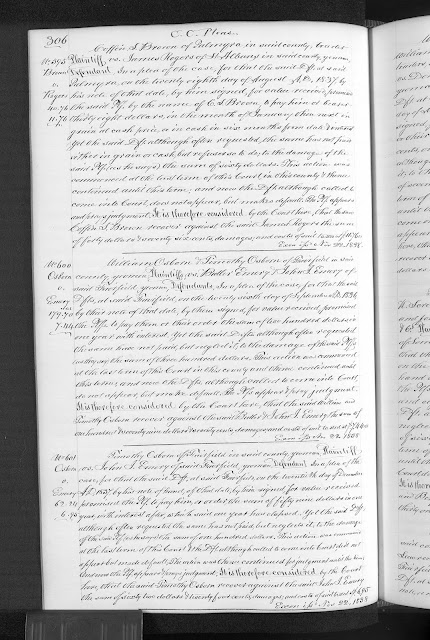
Timothy & his brother William, both yeomen (non-slaveholding, small landowning, family farmers)  lent money to several people who failed to pay them back.  Timothy appeared to be quite litigious in general, as shown below.  He and William sued and won this case in November of 1836 against the Emery brothers (all images can be enlarged by clicking on them), who likely were descendants of Jonathan Emery:


In March of 1839, they won a claim against David Hudson & Increase Kendall:


Below, Timothy lost a land claim against George Fitzgerald in March of 1840:

In the summer of 1845 the Osborn brothers won a foreclosure proceeding against Rufell Ellis & Moses Whitten for some extra land in southern Fairfield:


In January of 1856, Timothy sued the Somerset & Kennebec Railway Company for some reason, but nobody appeared in the court room, so there is no record of why he sued them.

In April of 1857, sued his cousin Joseph Osborn for back rent (about $27):


In October of 1879, he sued his cousin William Osborn of Harmony, Maine for nonpayment of debt.  Timothy recovered the money owed him here.


In May of 1882, Timothy transferred the Homestead to his son William, who was then only 21 years old.  In December of 1885, Timothy sold the additional Osborn lot to William for $1600, a property that served William well, given the number of successful mortgages he had placed on it.

Obituary of Timothy Osborn
The Independent Reporter
Skowhegan, ME
13 Oct 1898


Death Record for Timothy Osborn

ORIGINAL GRAVESTONES OF TIMOTHY & OLIVIA OSBORNE
(as discovered in the trees across the street from the homestead):


REPLACEMENT PLAQUES FOR TIMOTHY & OLIVIA OSBORNE
(Maplewood Cemetery, Fairfield, Maine):


GRAVES OF CHILDREN OF TIMOTHY & OLIVIA:


Here's a pedigree chart for Timothy.  It appears that he is 100% English descent, with one very distant Welsh line involved (Bethia Day's paternal great grandfather).


Thursday, July 14, 2011

The Burrill Family of Fairfield Maine

The Burrill (also written as Burrell) surname is purportedly rooted (at least for our ancestry) in the Anglo-Saxon name Burwell, which is derived from the Old English byrig-wiellw, which means 'town well' or 'fort by a spring'.

Early origins of the name stem from those families that resided in the township of Burwell, as such township was located in each of Northampton, Cambridgeshire, and Lincolnshire.  Anyone with this last name would have ancestors originating in one of these three East England counties.

According to Ancestry trees (which can be dubious in nature), my 13th great grandfather was Edmund Burwell (1485-1549), from Suffolk (closest to Cambridgeshire), and is the furthest I've been able to trace the line.  Edmund's grandson Thomas Burwell, along with Thomas' son John, sailed to Connecticut about twenty years after the Mayflower arrived, but later migrated up to Plymouth Colony.  Many other Burwells from England had sailed directly to Virginia Colony at the same time.  Our branch of the Burwell family name had changed to Burrell/Burrill.  Several of these settlers married into lines that descended directly from Mayflower passengers, much like all colonial families. 

With reliable records, however, I've been able to trace as far back as John Burrill (1609-1711), who came at the age of 26 on the ship Blessing July of 1636.  He settled in Weymouth, MA in 1639. He was granted 26 acres. He had two lots of five acres granted 'in the Rainge' and 1 acres 'in King oke hill.' He also had lot 33 of 5 acres in the First Division and lot 41 of 15 acres in the second division granted 14 Dec 1663.

He was provided arms and ammunition for King Philip's War on 1 Dec 1675, one of 13 Weymouth men in Capt. Johnson's Company in Oct 1675.

His son, John Jr. (1658-1731), married Mercy Alden, granddaughter to Mayflower passenger John Alden.

GRAVE OF BELA BURRILL
EMERY HILL CEMETERY
FAIRFIELD, ME


Bela Burrill (1756-1816) was my 5th great grandfather, and a direct descendant of the Burrell family from Weymouth, MA.  At the age of nine, while the family was living in Abington, in Plymouth County, his mother (Anna Vinton) was in Maine and died giving birth to Bela's youngest brother Ziba.  According to online trees, Bela's father John Burrill died in Abington on the same day (12 Mar 1765).  I have yet to find any backup records for this date coincidence (so it could be an error), but if true it could prove to have been a sad tale.  

Bela fought in the Revolutionary War for five months, in Capt. James Lamont‘s Company. Private 22 July 1775 to 31 Dec 1775.  Afterwards, he somehow found his way up to Somerset County, Maine, where he met Hannah Colemore, a Sagadahoc, Maine native.   Bela fought in Captain James Lamont's Company from 22 Jul 1775 to 31 Dec 1774.  Bela's brother John fought in the Revolutionary War, in Capt. Gould's company, Col. John Greaton's regiments, among others, and fought five and a half long years. His father John was a Sergeant and his grandfather John was a Captain.

Bela and Hannah settled in Fairfield, and had approximately nine children.  Their son Hull Burrill was a veteran of the War of 1812 and a prominent attorney from nearby Canaan, and father of 10.  He appeared in many Somerset County court records going after people for failure to pay him money.  Their son Jonas lived in nearby Clinton, and their son Bela Jr. lived in nearby Albion (now China).  Another son Benjamin Burrill (1782-1857), 4th great grandfahter, grew up in Fairfield and took on farming, just like the Colemores, Emerys, Sibleys, and Osborns who were his neighbors.  I have yet to establish proof that Benjamin is the son of Bela (an established John Alden descendant), but other applications to the Mayflower Society have succeeded for Benjamin's descendants in the past. 

In 1803, Benjamin married Margaret Sibley, daughter of English, French Huguenot and Nova Scotian immigrants, and they had five children.  In July 1825, he sued his brother Hull for a fraudulent conveyance of 82 acres of land in Canaan Hull had sold to him when he didn't actually own the property.  Hull never showed up in court, and Benjamin was awarded his money back. [Source:  Somerset County Court Records].


Benjamin's daughter, Lydia Burrill (1806-1854) married local farmer Jacob Osborn, son to sea captain Isaac Osborn (Rev War veteran and transplant from East Hampton, Long Island) and Sarah Wyman (Isaac's brother Ephraim married Sarah's sister Lydia - who was a cousin to Polly Wyman, Hull Burrill's wife!). 

Jacob died very young, and only a few years after marriage.  A couple of years later Lydia married Jacob's own younger brother Timothy Osborn (1805-1898), pictured below:


Their daughter Lydia Osborn married Charles Samuel Fuller (who was Timothy's cousin!).  Lydia and Charles were my 2nd great grandparents.

***

As is often the case with early New England families, another set of Burrills figure in to the family:

My third great grandfather, John Holland, whose nephew, James Madison Bell, married Sylvia Belle Burrill, who was also a descendant of immigrant John Burwell (Sylvia was also a descendant of the same Bean family from Scotland as the ancestors of Samuel Bean Fuller, father to Charles Fuller mentioned above!

Below is a pedigree chart of Lydia Burrill-Osborn-Osborn.  She was 25% French, 75% English.

Saturday, July 9, 2011

Edwin Clinton Temm (1901-1964)

My great uncle was Edwin Clinton Temm, elder brother to my grandma Emily Temm-Clarke.


TEMM FAMILY (1919)
Edwin is the elder boy seated on the left with the younger boys

He was born on the Temm Homestead on Beech Ridge Road in Scarborough Maine to John Henry Temm and Hattie Morgan-Temm, one of their eight children.  He was named after an earlier Edwin Clinton Temm who had died in infancy (and this baby's burial location is a family mystery).

He grew up and attended Scarborough schools, and spent most of his life working as a railroad machinist at the Portland Terminal Company in the South Portland Rigby Yards.

In 1928 he had moved to Portland and married Marion Eunice Dolloff, who had grown up in the Bath area to parents with long held Rumford and New Gloucester roots.  Edwin & Marion's marriage only lasted about nine years, and they had two daughters:

-Eunice Evelyn Temm (1928-1995) grew up in Portland and Windham, married Edgar Marks from Texas, and had three daughters.  This family settled in Manteca, California, and I believe descendants are scattered throughout California today.

-Eva Helen Temm (1930-2003) also grew up in Portland and Windham and went to dental school to become a hygienist.  She married Earl Pushard, a Merchant Marine from Dresden Maine, and had three children.  This family was briefly in northern Maine for a time and settled in Las Vegas and is still largely residing there today.

EVA HELEN TEMM-PUSHARD

After the divorce, Eunice married Glenn Buzzell and settled in New Hampshire.  Edwin remarried a few years later in 1943 to his neighbor across the street in Westbrook, Laura Isabelle Butler (lovingly referred to as "Aunt Isabelle" by many people). 

They bought a house on Pope Road in Windham and had three children.  Edwin passed away in 1964, and Aunt Isabelle held down the Pope Road house until her recent death in 2011.  Aunt Isabelle will always be fondly remembered as the family genealogist.  She was invaluable to me in my own research, and we had a lot of fun together solving some of the family mysteries.  She died just shy of her 90th birthday, and I'm very grateful of the time we spent together, and of her assistance in tracing the Temm ancestry.

Edwin and Isabelle are buried at Eastern Cemetery in Gorham.


Pictures of Edwin & Isabelle Temm and family:

Thursday, July 7, 2011

American Indian Ancestors: Fact or Fiction?


Having researched hundreds of American family groups at this point, and having spoken to many family researchers over the years, one conundrum seems to persist in most every white American family:  the tale of the mysterious "Indian" ancestor.

Try asking any white American what their heritage is, and I will bet you that most all of them will mention being part Native American.  It's a strange phenomenon, all these ivory skinned people claiming to be a small part of a rich native heritage. 

I've heard a number of variations on the story, with most of the stories involving one of the more famous Indian chiefs:  Geronimo, Sitting Bull, Massasoit, and even the famed and laughable tale of the "Indian Princess".  It sounds quite exotic, but Native tribes did not have titles like those of English Royalty.  A daughter of an Indian Chief might be referred to as a "Princess" in hindsight by an English Colonial, however, and I'm sure that's where the term originated and was then romanticized into infinity.

One blog about the famed fake Indian Princess named "Nicketti Powhatan", the supposed niece of Pocahontas, expertly hones in on the phenomenon revolving around one of the more enduring Indian Princess stories.

But stories are all that can be offered.  When you think about it, how could one actually prove a link (with true documentation) to a famous indigenous American from the 17th century?  It's not like they have their own vital records database going back that far.  What we have here are an assortment of family legends, nothing more.

Slate wrote a very thoughtful write up on this phenomenon as well, and the main thesis there was "To claim Cherokee blood is to authenticate your Americanness".  A very salient point captured here is that there is some basis for believing in a high frequency of Cherokee-Euro Settler marriages, in an effort to establish diplomatic ties, and to secure trading business between native and settler.  Further, Cherokees also were known to take on African slaves, which led to a certain amount of mixed blood offspring.

I think the connection is there, but it's been exaggerated over the generations.  A great many Hollywood celebrities make the claim to Indian ancestry, and many of these claims are simply unverified.  Former NFL player Emmitt Smith, like many African Americans, grew up hearing the story of having a significant amount of Indian blood, and DNA testing proved him wrong.

It's understandable though.  Growing up here, it's quite exotic to believe that one's family is rooted in anything other than European or African stock.  Speaking for myself, as a run-of-the-mill white person from New England, it's exciting to imagine that even the slightest touch of Spanish, Asian, African or anything other than the standard Irish/English/French blood could be involved.  I would view it as welcome news (not everyone shares that excitement, of course).

My opinion is that the true number of Americans with Amerindian blood is much lower than what has been claimed, and, outside of the folks who can easily prove this by having grown up on a reservation, or had recent ancestors who have done so, those few who truly have that famed "1/16th" Indian blood will find it near impossible to prove. 

Not all family researchers share my pessimistic viewpoint, however.  Many appear to like hanging on to the family story of the Cherokee Indian Princess, or other such stories, despite lack of available documentation.  But of course some families have a strong link.  I'm very curious about this process of proof, and would welcome feedback from those who have succeeded in bridging the gap between family lore and substantive documentation.

Many members of indigenous tribes of North America have expressed anger, outrage, and disgust over the fact that many white Americans claim to possess American Indian traits, understandably so.  Many other natives decry the rising interest in Amerindian genealogy as well.

"Indians" began being counted as a specific race on the 1870 U.S. Census.  During the prior census, taken in 1860, "taxed Indians who have renounced tribal rule" were the only ones to be counted (even though they were often still checked off as 'white').  After 1870, there is still some evidence that census takers (whether racist, coerced, or careless) would still list most people as "White" anyhow.  By 1885, many tribal nations started being counted on the U.S. Indian Census Rolls for those living on reservations.

The story I had always heard in my family while growing up was that somewhere on my mom's mother's side of the family, we are from the "Blackfoot Tribe".   As a child, it sounded interesting enough to me.  I began to adopt the idea as fact as a teenager, and believed myself to be special in some way, given that I already had been told that my dad's side of the family had Mayflower roots (a rumor I was able to prove true with a lot of help from cousins, and digging through a lot of old records).  I found it fascinating to imagine myself as descending from native people and also from those who colonized.  But this Tribe is from Montana, and my own research proved that I had no roots in Montana at all, so I quickly dismissed the story as family folklore.

There have been some great strides in genealogical DNA testing, whereby one can determine percentages of ancestry from just a cheek swab.  FTDNA is one such company, and such percentages can be revealed, along with the news that you may actually be part of some reputed Amerindian "Haplogroups".

My mother had her cheek swab done in 2010, for instance, and her group came up as "Haplogroup X".  Now, A, B, C, D, and X are all associated with migratory Siberian Asian (and Central Asian) people that settled in the Americas as the first, "Native Americans"...for lack of a better term.  There was some evidence at the time, however, that Haplogroup X also is potentially linked to European people, so the jury wasn't out yet.  In 2015, the Haplogroup got revised to a subclade of X, namely X2b4, which was confirmed as rooted in Western European ancestry, and NOT Native American.

I feel relieved to close this chapter on my family history - this story of the mysterious (and false) Indian, at least in my family, can finally be put to rest, along with the one about that guy who invented the telephone.

Sunday, July 3, 2011

Clarks of Connecticut

Our immigrant ancestors were Thomas Clarke who came to the New World on the ship Anne, and his father John Clarke who was a Jamestown settler and Master's Mate of the Mayflower.  Their descendants settled in Lyme and Haddam Connecticut during colonial times, and their many hundreds of descendants have spread out all over America.  While my Clarke line moved to Maine in the 1910s, where I grew up, the vast majority of these descendants actually stayed in central Connecticut, and still live there today.  I've had the privilege of meeting (online and in person) some of these distant cousins, through shared ancestral research. 


While the Clark/Clarke name is a very common English name, it's a fair assumption that about 75% of the current crop of New England Clarks descend from the above mentioned Thomas & John.


For the benefit of my common cousins, below is a pedigree of our Clark line going back to England, to the extent I've been able to research and confirm:


13th Great Grandfather:
Thomas Clarke (1500-1551) a nobleman from Norfolk, England, married "Catherine".


12th Great Grandfather:
Sir Thomas Clarke (1527-1580) a nobleman who settled in Hertfordshire, England, and married Martha Micklewood.


11th Great Grandfather:
William Clarke (1553-1624) from Hertfordshire, married Margaret Walker from Cambridge, England.


10th Great Grandfather:
John Clarke (1575-1623) from Cambridgeshire or Middlesex, explorer, ship worker, and ultimate settlor of Jamestown Virginia.  He arrived in America on the Mary Margaret, part of the "Second Supply" fleet of ships in 1608.  He was later captured by the Spanish in 1611 and held prisoner for five years until being exchanged for ransom.  He likely had arrived in Jamestowne again in 1622, but was potentially killed by Indians during the 1623 massacre.  His first wife, Mary Morton, died in England, and he married his second wife, Sybil Farr, just 10 years before leaving England without her.


9th Great Grandfather:
Thomas Clark (1599-1697) born in Stepney, England.  He was purported to have been a shipmate on the Mayflower, but went back with the ship and its captain.  This same story has been attributed to John as well, in other publications.  Thomas married Susannah Ring and settled in Plymouth, Massachusetts.  He was likely the eldest member of the Plymouth Colony at the time of his death at age 98.  Thomas had shortened the name from Clarke to Clark upon arrival in the New World.


8th Great Grandfather:
John Clark (1637-1719), first Clark in our family to be born in Plymouth.  He married Sarah Smith in Boston and became the first Clark to settle in Connecticut (Lyme).  They had two sons, John and Nathaniel.


7th Great Grandfather:
Nathaniel Clark (1672-1749), born in Boston, died in Lyme, CT.  Married Sarah Lay.


6th Great Grandfather:
Samuel Clark (1705-1758), born in Lyme, married Hannah Champion.


5th Great Grandfather:
Samuel Clark, Jr. (1744-1790), born in Lyme, married Ruth Graves.  Samuel moved to nearby East Haddam Connecticut, and was the first Clark to settle in East Haddam, where many Clarks live today.  Earlier East Haddamites were also ancestors of mine, and ancestors of many who married into the Clark line (a tangled web, for sure).  Samuel was a Revolutionary War Minuteman, and served under Captain Eliphalet Holmes.  He had children who stayed in East Haddam, yet some moved over into Central New York State, and have descendants still there today.  I'm uncertain about what caused this migration of several hundred miles.


4th Great Grandfather:
Sterling Clark (1767-abt 1855), born in East Haddam, married Sarah Warner, and had six children, again some of whom stayed in East Haddam, others who moved to NY State to be closer to their relatives already there.  Sterling himself moved to Whitestown, NY (in Oneida County), to live with his son Sterling Jr. (a doctor).  Sterling Sr. was listed as blind on the 1850 census.


3rd Great Grandfather:
James Clark (1795-??), born in East Haddam, married an Anne, and fought in the War of 1812.  He received a land patent in Ursa, Illinois, but sold it off soon thereafter.  No trace of he or Anne past the 1821 land sale.  He had five children:  Infant, Delia, Harriet, James A., and Leonard Sherman, who was my ancestor.


2nd Great Grandfather:
Leonard Sherman Clark (1821-1899), born in East Haddam, was a carpenter who built many East Haddam houses which are still standing today.  He married Esther Phelps Martin, and had twelve children.  Many of the currently living Connecticut Clarks are descendants of Leonard Sherman.  He was a Civil War veteran in Company C of 20th Connecticut Infantry Regiment; enlisted with his eldest sons John Ozias Clark and Charles Clark.  They fought in the battles of Chancellorsville, Gettysburg, Tracy City, Boyd’s Trail, Resaca, Cassville, Peach Tree Creek, Siege of Atlanta, Silver Run, Bentonville, and Raleigh.  Leonard was blind at the end of his life, just like his grandfather Sterling.


Great Grandfather:
Niles Martin Clark (1866-1911), born in East Haddam, was the 2nd youngest child of Leonard Sherman, married Lizzie Tooker of Lyme, and had nine children:  Emma, Claude, Niles, Clifford, Leonard, Ethel, Herbert, Geraldine, and James.  He worked as a blacksmith, and died of heat exhaustion working in a barn in North Lyme.


Grandfather:
Herbert Francis Clarke, born in Higganum, Connecticut, lived in Opportunity Farm for Boys, settled in Scarborough, Maine, married Emily Iva Temm and had twelve children.

Wednesday, June 1, 2011

Mathew Leonard from The Burrow

Mathew Leonard (1821-1904) was my 3rd great grandfather, the eldest child to Patrick Leonard (a tenant farmer in the Burrow Townland of Portrane, County Dublin) and his wife Lizzie Horish.  Mathew grew up in the Leonard Homestead (which had been leased by the family since the late 1700s), also known as the Portrane Cottages.  Mathew's grandfather, Thomas, and his father, Patrick, each died in 1865, leaving Mathew with the lease until his death in 1904.  The land and cottages would eventually all be Leonard owned by the 1940s (thanks to the Wyndham Land Purchase Act). 

Around 1850, at the end of the Famine, Mathew married Anna O'Brien (aka Anne Brien), of nearby Blanchardstown, and had eleven children, some of whom migrated to Portland Maine:

-Mary Leonard (1850-bef 1939) was baptised 8 Nov 1850 (the record states that her parents were "Michael" Leonard and Anne Brien of Donabate).  No further information.  She must have died before 1939, since her brother Matt's obituary doesn't list her as a sibling.

-Patrick J. Leonard (1852-1853) died as an infant.

-Mathew John Leonard (1854-1939) "Old Matt" was my paternal 2nd great grandfather, who emigrated to Portland Maine in 1881.

-Elizabeth Leonard (1857-1894) emigrated to Portland and married a railroad fireman named John H. Devine (1858-1894).  Elizabeth's godfather was old family friend Patrick Wade, who also emigrated to Portland Maine.

-Francis Leonard (1859-1945) sailed to Maine with his brother Mathew John in 1881, but only lived there for about three years, and returned to the Burrow.  He has many descendants, some who still live in the Burrow today.

-Ellen Theresa Leonard (1861-1893) (aka "Nellie").  She arrived with her brothers in 1881.  In 1888 in Portland, she married James Joseph Smart (who born in the Burrow to Charles Smart & Jane Dockrell).  James had recently arrived from living with his grandparents in Lancashire England and had been working in a copper mill lab.  James got a job in Portland as a telephone worker for NET&T.  They lived on 24 High Street, 5 Stevens Place, then later 2 Martyr Street (with other Smarts).   Both Ellen & James died young of pulmonary tuberculosis in Portland, and are buried in Calvary Cemetery, South Portland Maine.  James' cousin Charles, also from the Burrow, lived on 16 Briggs Street with his wife, Nellie Curran, and Nellie's parents, James and Rose Curran.  This was one of the row of houses on Briggs Street owned by Nellie Leonard's uncle Prod.  Ellen is the only child of Mathew's for which I cannot find a baptismal record, so I wonder if she might actually be Alice or Agnes below.

-Annie T. Leonard (1863-1948) was baptised in Donabate Parish, just like her siblings. At age 21, she married William Quinlan at Old Donabate Parish, but divorced him and migrated to Portland in 1913 upon hearing that Prod had left her money from his will. She remarried soon after arrival in the US, to a Willard Harland Batchelder. When her brother Mathew John was suffering from dementia in the mid 1930's, Annie took the opportunity to get his will changed so that she received his entire estate, minus $1.00 apiece for his sons Matthew Jr. and Thomas Matthew (so they couldn't contest the will). There was much ill will toward Annie after that family drama, and to this day the mention of Aunt Annie to any Leonard descendant produces a furled lip. She was a live-in housekeeper for the church for the remainder of her life. Not sure what she did with the money.

-Alice Leonard (1865-1898).  Alice was a spinster, living in the family house in the Burrow until her death at age 33 of tuberculosis.

-Agnes Leonard (1867-1870).  No further information.  She must have died before 1939, since her brother's obituary doesn't list her as a sibling.  A death record from 1870 is available at the General Register Office, and it might likely be her (given that the age was 3 years old).

-John Leonard (1870-1897).  John died in January 1897, of peritonitis.  His death certificate said he was married.

Back Row: Patricia Leonard, "Charles," Grace Mary Liversage
Front Row: Anneleina Leonard, Patrick Leonard, Mary Elizabeth Roberts-Leonard, Christine Leonard
(About 1940, England)
Photo Courtesy of Diane Rollins

-Patrick J. Leonard (15 Feb 1872-after 1948) (named after his deceased infant brother (and his grandfather) Patrick) was nicknamed "Patsy".  Patsy married once when he was young, to Bridget Davis, who died in 1903.  In 1909, he moved to Portland Maine to live and work near his brothers, around the time he was named a successor executor to his uncle Prod's estate.  He married Mary Elizabeth Roberts-Liversage there in Portland, July 1910.  Mary was a widow from Brighton, England, with two daughters (Ruth & Grace Liversage).  Patsy didn't enjoy America, and missed his home.  By March of 1911 he had brought Mary & her daughter Grace back with him to live in The Burrow, and lived in the house next door to his elder brother Francis.  Mary's daughter, Ruth Liversage-Davis, had remained in Portland with her new husband (and apparently one of Mary's brothers - Joseph Roberts - was living in Portland at the time as well).

In February 1913, Patrick was cited for failure to pay the Poor Rate Collector, and forced to pay one pound, six shillings, seven pence.

In January and also May of 1915, the School Committee got after Mary for her daughter Grace failing to go to school.  Mary had to pay fines, and Grace was forced to attend school until the age of 14.

Apparently Mary and Francis didn't get along, because court records of June, 1915 show that Frank grabbed her by the neck and threw her against the hedge, and she hit him on the side of the face with a shovel.  In In the 1910s in the Burrow, Patrick and Mary had three daughters of their own:  Anneleina, Mary Christina (Crissie) and Bertha (Patricia).

In March of 1915, his two younger daughters, Crissie and Patricia (somehow listed as Utreshia) had never been vaccinated (likely for pertussis), since 1912, and the Poor Law Union fined Patrick and imprisoned him at Mountjoy, forced to serve hard labor for a week.

Oral tradition has it that Patrick likely later moved the whole family to England (possibly Brighton), where all three girls married Englishmen.  According to Mary's brother's obituary in 1951, Mary was alive and well and living in England, but English Probate Records show Mary to have already died in 1943.  *** I did find a Dublin-born Patrick Leonard of the right age working as a gunner for the Royal Artillery in Lancashire England, 1891 (coincidentally where his brother-in-law James Smart lived in 1881).  It's entirely possible that Patsy met Mary in Lancashire initially, then moved with her to Maine temporarily, back to Dublin, then to Brighton or Lancashire, England.

Friendship with the Riley Family of Donabate
  • In a baptismal record from September 17, 1843, Mathew appears as godfather to Nicholas Riley, son to John and Ellen Riley.
  • In a baptismal record from December 6, 1846, Mathew appears as godfather to Margaret Riley, daughter to Patrick and Sarah Riley.
  • In Mathew's son Patrick's 1872 baptismal record from Donabate Parish - his godparents were Richard and Margaret Reilly.

Dog License Registers

Below are some dog license applications of Mathew for his many male dogs over the years.

Apparently he owned a black and white terrier in 1875, a red shepherd in 1876, a white bull in 1878, a white terrier from 1879-1881, a white bull in 1882, a black and tan terrier in 1887, a grey terrier in 1888, and a brown terrier in 1893, 1895 and 1899, and two brown terriers in 1903 (just before he died) and typically paid £2 and six shillings per license:


Court Cases

On May 27, 1876, James McQuaid complained about Mathew having a dog without a license, and Mathew had to go and get a license.

On April 30, 1887, Constable William Walsh filed a complaint against Mathew's wife, Anne Leonard, for carrying an unlicensed dog in the Burrow, and was charged 5 shillings, plus 1 shilling admin fees.

On July 23, 1887, Mathew filed a complaint against his own sister, Elizabeth Harrison, for allowing twenty fowl to trespass on his property.  On the same day, Mathew also filed a complaint against his neighbor, James Wade, for the charge of seven fowl trespassing on his cropped land.


On May 18, 1895, Mathew filed a complaint against Terence Dougherty, also of Portrane, on a charge related to goods sold.  The case was dismissed:


Census Records

The 1901 Census of The Burrow has Mathew & Anna Leonard living at Burrow House #5, with Patrick and Francis.  They had a chicken coop, horse stable, and cow house.  By then, Francis was already a widower, and had yet to marry Margaret Byrne.  Not sure yet where the others were living who stayed in Ireland (Annie, John, Mary, Alice).  (All images can be enlarged by clicking on them.)


The 1911 Census of The Burrow has Francis and Patrick with their own families, living at Burrow House #15 and #16.  According to the Farm House exhibit, Francis & Patrick had a farm with two cow houses, one chicken coop, and a horse stable.


Mathew died in 1904 at home, of cardiac failure, after three weeks of illness.  Anna passed a few years later, in 1907, at Portrane Asylum (later known as St. Ita's).  Given that Mathew's son, Frank, signed (with his mark, meaning he couldn't read or write) as informant on the death certificate of Mathew, I'm inclined to believe that Anna was already institutionalized at the Asylum during Mathew's death, or else she would have been the most likely informant.  It's troubling to me that the decision was made to place her there, but this was a common practice, if any kind of illness or senility was occurring, not just mental illness, they were placed in the local sanitarium.

Old Donabate Parish Cemetery, has a burial list online (managed by Fingal County Council), but it is limited to what gravestones have been easily identified and transcribed (pursuant to Memorials of the Dead publications).  There are many green patches with no stones on this burial ground, so I can't help but wonder who else is buried there.  

When I was in Ireland in October 2019, I did some research, and learned that unfortunately Donabate Parish didn't keep burial records at all, and that they rely upon the Council, who only relies upon the published book mentioned above.  I spoke with the Parish undertaker (Michael Rocks of Swords), and he said that they have their own burial records only going back to 1924, and that prior to that, the Parish would simply provide a pine box for the family, and let them go ahead and conduct the burial themselves - the church would simply not get more involved than that.  Therefore, given Mathew and Anna's deaths in 1904 and 1907, I have no hope of identifying the burial locations.  However, one particularly large patch of grass at the cemetery contains one small limestone gravesite immediately to the left of Mathew's son Frank's gravestone, and that may in fact be where Mathew and other Leonards are buried.  That's the best I can guess at this time.

FRANK LEONARD GRAVESITE (GRAY STONE ON THE RIGHT)
OLD DONABATE CEMETERY
(NOTE GRASSY AREA AROUND IT - POSSIBLY BURIAL LOCATIONS FOR OTHER LEONARDS)


MYSTERY GRAVE NEXT TO FRANK'S
(POSSIBLY HIS FATHER MATHEW'S)
***
SOURCES:

  • Donabate and Portrane, a History, by Peadar Bates
  • 1901 Census of Ireland
  • 1911 Census of Ireland
  • Baptisms, Parish Registers, Donabate
  • Civil Birth Records, Balrothery, Dublin
  • Civil Marriage Records, Balrothery, Dublin
  • Civil Death Records, Balrothery, Dublin
  • Petty Sessions Small Claims Court
  • Petty Sessions Dog Licenses
  • Interment.net

Monday, May 9, 2011

Niles Martin Clark

Niles Martin Clark (1866-1911) was my great grandfather.  He was the second youngest of 12 children born to Leonard Sherman Clark and Esther Phelps Martin of East Haddam, Connecticut.

The name "Niles" features prominently throughout the Clark family of today and long ago.  Niles Martin Clark, for instance, was named after his great grandfather, Niles Phelps (1771-1848), who himself was named after his great grandmother, Abigail Niles-Tiffany (1675-1739) of Braintree, Massachusetts.  Abigail's grandparents (John and Jane Niles) had migrated to Mass. from England shortly after the Mayflower voyage, but John Niles' father's surname was written as Nyle, and this family were thought to have been from Dorset, England.

At age 19, Niles Clark had a short lived marriage to a Bertha Watrous, and just after his 21st birthday he married Lizzie Matilda Tooker of Lyme.  He lived in Suffield and Granby, and worked as a blacksmith and horseshoer all his life.

A brief history of Niles & Lizzie's 9 children:

EMMA LEORA CLARK-STOLL


-Emma Leora Clark (1889 – 1947) married Anthony Stoll, born to British immigrants.  They had six children and settled in the Kingston NY area.

Clark Family in 1934
Left to Right:
Isabelle Clark-Bartley, Ken Clark (children of Claude),
Claude Clark-Smith, Frank Bartley (holding his son Leonard "Bushel" Bartley),
Emma Leora Clark-Stoll
1934 Studebaker Dictator 3W Coupe in the background


LEONARD (BUSHEL) BARTLEY, CLAUDIA CLARK-SMITH-BELL, LEN BELL (CLAUDIA'S HUSBAND), UNKNOWN NEIGHBOR, ANNE (FRANK BARTLEY'S GIRLFRIEND),
FRANK BARTLEY (FATHER TO BUSHEL, AND FORMERLY MARRIED TO CLAUDIA'S DAUGHTER ISABEL),
ANNE'S DAUGHTER (SEATED)
THANKSGIVING 1942
NEWBURGH, NEW YORK
 
-Claudia Cressie Clark (1892 – 1961) (nicknamed 'Claude') married Charles B. Smith, and lived in Beekman, NY, and later Union Vale, NY.  In 1927 she moved to Newburgh, NY (later to Fishkill).  She had four children:  Kenneth, Isabel, Harold (who also went by "Jim") and Ruth.  Claude divorced Charles around 1939, and immediately remarried to a well driller named Leonard "Len" Bell, and remained in Newburgh, on Gardnertown Road, then later on Fostertown Road.  After her divorce from Charles, it appears that the kids stayed closer to Charles (who claimed he was widowed on the 1940 Census, so it's clear there were hard feelings - in fact, for the 1930 Census, Claude claimed to be widowed as well, and she wasn't even divorced yet).  Claude and Len moved to Montgomery NY in 1949, where she worked as an operator at a dress manufacturer (similar to her mother's work), and Claude died a widow in 1961.  Claude and Len are buried together at Cedar Hill Cemetery in Newburgh, NY.

-Niles Carrol Clark (1894 – 1918) was named for his father, and grew up in a Home for Boys in Hartford, CT, settled in Hartford, but then was drafted to serve in WWI, only to die of pneumonia in France after the war was over, while he was waiting to be picked up.  It took THREE YEARS for Lizzie to get his body shipped back to the USA, and he is now buried next to his mother in Forest City Cemetery, South Portland, Maine.  He served in the Army in the Connecticut 102nd Infantry Regiment from 1917, and was severely wounded in July 1918 in Aisne Marne, and further wounded in Oct 1918 in Meuse Argonne.  According to Niles' nephew, the family lore has it that young Niles was "shot by German soldiers whilst rescuing Captain Eddie Rickenbacker from his downed airplane during WWI and died in France from complications of his wounds, probably gangrene."  This runs afoul of the more boring death record in City of Portland's vaults, and military records, stating he simply died of lobar pneumonia.  Spanish Flu was the common culprit during 1918, especially during the last battle Niles fought in (Meuse Argonne).  Besides, Eddie Rickenbacker's tenure in France did not line up with Niles' battle record in France with his regiment.  Niles was a hero to the Clark family, and his younger brothers Leonard and Frank each had sons they named after him.

-Clifford Nordell Clark (1896 – 1963).  "Cliff" was put in the Meriden, CT Home for Boys for most of his youth.  He ended up serving as in WWI, and after the war lived in Hamden, CT, where he worked as a bookkeeper at a gun factory in 1920.  Later on he lived in Newburgh near his brother Leonard during the 40s.  He traveled the world as a seaman, lived in Mississippi for a while, and ultimately settled in Galveston, Texas just two years prior to his death, when he was working as a messman for a shipping company.  From what I hear he was quite shellshocked from the War, and according to those who knew him, he would cower on the ground into a combat crawl anytime a loud noise occurred.  His brother Leonard ("Red") spoke of him as crazy, and that he would always be saying he was just coming from Cleveland, or just about to go to Cleveland, no matter where he was.  Cliff's obituary in the Galveston paper stated that his brother Leonard lived in Corpus Christi, TX, yet Leonard had retired 3 years prior to that to Phoenix, AZ (but according to Leonard's son, he had moved to AZ a bit later than that).  According to one of Red's children, Red talked about Cliff quite a bit and yet they hardly ever saw each other.  It's a shame that for a brief moment in the early 60s, both brothers were living very close to each other before Cliff died.  Cliff had only one child, Johnny Clark, who was living in Scarborough, Maine at the time of Cliff's death at the USPHS (military hospital) in Galveston in 1963.  According to Cliff's nephew, Cliff had fought in WWI, but I don't see a draft card for him at present.  

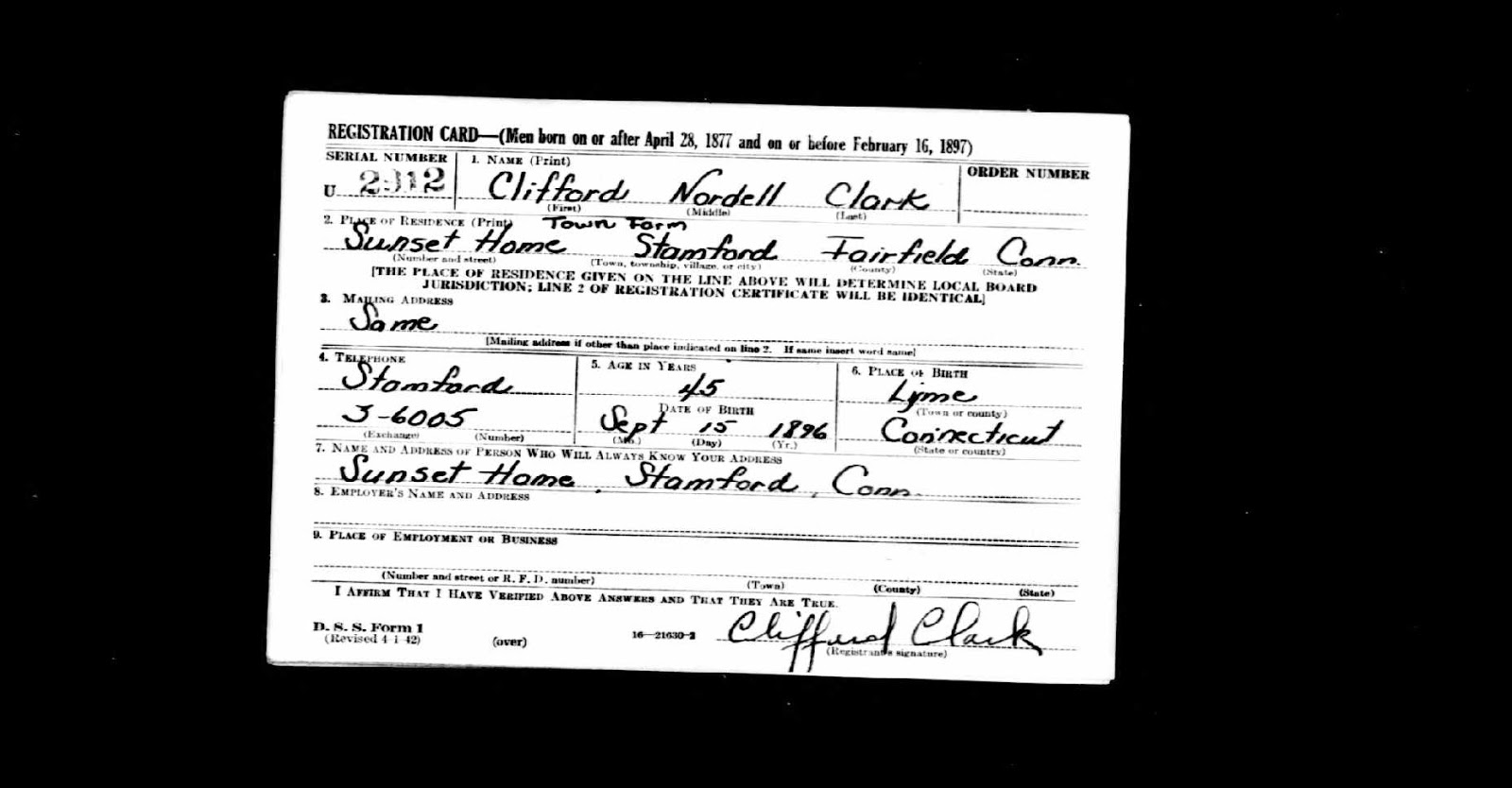
Cliff was drafted into the "Old Man's Draft" of WWII in 1942, at which time he was staying at the Stamford "Sunset Home Town Farm", a poor farm, and had already one toe removed due to diabetes.

Here is Cliff's WWII draft card:


Also regarding Cliff, on a 1955 ship register from Southampton England to NYC, Cliff had only checked one bag, while the rest of the passengers had checked between 3 and 7 bags.  Cliff died of a heart attack in 1963, just a couple of years after settling in Galveston TX, but had suffered from diabetes for a long time, and it was later told to me by a distant cousin that Cliff had had a leg amputated due to his illness.  Cliff is buried at Lakeview Cemetery, in the Marine Section.  

As for the Galveston house that Clifford lived in with Margaret (1415 Avenue N), it appears that they moved in at some point after September 1961, as per newspaper records showing others living there.

Further, it appears that his veterans headstone application cards below that he was dishonorably discharged in 1927, and perhaps went by a pseudonmym (William J. Nolan):


It's unclear when his wife, Margaret H. Clark died, or where she's buried, but she was alive as of 1966.  The 1920 Census record shows Clifford having a wife named Mona, age three years younger than him.  I'm not sure if this Mona is the same person as Margaret H. Clark who was his widow.  It's apparent that after Clifford's death in Galveston in 1963, she moved to nearby Texas City by 1966. I researched this address, and apparently it had ben turned into a park by 1995.

Also, there is another Margaret H. Clark of Galveston who was married to a painter by the name of Edward C. Clark.  She lived from 1910 to 1986, so this is not the same lady.  This was confusing to me, but I'm putting that information here for myself or other potential researchers to be aware of.

There are some records of a Mrs. Margaret H. Clark living in Connecticut after 1966, so it's possible she moved back to CT after Clifford died.  It would make sense, given they only lived in Galveston a few years.


JOHNNY CLARK
SAILOR
SON TO CLIFFORD CLARK

My hope is that someone researching the Clarks might know the whereabouts of Johnny, and if he's still alive.


LEONARD SHERMAN "RED" CLARK
ABT 1946


-Leonard Sherman Clark (1899 – 1974) was named after his grandfather Leonard Sherman Clark, yet was nicknamed "Red", due to his red hair.  In his later years, he simply went by "LS Clark".  Red was raised partly in the Temporary Home for Boys in Haddam, CT.  He had five children, lived most of his adulthood in Texas, and retired in Phoenix as an industrial engineer.  He was one of the few Clarks of his time to have ever gone to college, and one of the few who didn't work in blue collar trades.  His very interesting story can be read here.

-Ethel Dorothea Clark (1903 – 1981) first married in 1920 to German immigrant Oscar Hellmuth, and had one daughter Cecelia (1921-1991), who had two daughters of her own in the 1940s (Celia and Agnes), and worked with her stepdad Cyril in his tree surgeon business.  They divorced in 1930, and she immediately married a tree surgeon named Cyril Adams (originally from San Francisco), and while they had no children, they did live in Hull, Mass during the 1940s, and were living in El Monte, CA (Los Angeles County) for the 1950 Census, and then later in San Francisco and Richmond, California.  Ethel did a lot of factory work, including as a sorter in a tobacco factory (1930 census), and was also a housekeeper.

FRANK CLARKE

-Herbert Francis Clarke (1905 – 1982) was my grandfather, and was nicknamed "Frank".  He lived most of his life in Scarborough, Maine and worked as a stonemason.  His youth was spent at Opportunity Farm in New Gloucester, Maine.  He had 12 children (three more than his father), and many descendants.

-Geraldine Frances Clark (1908 – 1987) grew up in Granby, CT and Scarborough, ME.  She married Fred Meserve, moved to Rochester, NY, and later married William C. Smith.  At some point between 1965 and 1979, she and William moved to Bailey, Mississippi to be closer to her nephew Bill's family and her niece Florence's family, where they lived in side by side trailers on Grissom Road.  No descendants.  Geri's ashes are buried on top of her brother James' body in Ossian, NY.

GERALDINE CLARK SMITH
WITH HER HUSBAND WILLIAM SMITH
AND HER NEPHEW BILL CLARKE


AUNT GERALDINE'S TRAILER
GRISSOM ROAD
BAILEY, MISSISSIPPI


JAMES RAYMOND CLARKE

-James Raymond Clarke (1910 – 1979) also spent some of his youth in Opportunity Farm, with his brother Frank.  He moved to western NY and was married with seven children.

***

The Death of Niles Martin Clark

Niles had been battling tuberculosis, whether he knew it or not, and died of it at age 45 in the hot summer of 1911 in a barn in North Lyme, with a contributing factor of heat exhaustion.  During the time of his sickness and death, Lizzie dispensed of her sons to various orphanages, took the family fortune and remarried three more times.


SITE OF DEATH OF NILES MARTIN CLARK (JULY 1911)
NORTH LYME, CT

While the above story of Niles' death rings true when reading available records, there was another, much more entertaining story passed down regarding Niles (through the children of his son Red).

According to one account, Niles was a very powerful man; and that he could hold the hind leg of a mule in his hand while someone coaxed the mule to kick and, he was that strong, that he could hold the mule's leg and it could not kick him. At the same time, he was a man who liked to drink and gamble a lot. One night, drunk, someone bet him that he couldn't do it but, being drunk and a bettor, Niles accepted the bet. The mule kicked, his hand slipped, he got kicked in the chest and died under a big tree in the backyard days later of a stove-in chest.

Now given that Niles' death certificate has him dying of tuberculosis, and given that his father, Leonard Sherman Clark was a man with the height of 5' 5 1/2", I'm having trouble believing this entertaining version of old Niles.  Besides, given that Niles' wife, Lizzie, was a controlling and very tough woman, it would stand to reason that she would only marry gentle and easy going, hard working men, which most of the Clark men were.  It's difficult to imagine one of the old Clarks being a 'powerful man' of physique and temperament.

Pedigree Chart for Niles can be found below.  He is of 100% English colonial descent, from all research done to date.