Sunday, September 30, 2012

Thomas Clarke of Plymouth

My 9th great grandfather was Thomas Clarke of Plymouth Massachusetts, who arrived on the ship Anne in 1623.

He was believed to be son to John Clarke, who was an early settler of Jamestowne, Virginia.  I've written a page dedicated to the compiled research on John here.

Depending on who you believe, it is stated that either John or Thomas was a master ship mate of the Mayflower

According to this site, the History of the Town of Duxbury, declares that it was actually Thomas Clarke who was the Mayflower ship mate.

A memorial posted next to Thomas' gravesite in Plymouth also repeats this tradition:


A volume published in 1881 entitled "Clarke-Clark genealogy: records of the descendants of Thomas Clarke of Plymouth" by William W. Johnson, addresses the question of whether it was Thomas who was the ship mate of the Mayflower.  It holds that Thomas' grandson Nathaniel had always carried that tradition that it was his grandfather who was the ship mate in question, and that Clark Island in Duxbury Bay is named for Thomas.  I wonder if there was some kind of family dispute back then regarding whether it was Thomas or his father...?


CLARK ISLAND
DUXBURY BAY, MASSACHUSETTS


This volume provides a poem written about Thomas which appears to back up the Mayflower ship mate hypothesis:

As with any family tradition, the one that is most flattering is the most often repeated.  I'm certain that anyone who has claimed descent from either John or Thomas (or both, if we are to believe their mutual kinship), has likely carried forward the idea that their ancestor was a Mayflower ship mate.  There appears to be a lot of writing supporting either hypothesis.

Thomas's son, John Clarke of Plymouth, married Sarah Smith and relocated the family west to Lyme, Connecticut, situated on the Connecticut River.  John and Sarah were the forebears of the entire Connecticut Clarke family, a vast and complex family group with many descendants still in the same area today.

For more about what has been written about John Clarke, potential father to Thomas, please read here.

John Clarke of Jamestowne

My 10th great grandfather was John Clarke (1575-1623), a Jamestowne Virginia settler originally from Cambridge, England.

John shows up on the passenger manifest for the 1608 Second Supply ship, which was the eighth ship to arrive in Jamestowne.  He was listed as a "tradesman".

It is believed that Thomas Clarke, who came over on the 1623 ship Anne, just three years after the Mayflower, was son to John.  This is only supported by baptismal records showing that Thomas' father was named John.

My Clarke male family has done the appropriate DNA testing on this line, and as of November 2020, the current Haplogroup Name we've been tagged with is I-PH2591, which has been the official FTDNA Group aligned with this ancestry.  Some other Clarkes have undergone Big Y testing, for deeper analysis, and have emerged with a newly named Haplogroup I-Y51873.  I would assume that if my family did the same testing, they would have the same result, if we were to decide to invest that money.

I paid a visit to Jamestowne in the Fall of 2012, and enjoyed learning of all the amazing archaeological discoveries still being made.  It was truly thrilling to see happy excavators at work.

HAPPY ARCHAEOLOGIST

NEW GRAVES ERECTED WHERE SKELETONS WERE FOUND
ONE COULD VERY LIKELY BE THAT OF JOHN CLARKE.

CONFIRMED SITE OF MARRIAGE OF
POCAHONTAS AND JOHN ROLFE


THE OLD CHURCH

According to many sources, John was captured by the Spanish in 1611 and spent five years in captivity before being traded with the English.

It has been written that either John or Thomas was employed on the Mayflower as a shipmate.  There are differing accounts here, depending on whom you believe.  I have written a separate page on Thomas Clarke, which speaks of what is known and speculated regarding Thomas, and how much has been written crediting Thomas with the shipmate job.

According to The Mayflower and Her Passengers by Caleb H. Johnson (copyright 2006 Xlibris), which is a very fun and informative read, John Clarke is given credit as ship mate, and not Thomas:

The Mayflower's Crew Master Jones and the Mayflower had never been across the Atlantic before. Their stormiest seas were those of the North Sea off Norway in 1609, and their longest voyage was just to Malaga, Spain, and back in 1615. To bring on some experienced hands, two men were hired, John Clarke and Robert Coppin, to be master‘s mates and pilots. Both had been to the New World before. Robert Coppin had been an early investor in the Virginia Company, buying a share of stock for £12 and 10 s; he was named on the Second Virginia Charter of 23 May 1609. He quite possibly was from a Coppin family found in Harwich, the same hometown as Christopher Jones. He appears to have had some experience in whaling and may have spent time in Newfoundland; he had some knowledge of the New England coastline and had been to the region at least once previously. otherwise, very little is known about him. Much more is known about Master‘s Mate John Clark—his adventures in Virginia could fill an entire book. John Clark had been a ship‘s pilot since 1609, but his first experience with the New World came in March 1611, when he left London piloting a three-hundred- ton ship to Jamestown, Virginia. Along with the ship that he was piloting, there were two other ships: one 150 tons and one 90 tons, all under the command of Sir Thomas Dale. In all, the ships brought three hundred men to the Jamestown colony, then in its fourth year. The voyage lasted two and a half months, although they made brief stops in Dominica and on the „island of Nevis“ to the north-northwest before reaching Jamestown. Once in Virginia, John Clark piloted the ships into the mouth of the James River, to Point Comfort—the farthest point up the river that large ships could sail. For many weeks after arriving, he piloted barges back and forth between Point Comfort and the Jamestown fort, unloading the six hundred barrels of flour, fifty barrels of gunpowder, and other supplies that had been brought to the colony, and loading the ships back up with timber and sassafras for the return voyage to England. After living and working in the Jamestown colony for about forty days, John Clark noticed a Spanish ship enter the mouth of the James River. The ship sent out a longboat with about thirteen men to the small English fort at Point Comfort. Three men got out of the longboat—one of which John Clark recognized as an English pilot he had seen in Malaga, Spain, in 1609. The three men informed the English that they were seeking a Spanish ship that had gotten lost on the coast. The English captain at Point Comfort sent for the governor, who came down from Jamestown on a barge to speak with the men. The governor informed them that their ship was not anchored in a safe place in the bay—they should bring it in closer to the fort. The Spanish replied that they did not have a capable pilot to do that. So the governor had the three Spanish men remain on shore and ordered John Clark and a couple others to take the longboat out to the Spanish ship and then pilot the ship into safer harbor. When John Clark arrived at the Spanish ship with the longboat, he informed the ship‘s master, Don Diego de Molina, that he was to pilot the ship into a safer harbor near Point Comfort. But Don Diego was leery of a trap and refused, saying he would not sail in until the Spanish men onshore were returned to his ship. John Clark was taken captive, and tied up for good measure. The next day, still bound, he was carried over the shoulder by one of the Spanish mariners onto the longboat, and with the master of the Spanish ship, they went to speak with the English. Don Diego demanded the return of their three men in exchange for Clark. The English at Point Comfort said they would have to consult with the governor at Jamestown first, before they could make such a decision. But the governor was many hours away. Fearing the English would send out some of their ships to attack, the Spanish, with captive John Clark, fled back to their ship and sailed away. They ended up taking him as their prisoner to the Spanish settlement at Havana, Cuba. John Clark remained in Spanish custody in Havana, where he was interrogated on his knowledge of the English settlements in Virginia, and English plans to colonize the region. After two years, he was transferred to Madrid, where he was again interrogated by Spanish authorities. Finally, in 1616, after having been in Spanish custody for five years, he was freed in a prisoner exchange with England. It was not long before John Clark was back in the piloting business. In 1618, he found himself working for Captain Thomas Jones, an English sometime pirate who happened, in this case, to be taking a load of cattle to Jamestown in his ship the Falcon. Shortly after his return, Clark was hired to be a pilot for the Mayflower’s voyage to America.

According to MayflowerHistory.com, John was the Master's Mate on the Mayflower.


According to FindaGrave, ...
John Clark was the Master's Mate and pilot of the "Mayflower", and accompanied the Pilgrims on many of the exploring parties, piloting the shallop. Clark's Island in Duxbury Bay is named after him, because he miraculously brought the shallop ashore during a strong storm on one of these expeditions. John was given two shares in the Virginia Company for his service. He sailed to Virginia on 10 April 1623 in Daniel Gookin's ship, the "Providence", and died shortly after he arrived.
But on this very page of FindAGrave, there is a picture of the Mayflower commemorative plaque for the First Encounter, and a transcription.  It merely references "Master Mate Clark", so that could be either Thomas or John!


According to Packrat, which carries an online transcription of the 1608 Second Supply ship manifest, he was a tradesman on the 1610 voyage to Jamestowne.  In fact, this site purports to transcribe all the early Pilgrim ship manifests and doesn't list a single Clarke on any of the 1610 ships.

According to The First Republic in America: An Account of the Origin of this Nation, by Alexander Brown, John Clarke was among the men who fell at the Indian Massacre of 1622 in Jamestown, and was pilot of the ship Providence in 1622.  The ship manifest, however, has been transcribed by Packrat to read that William Clarke was the only Clarke on the Providence.  According to a genforum post, this William was John's son, who was the pilot of that ship.  Yet, I see no reference to John having been pilot of this ship, when viewing the transcribed manifest.

A Richard Clarke was one of many of the Mayflower passengers who died the first winter in Plymouth, and left no descendants. I wonder if he was related to either John or Thomas?

**

Below is a well sourced writing I was given by Clark researchers:

John Clarke was hired to be the Master's Mate on the Mayflower by the Virginia Company and the Merchant Adventurers because he had been to the American coast on several prior occasions.

Much of John Clarke's biographical history is known, but his genealogical history is less certain. He is possibly the John Clarke who was baptized in Redriffe (Rotherhithe), Surrey, England on 26 March 1575, and may have been the father of Thomas Clarke, an early Plymouth settler. A baptism for Thomas Clark, son of John Clark of Rotherhithe is found on 8 March 1599/1600 at St. Dunstan's, Stepney, Middlesex, England. He may be the John Clarke who married Sibil Farr on 18 April 1610 in Rotherhithe, or the John Clarke who married Mary Morton on 18 February 1598/9 in Stepney, Middlesex--or perhaps he was married twice.

John Clarke had made several trips to Jamestown, Virginia, as well as to New England. Clarke had been in Malaga, Spain in 1609, and in March 1611 sailed from London to Virginia. About June 21, 1611, he was captured at Point Comfort by the crew of a Spanish caravel that had brought Don Diego de Molina to Virginia. He was taken to Havana, where he was interrogated on 23 July 1611. He was then taken to Seville, Spain, and then to Madrid where he was again examined on 18 February 1613. He calls himself 35 years old in his 1611 deposition, and calls himself 40 years old in 1613, giving his residence as London. He was released to the English in 1616, in a prisoner exchange between England and Spain.

John Clarke is mentioned in a letter written by Robert Cushman on 11 June 1620: "We have hired another pilot here, one Mr. Clarke, who went last year to Virginia with a ship of kine." This 1619 trip to Virginia was with Captain Thomas Jones of the Falcon, a some-time pirate.

He was the Master's Mate and pilot of the Mayflower, and accompanied the Pilgrims on many of the exploring parties, piloting the shallop. Clark's Island in Duxbury Bay is named after him, because he miraculously brought the shallop ashore during a strong storm on one of these expeditions.

From Virginia Company Records:

13 February 1621:

Mr Deputy acquainted the Court that one mr Io: Clarke beinge taken from Virginia longe since by a Spanish Shippe that come to discouer that Plantac̃on by whome he was carried to Spayne and there deteyned fower yeares thinkinge to haue made him an instrument to betray that Plantac̃on, That for somuch as he hath since that time donn the Companie good seruice in many voyages to Virginia and of late went into Ireland for transportac̃on of Cattle to Virginia he was an humble Suitor to this Court that he might be admitted a free Brother of the Companie and haue some shares of land bestowed vpon him, wch request the Court taking into considerac̃on haue been pleased first to graunt him his freedome and haue also thought fitt that two shares of land old Aduenture be giuen him as a free guift of the Company wch they haue recom̃ended to the next Quarter Court for confirmac̃on.

10 July 1621:

That mr Swayne vppon receipt of the ffraight of 3d p̱ pound should deliuer the Tobacco belonginge vnto them to mr Iohn De Clark whom by the p̱swasions and recom̃endac̃ons of mr Alderman Iohnson and mr Chamberlyn they did choose to be their ffactor.
mr Swaine to de- liuer ye Tobacco to mr Io: De Clark

They entreated mr Abdy, mr Chamberlyne, mr Essington and mr Bull to meete and consult concerninge the sale of this Tobacco nowe come home and ther vppon to write their letters of advise and direcc̃on to mr Iohn De Clark speedylie to try the markett and to returne them answer how the prizes went, mr Alderman p̱swadinge that the deferr- inge of the sale a little while would cause a good rise in the price.
A Comittee to Con- sult about ye sale of ye Tobacco.

Mr Chamberlyn and mr Bull were entreated to keep accompt of this present returne and to take order for discharge of the ffraight and all other duties and itt was ordered that all such monneys as mr Iohn De Clark should receave vppon Sale of the said Tobacco should be made ouer to mr Abrah: Chamberlin and mr Richard Bull who for ye same are to be accomptable to the Magazine Company. [251]

27 July 1621:

Itt is allso moved that Iohn De Clark shall have order to sell ye Mag- azine Tobacco att 5s flemish that is to say 30 stivers and not vnder butt is to take his best markett for advanceinge the said price as much as he cann.
Io De Clark to sell ye Maga: Tobacco

14 November 1621:

It was ordered by consent of the Aduenturers of the old magazine that mr Abraham Chamberlen shall take vp as much money here as appeareth by the Account of Iohn De Clarke to be due to the old Magazine and remaine in his handℯ and paye the same ouer to mr Richard Bull that a diuident may be made to the Aduenturers.

4 December 1621:

ffor somuch as it was formerly ordered at a Court held the 14th of Nouember last by the consent of the Aduenturers of the old Magazine that mr Abraham Chamberlen should take vp as much money as here as appeared by the Account of Iohn D' Clarke to be due to the old Magazine and remayninge in his handℯ and paye the same ouer to mr Rich: Bull that a Diuident might be made to the Aduenturers before Christmas; It was nowe complaned that the said order was not p̱formed But mr Abrah: Chamb̴len said that he had not as yet Iohn D' Clarkes Account whereby he might knowe what was due vpon the foote thereof but beinge brought vnto him he hath promised that vpon the cominge of the Post from Midleburrough who was nowe expected wthin two dayes if it shall appeare by Iohn D' Clarkℯ letter he hath not already transmitted the money to be paid here, it shall then remaine still in Iohn D' Clarks handℯ and he will forthwith take vp somuch here and paye the same ouer vnto mr Bull accordinge to the former order.

19 December 1621:

Whereas ∥mr∥ Abraham Chamb̴len had formerly promised to take vp so much money here as appeared by the Account of Io: D' Clarke to remaine in his handℯ for the Tobacco sold by him at Midleburrough, fforsomuch as Iohn D' Clarke had aduertized by letter that he had trusted out some p̱t of the Tobacco to be paid at certaine dayes wch were not yet due, mr Chamb̴len therefore moued that the money might be forborne till Iohn De Clarke had receaued it, beinge p̱swaded that §it§ was sure enough, but in the meane time he desired he might not be tied to his former p̳mise least for his good will and paines freely bestowed for the Companie he should ruñ into an inconven- ience. [302]

13 February 1622:

Mr. Deputy acquainted the court, that one Mr. John Clarke beinge taken from Virginia long since by a Spanish ship that came to discover that plantation; that forasmuch as he hath since that time done the companie good service in many voyages to Virginia, and of late went into Ireland for transportation of cattle to Virginia, he was an humble suitor to this court, that he might be admitted a free brother of the companie, and have some shares of land bestowed upon him.

John was given two shares in the Virginia Company for his service. He sailed to Virginia on 10 April 1623 in Daniel Gookin's ship, the Providence, and died shortly after he arrived. 

In June of 2020, I reached out to the Jamestowne Society for more information, and to see if my lineage to John could be verified.  They declined to include me in the Society, stating that there were four John Clarkes at Jamestowne, so it's difficult to know whether my John might be the same who has been catalogued as dying in 1623, shortly after arriving in Jamestowne.  Therefore, NO men named John Clarke have been listed as a valid Jamestowne ancestor.
________________________________________

1. Massachusetts Historical Society Proceedings, 3d series, 54 (1920):61-77, "John Clark of the Mayflower".

2. American Historical Review 25:448-479, "Spanish Policy toward Virginia, 1606-1612; Jamestown, Ecija, and John Clark of the Mayflower".

3. The American Genealogist 42:201-202, 47:3-16

4. Of Plymouth Plantation, by William Bradford, written 1630-1654

5. The Genesis of the United States, by Alexander Brown, 1964, pages 854-855.

6. Records of the Virginia Company

Wednesday, September 26, 2012

Temm Family Migrations (Germany to USA)

My 2nd great grandfather, Marcus Timm of Hamburg who migrated to Maine around 1852, was one of several Germans bearing the Timm/Temme surname to have migrated to America in the 1800s.  This post will seek to track other similar families, using available records, to determine the possibility of a relationship to my Marcus.

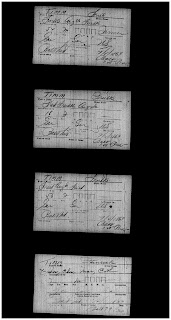
Thanks to ship arrival index cards found on NARA microfilm, I was able to learn the following:

1.  A ship arrived in Baltimore on 1 October 1833 carrying 36 year old farmer Heinrich Timm, 27 year old woman Christine Timm, 7 year old boy Friedrich Timm, 5 year old girl Margaret Timm, and 2 year old Catherine Timm, all of Germany.

2.  A ship arrived in Baltimore on New Year's Day 1836 carrying a dyer named Joseph Temme of Germany.

3.  The ship Ernestine arrived in New Orleans on 4 Jun 1850, carrying 18 year old woman Louise Temme, all of Germany. 

4.  The ship Diana arrived in New Orleans on 8 Nov 1851.  On it were a number of Temme family members from Germany:  42 year old man F. Temme, 30 year old farmer A. Temme, 17 year old boy A. Temme, 15 year old boy E. Temme, 12 year old boy C. Temme, 8 year old boy L. Temme, 6 year old boy F. Temme.

5.  A ship arrived in Baltimore on 2 July 1869, carrying 56 year old woman Friedke Timm, 52 year old farmer Friedrich Timm, 26 year old woman named Arigote (sp?) Timm, and 18 year old woman Friedke Timm.

Cards attached below:


Other Timms found in Maine Directories, which may or may not be related to Marcus:

-Neils Timm, farmer/laborer:  Portland Directories (1895, 1896, 1898).  Lived on 24 Summit Street and worked at 13 Spring Street.  I wonder if this was a cousin of Katie's?  Maybe he was one of  Marcus' little brothers?

-Fritz "Fred" Timm, shoemaker, born in Germany Sep 1852 (migrated 1873, much later than Marcus), naturalized 1884:   Belfast/Camden/Rockland Directories (1875, 1877, 1899), lived on Mechanic Street in Rockland and Pleasant Street and Bridge Street, both in Belfast.  If there's any relation, then he'd be Marcus' nephew.

-Vernon Timm, millworker at S.D. Warren:  Portland Directories (1950-1964).  Lived on Pine Street in Portland with his wife Mary.

-H. Alan Timm, Executive VP of First National Granite Bank of Augusta (1962 Augusta Directory).  Lived on Manchester Street in Augusta with his wife Barbara.

-Frederick N. Timm, assistant manager, Personal Finance Co. (1948 Dover, NH Directory) lived on Barrington Street in Dover with his wife Marjorie.

-Christian Christoph Temme of Missouri was born around the right time to be a younger brother, and was a politician after the Civil War.

Wednesday, August 29, 2012

The Morrills of Portland, Maine

There were over a dozen different historical families bearing the name Morrill in Portland Maine during 19th Century Portland.  Some of these families appear to be of immediate relation, at current estimation.  In fact, it is believed that generally all New England Morrills can trace their heritage to either of these two early settlers, who are unrelated to each other:

-John Morrell of Kittery, Maine (1640-1723), a Quaker and a plasterer of unknown parentage, probably English (though some believe he may have been Irish), who was an early citizen of Kittery, which had only settled from the Abenaki Indians in 1623.  In 1693, John was the first settler of North Berwick, which was annexed from Kittery under the name "Kittery Commons", and built his log cabin on Wells Street.  It is reported that John's young great granddaughter, Sarah Morrell, was killed and scalped by Indians within the limits of North Berwick village in 1748, when she was 12 years old, so peace wasn't achieved even a century after settlement.

-Abraham Morrill of Salisbury, Massachusetts (1595-1662) (originally from Essex, England).

The name was occasionally spelled "Morrell" in the States, which is the traditional English spelling.  The use of that spelling in the USA appears to be arbitrary, upon examination of all vital records, censuses, and city directories involving the below families.

This blog post will seek to identify most of the old families, including the Morrills who were the namesake of Morrill's Corner in Deering, where only a couple of the different Morrill families lived during the 19th Century.  The Morrill House on 1229 Forest Avenue, which was north of an Amoco service station (now a Subway sandwich shop) in the heart of Morrill's Corner, appears to have been a prominent house during its heyday, but I'm not sure which Morrill owned it, and when.  I believe it could have been owned by Levi Morrill (son to Stephen, brother to Bruce).  It was razed around 1933.  More on this below.  Another Morrill House just south of the corner, at 1163 Forest Avenue, owned by Rufus Morrill, Jr. (where the Meineke now is), is also a subject of study below.

This list cannot be deemed exhaustive, so any Morrill researcher wishing to assist with this is more than welcome to email me.

The first six families listed below represent the only families I have found to have arrived in the Portland area by 1840, most of which have an established link to the historical Morrell family of Berwick, Maine, which traces its roots to John Morrell:

1.  Jonathan Smythe Morrill (1804-1881).  Jonathan, my third great grandfather, was a carpenter born in Tuftonboro, New Hampshire to Jotham Morrill (born 1768 in Berwick Maine) and Catie Brown.  Jotham is my current 'brick wall', as I cannot seem to find his parentage so that I can link him to either John or Abraham, but I suspect it's John, given his birth occurring in Berwick.

Shortly after Jonathan's marriage in Tuftonboro to his new wife, Sally Elliot, they moved to the Deering district of Westbrook Maine by 1830 (later this area was later officially named the Town of Deering, and soon thereafter annexed to Portland).  As early as 1840, they lived on 62 Washington Street, in Portland's East Bayside district.

An entire blog post is dedicated to this family here, but his five children which survived to adulthood were:  Sarah Jane Morrill-Andros-Morse (1828 – ), Statira G. Morrill-Tucker-Carey (1831 – 1862), John Henry Brown Morrill (1834 – 1894), Martha W. Morrill-Curtis, and Emily N. Morrill-Morgan-Hall (1844 – 1900), who was my 2nd great grandmother.

His five adult children bore him 21 grandchildren, and at least 47 great grandchildren, all of whom are deceased at this writing (2012).  A great many of the descendants of these great grandchildren reside in the Portland area today.  Jonathan's family is the largest of the Morrill families of Portland.  But he wasn't the first Morrill to arrive in Portland...


EMILY N. MORRILL-MORGAN-HALL
(ca 1890)
The youngest child of Jonathan Smythe Morrill

2.  Stephen Morrell (1737-1816) was from Berwick, and was brother to Attorney Peter Morrell (mentioned at #3 below), and first cousin to Josiah (mentioned at #4 below).  Stephen and his wife, Elizabeth Winslow, married in Falmouth in 1767, and settled in the Stevens Plains area at some point thereafter, the area which later became known as Deering, and Morrill's Corner being named as an area thereof.  Stephen was the first Morrill to settle in this area, and arrived prior to any other Morrill  in Portland.  Sometime before 1809, according to City tax records, his house was built on Forest Avenue, an eighth mile south of Morrill's Corner, and about a half mile north of the Morrill family tannery which would eventually be built just north of Grove Street.  The house had an initial address of 493 Forest Avenue, until 1899.  After Deering was annexed by Portland in 1898, Forest Avenue was eventually renumbered, and the Morrill House was then known as 1163 Forest Avenue, starting in 1900.  It was a two family house owned and lived in by his son Rufus, Rufus' son, Rufus Jr., and Rufus Jr.'s daughter, Sarah Sawyer Morrill (who was the last Morrill to live in this house, just before it was razed in 1941, and the last Morrill to live in Morrill's Corner).


RUFUS MORRILL HOUSE
1163 FOREST AVENUE
MORRILL'S CORNER
(1924)
Some children playing and waving might be grandchildren of Rufus Jr.

MEINEKE MUFFLER
(2010)
CURRENT USE OF LOT OF FORMER
RUFUS MORRILL HOUSE
Stephen and his two wives had thirteen children, but two (Rufus and Levi) were most instrumental in the development of Morrill's Corner, and a grandson (Charles Sumner Morrill) was instrumental in fathering the Burnham & Morrill empire:

-Rufus Morrill, Sr. (1796-1860), a sheep skin tanner, married both Webb sisters (Mary and Sally), and had nine children in Westbrook, most likely in the house above, which was situated next to a toothpick factory for quite some time.  Rufus Jr. (1834-1911), a nurse, who was second to youngest, had three children in Westbrook. Rufus Jr. was a railroad engineer , and he kept the house until his death, where lived with his sister Susan and his daughter Sarah (both spinsters).  Sarah owned it for many years after Rufus' death (Rufus' Sr. son Edmund had moved to Ellsworth, NH, and his eldest daughter Mary had died in China in 1900 - Edmund later became the Governor of Kansas).  Sarah rented the 2nd apartment to a variety of tenants (George A. Thombs, James Sneddon, Albert T. Stults, Truman E. Estabrook) during Sarah's final years there.  Around 1938, Sarah ended up at an elderly care private hospital on 554 Stevens Avenue (owned by Mae Ward) and Sarah's tenant, Truman Estabrook, stayed with the house until it was razed in 1941, in favor of an automotive shop.  The hospital Sarah stayed at also served as the quarters for the sexton of Evergreen Cemetery.  Sarah died there in the 1940s. Below is an article concerning Governor Edmund Morrill of Kansas and his visit home to Portland, and this article provides quite a bit of information about the Morrills Corner of the turn of the century.

ANNOUNCEMENT ABOUT GOVERNOR MORRILL'S VISIT TO PORTLAND
KANSAS CITY JOURNAL
AUGUST 29, 1895

-Levi Morrill (1802-1868) was a manufacturer.  He and his wife Harriet Quimby had two children. According to the above, he built the red brick mansion which was then occupied by Keeley Cure hospital (which might be where the Amoco station was-see photo at bottom).  Levi tanned hides, while his brother Rufus tanned sheep skins.  Levi's son, Charles Edwin Morrill (1841-1891), fought in the Civil War.  By 1871, Charles was in charge of the tannery (located a half mile south of Rufus' house), which was then called the "C.E. Morrill Tannery", located on Forest Avenue - just north of Grove Street.  According to Morrill Online, in 1871 and 1874 he patented methods of manufacturing shoe bindings (patent no. 121,400 and 134,763), and with Charles Hardy, he patented a method of evening leather in 1874 (patent no. 147770).  This tannery could well have been previously run by his father Levi, uncle Rufus, and grandfather Stephen, prior to that.  Charles Edwin Morrill's son, Levi Morrill, carried on the family business to some extent.  He moved to Boston and worked as a leather merchant.  Levi married Anna Hill Lee of DC in April of 1904.  Two weeks after the wedding, during their honeymoon in Atlantic City, Levi suffered from morphine poisoning and died in his room at the St. Charles Hotel.

CORNER OF FOREST AVENUE
AND GROVE STREET
(2009)
FORMER SITE OF MORRILL TANNERY

-A third child of Stephen's, one Asa Morrill, was father to Charles S. Morrill (1811-1849).  Charles was a lumber dealer who lived on 37 Sumner Street.  He was in Portland as early as 1833 (according to his marriage record).  He and his wife Charlotte Vose had six children:  Mary, Charles (more on him below), Charlotte M., George A., Walter H., and Hattie Morrill-Stewart (who was born just seven months after Charles' death).  Charlotte and her family relocated to Boston in 1873, but Charles Jr. (1933-1901) stayed behind in Portland, becoming a famous merchant, and carrying on his father's business affairs.  He lived at 307 Brackett Street in the West End with his wife Calista.

CALISTA MORRILL ON VANDA THE HORSE

Charles' son, Charles Sumner Morrill, was a founding member of Burnham & Morrill Company, which owned, among other things, the famous B&M Baked Beans plant in Portland.  The Company was started by George Burnham, Jr., in 1867, and later joined in ownership by his brother John E. Burnham, and Charles Sumner Morrill.  Their first location was 61 1/2 Commercial Street, on Burnham Wharf, one of many new businesses launched in the wake of the Great Fire.

1871 PORTLAND DIRECTORY


George Burnham brought his meat and fish packing experience from his days with Rumery & Burnham (a packing company he helped establish earlier), and Morrill brought his corn canning experience from his work at Richardson & Robbins in the mid-1850's. Morrill had been one of Burnham's foremen at Rumery and Burnham in the late 1850's, and that's where the relationship began.

The above history was mostly provided by the B&M business website.  However, the 1847 City directory shows Charles S. Morrill living at 37 Sumner Street (does the "S" stand for Sumner?), with occupation as a lumber dealer at Burnham & Morrill on Burnham Wharf, so the connection likely goes back a bit further than the 1850s...

1847 PORTLAND DIRECTORY

Women at the Burnham & Morrill plant
fill cans with fish flakes.
(1934)
Courtesy of Maine Historical Society


B&M PLANT

Charles's son, George Burnham Morrill (1836-1934) was named after Charles' business partner (and had inherited his father's interest upon his death in 1901), bought out the remainder of the business in 1910, when he then moved the business from 13 Franklin Street to its current site on Casco Bay (pictured above).  George lived briefly at 47 Chadwick Street and 22 Carleton Street, but upon his inheritance, moved to the palatial eight bedroom mansion at 150 Vaughan Street in the West End with his wife Margaret P. Elwell (1873-1939), children Catherine, Charles Sumner II (named after his grandfather) and George, Jr., and many servants and in-laws.  Margaret was a published author.  In 1930 she wrote a book entitled "The Love That Abideth", which was a tribute to her children, and especially her daughter Catherine, who had died at age 21 of a heart condition.

More about the B&M history can be read here.

GEORGE MORRILL HOUSE
150 VAUGHAN STREET

3. Peter Winslow Morrell (1797-1881) was born in Berwick, Maine, to Attorney Peter Morrell (brother to Stephen above) and Amanda Winslow of Berwick.  For the 1830 census, Peter and his wife Ruth were living in Westbrook (same time period as Jonathan's move).  In 1840 they moved to Portland and lived at 26 Pearl Street, where they had two children:  Mary and Edwin.  Peter worked as a farmer and a tanner, and Edwin (who married Amanda Houston) worked as a grocer.  Peter was the only one of his dozen siblings to move to Portland.  The rest all stayed in Berwick, or moved to Dover, NH.  But as indicated in this blog, it appears that he followed his uncle Stephen and his cousin Aaron to Portland.

Below is a tree outline of this historic family (click to enlarge), and the elder Peter Morrill was grandson to John Morrell of Kittery:


I created the above to give you an idea of the Morrill migration from Berwick to the Morrill's Corner area, and it omits many people.  This is subject to further update, of course, should I discover the need for it.  But as for this writing (September 2012), it gives a relatively accurate picture of the history of this family, for which Morrill's Corner is named.

An interesting side note to all this is that Jonathan Smythe Morrill's family (mentioned above) was from Tuftonboro and Moultonboro, NH.  A William Morrill of Moultonboro had originally come from Berwick, Maine and descends from John Morrell.  William's age is close to that of Jonathan's father, Jotham, of Moultonboro.  So I feel there is a possibility that Jotham and William were brothers.  To add fuel to this theory, Peter W. Morrell appears in the Westbrook, Maine 1830 Census, the same census which shows Jonathan Morrill, having recently moved from Tuftonboro, NH.  If Peter and Jonathan were cousins, it's possible they planned their move to Westbrook together in the 1820s, just after they both had begun their families.

4.  Aaron Morrill (1780-1833) was born in Berwick, Maine to blacksmith Josiah Morrill (who was uncle to Stephen above).  By 1820, he had moved his wife Jennie and sons Josiah and Luke to Falmouth proper (which at that time had already excised the City of Portland).  Aaron's siblings and parents all moved to Litchfield in 1824.  Luke's son, Carroll W. Morrill (1853-1940), relocated to Portland and was an attorney, bail commissioner, and city solicitor, who lived on 818 Congress Street.  Aaron's grandson was Edwin Morrill (1828-1909) who also lived in Portland.  He married Amanda Houston in 1854, and had two children, Alice and Mary.  They divorced in 1876.  Edwin appears in the 1900 Census at the Veterans Home in Chelsea, Maine.  This Edwin worked as a wagoner, and he's easily confused with his 2nd cousin Edwin born around the same time, who was son to Peter Winslow Morrill above. 

5.  John Morrill Jr. (abt 1780 - ) appears only in the 1830 Census of Portland, but with a household of 23 people.  I cannot seem to match this apparently wealthy early settler with other records yet.  It's quite possible that John was some relation to the North Berwick Morrills, given the rich heritage of this family.

6.  Nathaniel Morrill appears in the 1820 Census, with a family of seven.  A Nathaniel Morrill also appears in the 1847 City directory on 74 Sumner Street, with occupation listed as "truckman".  Since he lived a few doors down from Charles Sumner Morrill, I'm inclined to believe there may have been a relation here as well.

The following are Morrill families which had arrived in Portland after 1840, some of which appear to also descend from John Morrell of Kittery and later North Berwick.

7.  Edward J. Morrill (1846- ) and his wife Ella had two children, Edward and Elfreda.  They lived on Lincoln Street and Edward worked as a post office clerk.  His parents were from New Brunswick, and he was born in Washington County, Maine.  This family only arrived in Portland around 1869, and didn't stay long past 1900, since everyone appears to have moved to Los Angeles.

8.  Paschal Morrell (1827-1873), son to a Francis James Morrill of Livermore (and great grandson to Stephen Morrill listed above), was a cabinet maker and tailor.  He and his wife Nancy Ballow moved to 103 Oxford Street in Portland just after having their daughter, Ada in Massachusetts in 1855.  In 1858, the family lived at 30 Gray Street.  By 1870, they had moved to Monticello, Minnesota, where Paschal started a farm.  The only record I have of them being in Maine is the 1860 Census, and a few city directories.

9.  Moses Morrill (1799- ) and his wife Margaret.  No further information. It's difficult to differentiate between this Moses and the ones below, but I believe he lived at 95 State Street, and worked as a trader.  He had one daughter, Harriet.  No descendants remained in Portland.

10.  Lot Myrick Morrill (1813 - 1883) also descends from John Morrell, founder of North Berwick.  Lot was great grandson to Peter Morrell (born 1709).  He was Governor of Maine, 1858-1861; United States Senator from Maine, 1861-1869; member of the Peace Convention in Washington, D. C., 1861; again United States Senator from Maine, 1869-1876; Secretary of the Treasury under President Grant, 1876-1877; Collector of Customs in Portland, Maine, 1877-1883; and brother of politician Anson P. Morrill.  He lived most of his life in Augusta, but he had a home on 73 Deering Avenue, and lived there quite often through the 1870s and 1880s while working as the main collector of customs at the Customs House on Fore Street.  It doesn't appear that any other Morrills from his immediate family lived in Portland.

LOT MORRILL

11.  F.J. Morrill (   ) ran the Portland arm of a business, originally started by a doctor in Skowhegan, called "Conant Vapor Baths" in 1899 on 162 Brackett Street.  I cannot yet determine who this is.

12.  Frank H. Morrill (1849-1911) was born in Lewiston to Franklin & Miranda Morrill of Falmouth Portland.  He attended Bates College, then moved to Portland in 1872, and started up a business with Charles Ross called "Morrill and Ross Grocers" on 671 Congress Street.  He lived on 25 Tate Street, 25 Crescent Street, and 377 Cumberland Avenue.  He and his wife, Mary Roberts, had two daughters, Anna and Alice.

13.  Levi N. Morrill (1803- ) married Phebe Kennard in Portland in 1846.  He worked as a joiner, and lived most of his life in the West End, at 75 Brackett Street, also at the corner of Winter and Spring Streets.  They lived the remainder of their lives at 24 Spruce Street.  He and Phebe had no children.  Phebe worked as a tailoress.  I'm not certain if Levi was born in Portland or who his father was.  This Levi is easily confused with Levi, born 1802, who was descendant of the Berwick Morrills.

14.  Moses C. Morrill (1827- ) was a house carpenter.  He and his wife Elizabeth lived on Spring Street, and had a servant in 1880.  No further information.

15.  Sadie Strout-Morrill (1864-1944) of Raymond Maine married Linwood Morrill of Buckfield Maine (whose parents were from Turner but they also descend from John Morrell of North Berwick).  Upon Linwood's death in 1912, Sadie moved to Grant Street in Portland with two of her children, Ruth Morrill-Lavigne and Emma W. Morrill-McCabe, both of whom stayed in Portland with their families, while Sadie removed to Poland Maine in her later years.

The below Portland Morrill families descend from Abraham Morrill of Broad Oak, Essex, England, who was an early settler of Salisbury, Massachusetts in 1640, formerly owned by the Pennacook Indians.  There are many Morrills in Salisbury, and most of them are likely descended from Abraham, who doesn't appear to be any relation to John Morrell of North Berwick.

16.  Moses Morrill (1823-1905) was born in Limerick, Maine (no relation to the above Moses).  His father was Colonel John Adams Morrill, whose ancestors came from Salisbury Massachusetts.   Moses moved to Portland in 1840 and married Miriam Harmon, and had four children:  Mary, Arthur (who founded the New Haven Normal State Training School, and got an honorary degree from Yale), Charles and Grace.  From 1877-1888 he was apparently working in 'aerated oxygen treatment', and also as a confectioner (probably at Brown Company Sugar Mill), according to Portland City Directories. He was the only one of his family that had left Limerick for Portland.  He lived at 778 Congress, where he died in 1905.  The only grandchild of Moses was Miriam Gertrude Morrill-Colby, who settled in Berkeley, California, having only one child, Thomas Colby.  No descendants remained in Portland.

17.  Jedediah Nathaniel Morrill (1805-1895) was born in Strafford, Vermont to Stephen Morrill and Betsey Bliss.  Jedediah worked as a bookkeeper and merchant, and was the only one in his family to make the move to Portland.  He married Abbie Whitmore in Portland in 1834, where they had four children and lived on 12 Park Street and later at 78 Danforth.  His advertisement in 1858 City Directory reads:

"J.N. Morrill will attend to weighing and gouging at short notice
- 117 Commercial Street." 

The entire family moved to Boston and New Jersey somewhere between 1864-1868.  No descendants remained in Portland.

18.  Enoch Osgood Morrill (1832-1892) was born in Salisbury, Massachusetts, and migrated as a young man to Portland.  He worked as a trader and grocery retailer who lived and worked on St. Lawrence Street.  He and his wife Eliza, and children Edward and Fred moved to North Yarmouth around 1868.  Edward and his wife Fannie moved to Portland but never had children.  Fred stayed behind in North Yarmouth and tended the family farm.

Other Morrills in Portland during the 19th Century, unknown ancestry.

19.  William B. Morrill (1852-abt 1906) was a dentist from Woodfords, but was born in Illinois.  He married his wife, Julia Chenery, in 1882, and had one son, Frank O. Morrill, who worked for Standard Oil Company.  Dr. Morrill's business was located at 499 1/2 Congress Street, from 1880 to 1897.  By 1900, he had moved his practice to 5 Perkins Street, then later to 66 Kenilworth Street, where the business folded in 1906 and Dr. Morrill died.  His wife and son moved to Seattle shortly after his death, and then this family later relocated to Beverly Hills, CA.

ADVERTISEMENT
PORTLAND FLORAL MONTHLY
JULY 1880
20.  William E. Morrill (1878-1907) was born in Portland to a laborer named Charles F. Morrill and Lucy Anne Berry, from Farmington and Gray, ME, respectively.  He worked as a brakeman on the railroad, and was in an accident at work.  He died from shock resulting from the accident.

21.  Ferdinand "Ferdo" Archie Morrill Sr. (1879-1935), son to Francis "Frank" Asbury Morrill (1844-1906) of New Sharon, Maine and Somerville Mass.  Ferdo was born in Somerville, and moved to Scarborough Maine with his sister Mabel and mother Rose.  Mabel remained in Scarborough, and Ferdo moved to Franklin Street in Portland as early as 1920, later moving to Oxford Street, and worked as a baker.  Ferdo had five children in Portland:  John Alvin Morrill (who worked as a packer and also as a cab driver), Ferdo, Jr. (who fought in the Army in WWII and lived in Bangor for a while), Edna (who never married, but ran the family house on Oxford Street after her parents died, Charles (who died in France during WWII), and Francis Asbury (named after his grandfather), who worked as a chauffer and also fought in the Army during WWII.  Ferdo's great grandfather was Joseph G. Morrill Sr. of New Sharon, Maine, born around 1790, and that's as far back as I can trace to date.  I've been told in 2016 by a descendant of Ferdo that they are linked to John Morrell of Kittery.

***


"MORRILL HOUSE"
BEHIND AMOCO STATION
MORRILL'S CORNER
1229 FOREST AVENUE / 6 ALLEN AVENUE
(Became a lodging house up until 1932)

(PHOTO COURTESY MAINE HISTORICAL SOCIETY)

SERVICE STATION IN 1924
(MORRILL HOUSE NEXT DOOR)

(PHOTO COURTESY MAINE HISTORICAL SOCIETY)

The large colonial brick house above was also known as the "Morrill House".  In its later years it was a rooming house run by George and Loretta Beach.  It was closed for business in 1932, and it was razed sometime shortly thereafter.  I don't know which Morrills lived here, though, or when.  It might have been the family of Levi Morrill, son to Stephen and brother to Rufus.

In 1900, another business started up on The Corner.  It was called "Morrill's Coal & Grain Company" on 35 Allen Avenue.  The business ran until at least 1940.  This business was not owned by anyone in the Morrill family, however.

ADVERTISEMENT
1940 CITY DIRECTORY

Many of the Portland Morrills are buried at Pine Grove Cemetery.

Sources:

Morrill Kindred in America by Annie Morrill Smith published 1931, The Grafton Press

Deering:  A Social and Architectural History by William David Barry and Patricia McGraw Anderson, published 2010 by Greater Portland Landmarks, Inc.

FindAGrave

US Federal Censuses

Maine Vital Records

Thursday, July 26, 2012

The Devines of Portland Maine

There were many Devine (Duibhin) families living in the Portland Maine area during the 19th and 20th centuries, and are all buried at Calvary Cemetery in South Portland.  This post will attempt to assemble them in some manner, for the purpose of sharing research with my Devine cousins.  Each family is listed separately below, and I have yet to find a proven link between any of them, but at the bottom of the page I'll attempt a few guesses.

The first seven families come from County Tyrone, Northern Ireland, as apparently do #10 and #14...

1.  James Devine (1828-1864) was born in County Tyrone to Bernard Devine (1784-1864) and his wife Margaret (Bernard is called "Bernard the Elder" here).  James arrived in 1847, married Ellen Norris, and had four children:  Catherine, Edward, Margaret and John.  John married my great grand aunt Elizabeth Leonard, daughter to Mathew Leonard of the Burrow of Portraine, County Dublin.  James died rather young, of consumption. His brother, Bernard Devine, Jr., married Susanna McGlinchey, of County Derry - part of the Portland McGlinchey clan that had a flourishing illegal liquor trade in Portland headed up by her own brother James.

2.  Hugh P. Devine (1842-1912) was born in County Tyrone, according to trees on Ancestry.  His parents were John Devine & Nancy Ward.  Hugh worked as a plasterer, and married Mary A. Feeney of Ireland (1849-1922), and had seven children:  John, Mary (who died at age 20 of liver cancer), William (who moved to Augusta), Margaret, George (who moved to Newcastle), Catherine and Francis (who moved to Cohasset, MA).  They lived on 92 Sheridan Street, in Portland's Munjoy Hill district.  This family is also buried at Calvary Cemetery, South Portland, although several of them had settled in Massachusetts.


3.  Bernard Devine (1847-1914) was born in County Tyrone (according to his naturalization record) to tenant farmer Patrick Devine and his wife Bridget Hegarty.  He emigrated to Portland in June of 1867 and worked as a merchant and a teamster.  I have to believe that he's some relation to James above, whose father and brother were also named Bernard.  Upon arrival, he stayed with the O'Connor family, and soon married Bridget Maney, and lived at 280 State Street, near St. Dominic's.  They had five children.  Only their youngest child, John James Devine (1886-1954), married.  John fought in WWI, and he later moved to South Portland with his wife Eulalia.  They had four sons, and at least eight grandchildren.  Several descendants remain in the Greater Portland area.

4.  Cornelius Devine (1827-1881) was born in County Tyrone (according to his naturalization record) and arrived in Portland in April of 1847.  He worked was a stonemason and lived on 3 Bond Street in Portland.  He and his wife Mary had seven children.  He fought in the Civil War, Company G, Cavalry.  For the 1870 Census, Mary and one of their children James were living in the City Alms House.  This particular family is hard to track, so I don't know if there were any descendants past the seven kids.  In 1865, Cornelius sold a house lot on Salem Lane in the West End to my great uncle, Thomas D. Leonard.  Now, Thomas' niece, Elizabeth Leonard had married James Devine (#1 above) about 20 years prior to this land sale.  I wonder if there was an established and known connection between these two Devines from Tyrone?

5.  Joseph Devine (1870-1950) arrived in Maine in 1889.  He worked as a bricklayer, and was the son of James Devine and Mary Glass of Ballinamallaght, County Tyrone Ireland.  According to some records, he came to Portland with siblings Catherine (who married a Patrick Devine - see #10 below) and John.  He married Bridget Slane in 1892, and had five children (John F., Joseph M., James Edward, Mary C., and young Margaret who died at age 3). None of them had any children to my knowledge, but there is an infant Mary A. Devine buried here, who died in 1998.  I wonder what her connection was.  John died in 1921 while serving in the Navy on the ship Hewitt.  Below is an article in the Portland paper which had declared him missing for five weeks (and reported dead soon thereafter).


GRAVE OF JOSEPH DEVINE AND FAMILY
CALVARY CEMETERY
SOUTH PORTLAND, ME

6.  George Devine (1834-1863) was born in County Tyrone.  He migrated to Portland in April of  1851, and then married Mary Ann McFarland in 1857.  He worked as a marble polisher and stone cutter.  George fought in the Civil War (Co. G, 5th Maine Infantry), and was wounded and captured at the Battle of the Wilderness in May 1864.  He died of dysentery in a POW camp in Georgia (a common affliction).  George and Mary Ann had two sons, James and Peter, just before George died at the young age of 29.  Only James married (according to his death record), not sure if he had kids.  Mary was present on the 1880 census living next door to Joseph Devine (#5 above).  I wonder if there was a known relation.  George is one of almost 13,000 individuals buried at the Andersonville National Cemetery in Georgia, and I believe the gravesite featured below memorializes him, but also contains the grave for Mary Ann. 

GRAVE OF GEORGE AND MARY ANN MCFARLAND
CALVARY CEMETERY
SOUTH PORTLAND, ME


7.  Michael J. Devine (1868-1908) was born in County Tyrone, son to Henry Devine.  He married Margaret Honan, and had one daughter, Bernadette, who died young.  It appears that Margaret may have had an additional child named Florence, prior to her marriage with Michael (see grave below).  No descendants remain.


8.  Patrick Devine (abt 1814-??) was born in Ireland and married a Catherine (1816-1875).  They had a son named James, who died at age 15 in Boston of pneumonia.  They lived on 12 Larch Street in Portland.  Catherine and young James are buried with James above (not sure of the relation, though).  Not sure what ever happened to Patrick.  No descendants.

9.  Coleman E. Devine (1870-1920) was born in County Galway to Martin Devine and Bridget Foley.  He emigrated to Portland in 1888.  He and his wife Bridget Joyce (who was from Northern Ireland) lived on 24 Sheridan Street and had at least ten children (several of them babies which died).  Coleman's brothers Brian and Martin Jr. emigrated to Portland in 1891.  This family lived briefly in Bangor (1910 Census).  Of the ten children of Coleman, only Helen Devine-Mitchell married and she had five children in Westwood, MA.

10.  Patrick Devine (1858-1932) was born in Ireland, arrived in Portland in 1883, and married Ellen Catherine Devine from Ballinamallaght Northern Ireland (daughter to James Devine and Mary Glass, and elder sister to Joseph Devine referenced above in #5, according to statements made by David Cronk on this thread in Genealogy.com).  Patrick and Catherine lived at 231 Danforth Street and had six children.  Patrick worked as an engine cleaner on the railroad.  When he died, Catherine and the children lived on Vesper Street, and later moved the family homestead to North Street.  Three of his six children married, and bore Patrick grandchildren, some of whom survived to adulthood, in addition to four children who died as infants, buried with Patrick's family.  Now, Patrick's gravesite is very close to Joseph's gravesite.  I haven't established a relationship, but they could be brothers.  If so, Patrick would also be from County Tyrone.  I have no idea who Mary A was (1895-1998), who is listed at the bottom of the gravestone below.  I can't find anyone in the family records who lived to be 103.  If she were a sibling to John, James and Joseph, why wouldn't she be in other records, and why wouldn't she be listed in birth order with the rest of them?


11.  George F. Devine was born in 1870 in Canada to Scottish parents.  He arrived in Portland in 1897.  He and his wife Alice had five children and lived on 469 Washington Avenue.

12.  Stephen Devine (1876-1898) was born in Ireland to tenant farmer Michael Devine and his wife Catherine Foley.  Stephen emigrated to Portland as a young adult, and worked as a longshoreman, but died of typhoid fever at age 22.  He is buried in Calvary Cemetery with an Ellen and a Frank, both of which were born around the same time as he, so they could be siblings.

13.  Stephen Devine (abt 1850-?) married a Sarah, and had two sons named Stephen, each of whom died as babies.  They also had a Sarah.  Not sure of this family's connection or origins.

14.  Richard Devine (1887-1972) was a bookkeeper from Stroanbrack, County Tyrone.  He was one of eleven children born to Bernard "Barney" Devine of Stroanbrack.  He left Ireland for the USA to find a better life, like so many others, and arrived in Portland in 1910, where he went to work for the Burrows Corp at 70 Free Street, where he worked until he went in the US Army in 1918, not long after his first wife Annie had passed from Spanish Flu.  They had wed in 1912, she having been a neighbor back in Ireland, born to Felix Devine of Ballinamallaght (close to Stroanbrack, but no known close relation).  In 1920, Richard remarried to Rose DeCoste, and had two daughters, Helen and Ruth.  He continued working at Burrows Corp as a foreman, after his discharge from the Army.

RICHARD DEVINE

As for the first seven families:  James (#1 above), Cornelius (#4 above), George (#6 above), Hugh (#2 above)'s father John, Michael (#7 above)'s father Henry, Joseph (#5 above)'s father James, and Bernard (#3 above)'s father Patrick I believe could all be brothers from County Tyrone, and that Bernard the Elder is father to all of them.  They all have proven links to County Tyrone, based on their naturalization records.  I also wonder about #14 having a father also named Bernard from Tyrone.  He may be linked to Bernard the Elder as well.  #8, #10, and #12 were all born in "Ireland" prior to 1922 when N. Ireland was separated, so they could also be connected to these families, and such proof could be obtained by digging through more Naturalization records.

One thing I find intriguing is the very low birth rate of these families.  It appears that only 20% of all of the descendants of the above discussed Devines ever married.

Sunday, July 22, 2012

The Jamesons of Maine

My seventh great grandfather was William Jameson (1675-1734), a Scotch-Irishman, who arrived in Boston Harbor on 4 August 1718, coming in from Antrim, Ulster, Northern Ireland with his wife and many other Presbyterian pilgrims.  According to Jameson historian Scott Jameson, from Boston Harbor they first settled in Nutfield Plantation, which is now Londonderry, NH.

William Jameson and his sons were founding fathers of Falmouth, Cape Elizabeth, Friendship, Thomaston, Warren, and Rockland, Maine. His grandsons fought in the Revolutionary War.

Many Scotch-Irish (all Presbyterians) had traveled to America at the behest of Samuel Shute, Governor of New Hampshire and Massachusetts.  There is a memorial to Governor Shute, dated March 26, 1718, whereby over three hundred Scotch-Irish had signed their names, "to assure the Governor of their sincere and hearty inclination to transport themselves to that very excellent and renowned plantation, upon their receiving from his excellency suitable encouragement."  Among the signers of this memorial were our ancestors, William Jameson and his brother John.

William Jr. and John had sailed from Northern Ireland, and were sons of William Jameson, a Scottish Presbyterian Covenantor who had fled with his sons from his home in Argyleshire, Scotland in 1685, upon succession of James II, who was anti-Covenant, to the English Crown.  William and his family had resettled in Omagh, County Tyrone.  But not for long, since they were part of a mass Scotch-Irish migration 33 years later.

JAMESON MIGRATION
LOWLAND SCOTS TO ULSTER NORTHERN IRELAND
COVENANTER PERSECUTION
1685

While William Jr's brother John had settled in Connecticut, William moved north to Maine, in a region known as Purpoodock Point.  This area was later settled as part of the very large town of Falmouth, and William was a founding citizen.  He lived there until his death in 1734.  Some of his children were born there as well, and their area became later known as the town of Cape Elizabeth when it separated from Falmouth in 1765.

William Jr's eldest son, Martin, was an early settler of Saco, Maine, and stayed there until the end of his life, but his three sons, Samuel, Paul, and Alexander eventually moved north and settled the town of Friendship (which was formerly known as Meduncook Plantation).  Their children were early settlers of Thomaston and Rockland.

An important historical book entitled "The Jamesons in America, 1647-1900", published around 1900, traces all their history from arrival in 1718 through to 1900, with a separate chapter entitled "Jamesons in Maine".  I've noticed some discrepancies in this publication when compared to official records, as is always the case with published genealogies.  But largely, it is a reliable and informative history of this large family, and is the source file for much of this writing.

Many of the Jameson family in Maine lived by the ocean in Rockland, in an area now known as “Jameson Point”.


ROCKLAND BREAKWATER LIGHT
JAMESON POINT

William had eight children, including daughters Mary, Martha, and Patience.

A brief account of his other five children follows:

1.  Martin Jameson (1705-1760) was born in Ulster, Northern Ireland, and came over as a boy with his parents and brother Samuel to Maine.  He fought with his father in active service against the Indians on the "Muster-roll of Capt. John Gray and Company, from June 1st to Nov. 30th, 1725".  He married Grizzel Patterson of Saco about 1738.  At the time of his death, he was the eighth highest payer of taxes in Saco, and his estate was valued at ₤233 (well over $10K in 2010 money).  Their son Robert Jameson founded a large family of Jamesons in Saco, which until 1805 was named Pepperrellborough.  Robert's grandson, Charles Thorndyke Jameson, settled in the Prides Corner of Westbrook, Maine, just below Highland Lake, and has his own family cemetery on Bridgton Road, behind the firehouse, which was the location of the Webb-Jameson farm for many decades.

Tote Road
Off Bridgton Road, Westbrook, ME
Jameson Cemetery is located toward the end
(I was unable to locate)
JAMESON CEMETERY
WESTBROOK, MAINE
COURTESY OF WESTBROOK HISTORICAL SOCIETY


Charles married two sisters, Bethana and Ruth Webb, and had five children with Ruth.

CHARLES THORNDYKE JAMESON
(1804-1877)

2.  Samuel Jameson (1709-1768) was also born in Ulster, Northern Ireland, and came over as a boy with his parents to Maine.  He first married Sarah Smith of Arundel, and had two children, Jane and William.  He then married Sarah McLellan (daughter to fellow Scotch-Irish settler Bryce McLellan) in Falmouth (now Portland), and settled with his big family (including the additional seven children from this marriage) in Friendship, Maine, where he was documented as the first permanent settler.  He also served in the French-Indian Wars, and was taken prisoner during these wars, along with his brother Alexander.  Samuel died soon after release from the prison, due to poor care while captive.  Samuel was also an early settler of the town of Warren, Maine, upon the Oster River.  Below is the transcript of Samuel's probate:


3.  Paul Jameson (1720-1795) was born in Falmouth, later known as Cape Elizabeth.  He fought in the Revolution, married Elizabeth Pebbles, and lived the majority of his life in Friendship, Maine, having followed his older brother.

4.  Margaret Jameson (1703-1760) was born in Northern Ireland, the first child of William.  She traveled to Falmouth Maine with her father as a teenager.  Margaret migrated to Scarborough and in 1717 married Robert McKenney, and had nine children.  Their daughter, Hannah, married Robert McLaughlin of the famous Scarborough McLaughlin clan.  Their daughter Rebecca married James Holmes and they became the first settlers of the town of Cornish Maine (then known as Francisboro).

5.  Alexander Jameson (1717-1800), my sixth great grandfather, was born in the part of Falmouth which was later known as Cape Elizabeth.  He fought in the Revolution, and married Mary McLellan, likely sister to Sarah (who married Samuel above).  Alexander followed his brothers Samuel and Paul to Friendship, Maine - where Samuel was first settler (formerly Meduncook Plantation), and lived on Emery Davis Farm.  Alexander's son, Robert Jameson (my fifth great grandfather), served on the Meduncook Committee of Safety in 1776, and so is credited with giving public service during the Revolutionary War (according to 1998 publication Supplement to Soldiers, Sailors and Patriots of the Revolutionary War in Maine by Major General Carleton Edward Fisher).  Robert left behind over 135 descendants when he died at age 86. One of them, his granddaughter Mary Ann Jameson, was mother to my 2nd great grandfather, Charles A. Murch.


Notes about Mary Ann Jameson and her husband James Murch:

-They married in St. George, Maine in 1841.

-They had five children within ten years.

-She was listed as a widow on the 1860 Census, and all subsequent Rockland directories.  James had appeared on the 1850 Census, but died a year later, in December of 1851.

-Mary Ann died of La Grippe in Rockland just before Christmas of 1892.

-For various available Rockland Directories (1875, 1877, 1882), she was a widow living at 13 Tea Street, across the road from Freeman Jameson (who lived at 16 Tea Street), who was her 2nd cousin. 

13 TEA STREET


16 TEA STREET

-For the 1889 Rockland Directory, Mary Ann had left the Tea Street house and was boarding at John McNamara’s on Old County Road.  I wonder what happened to her house?
 -Mary Ann's 1892 death record erroneously lists her father as "James Jameson"...


 -Mary Ann's father is listed as "John Jameson", however, in the 1900 volume The Jamesons in America, pp 263-264, her father is affirmed to have been John.


-The Rockland Cemetery Association, which manages Acorn, Tolman, Robins, and Seaview Cemeteries, told me they have burial records for only a "Nellie Murch" buried in the 1960's...no James or Mary Ann.  They also looked at Appleton and found a Grace Murch buried in 1913, and found a Jennie Murch buried in 1911 at Vinalhaven Island Cemeteries.  The search continues for the final resting place for these Murches.

It appears that in Thomaston, near now demolished Henry Knox Mansion, there was an old cemetery called "Old Fort Burying Ground", and that some Jamesons are buried there, including Martha Jameson-Porterfield, daughter to William above.  I wonder if this is a good place to look for these other family members?  I wonder if it's now the same cemetery as what is now known as Elm Grove Cemetery, since Henry Knox is buried there (and it was written he was buried near his home).