
A little known cemetery exists on Portland's Eastern Promenade. It is maintained with care by the City, but the average citizen of Portland has never even heard of it.
The above photo shows the mass grave of 21 American Prisoners of War from the War of 1812. It's likely that most of these soldiers have no living descendants or anyone who would visit the cemetery to pay familial respect, but this blog post would seek to remedy that, if it can indeed be done. 200 years is a long time to try and trace descendants of young men who died far from home.
Portland didn't directly participate in the War of 1812. In fact, New England (and especially Maine) was very much against the War, and almost enacted statewide secession proceedings because of the escalation to this war. The reason being, it interfered with our lucrative timber trade deals (both on record and behind the scenes). Portland privateering, however, did help to increase tensions with the British, ultimately escalating the conflict.
Of course Portland did serve a function during the War, as it always had, as a port of entry for ships going to other places for battle. The Falmouth timber export business was thriving at this time, and such timber was used for building a variety of ships, homes, and other structures, all over the eastern colonies, and in the former motherland in Britain.
But after the Revolution, our obligation to ship timber abroad had ceased, and the new nation could then focus its efforts on building the new Empire. However, the new United States still participated in timber trade with the English, but now as a financial endeavor. Several Portland businessmen, like the McLellan brothers, built quite a fortune on the backs of such trade, which dramatically ended when the Embargo Act was passed in 1807, forcing the McLellans and others to close business, sell their properties and default on debts. The embargo was a response to the British quelling our trade with the French, and a direct influence on the decision of going to war.
Despite the lack of battle seen by Portland during the War, one particular battle still resonates on Portland soil to this day. The Battle of Queenston Heights, which took place in Canada in October of 1812, was the first major skirmish between the U.S. and the British, and resulted in British victory. Many American POWs were captured and imprisoned in Quebec. Upon parole one month later, a group of these soldiers were to be exchanged in Boston, and were placed upon the ship HMS Regulus on November 19th. Several of the soldiers became very ill with malnutrition, dysentery and fever, likely caused by typhoid, so the ship took anchor in Portland harbor just before Christmas, under a truce flag, whereby the soldiers could receive care at the Town Hospital (then close to the Eastern Promenade) prior to the ship continuing on to Boston.
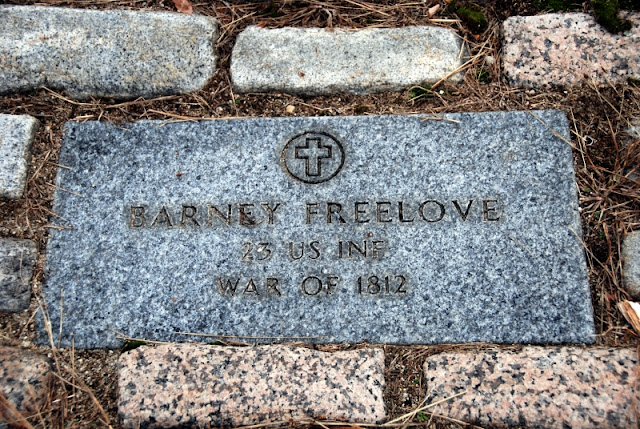
According to the below "Sick List", there were 20 soldiers from the ship who died in passage, with an assumed quick burial at sea (to avoid further contamination to the remaining soldiers on board) and another 26 soldiers who were cared for at the Town Hospital, beginning on 29 December (see image below, referred to later as the "POW List"). One of the soldiers who had died in passage, Barney Freelove (See #18 on the right below), has record of being buried at the 1812 Monument, so it opened up the questions which I was able to answer:
1. Were all the soldiers who died on passage buried at sea, or were some actually buried at the Monument? According to War records, Barney Freelove, William Rice, and Thomas F. Wood, from the 'died on the passage' list, were actually buried in Portland.
2. Did all the soldiers who were brought in on the sick list die in Portland? No, actually several soldiers on the left side of this list actually left Portland healthy enough to return back home (typically to NY State) and their War records show that they were later paroled elsewhere. These would include: 2 (John Harris), 6 (Gabriel Zeilman), 7 (Elias Hews aka "Elisha Hughes"), 8 (James Brower), 13 (Peter Carroll), 14 (William Stewart), 15 (Benjamin Blanchard), 19 (Randall Dean), 22 (Joseph Mills), and 26 (Abner Perry).
21 of these soldiers perished within a month, and were buried at the mass grave on the Promenade (pictured above).


A stone placed in the center of the gravesite in 1887 carries a bronze plaque with the following inscription:
This post will attempt to assemble some information about these soldiers, in the event that other researchers are looking for them:
This post has now been updated to reflect the work that the City of Portland did on October 2024, to name five of the eight unknown soldiers. Four of these I had previously named and told the City of this in 2012, but I'm not sure if my research was utilized for the new proceeding.
Starting with the 13 marked soldier graves...




Alexander Smith


 |
| SOURCE: WAR OF 1812: PRISONER OF WAR RECORDS (NARA) "THE POW LIST" |
21 of these soldiers perished within a month, and were buried at the mass grave on the Promenade (pictured above).


A stone placed in the center of the gravesite in 1887 carries a bronze plaque with the following inscription:
Within this enclosure
were buried 21 soldiers
captured by the English
at the Battle
of Queenston, Canada
in the War of 1812
and died in hospital here
while on their way to
Boston for exchange.
This post will attempt to assemble some information about these soldiers, in the event that other researchers are looking for them:
This post has now been updated to reflect the work that the City of Portland did on October 2024, to name five of the eight unknown soldiers. Four of these I had previously named and told the City of this in 2012, but I'm not sure if my research was utilized for the new proceeding.
Sources used in this article:
- Maine, U.S. Veterans Cemetery Records, 1676-1918
- U.S. Army Register of Enlistments, 1798-1914 (the "NARA File")
- War of 1812, Prisoner of War Records, 1812-1815 (the "POW List")
- U.S., War of 1812 Pension Application Files Index, 1812-1815
After going through all records, I feel that I've been able to successfully identify these eight (actually nine) unknown soldiers, and they are listed at the end of this post:
Starting with the 13 marked soldier graves...

John Barrows
PRIVATE
6 US INFANTRY
This soldier appears in the cemetery records, as having been buried at Eastern Promenade, but the name entry on the the POW list appears to read "John Baines" This name also produces no results in a search of the NARA File.

Daniel Curtis
PRIVATE
23 US INFANTRY
Looking closely at the POW List, the only name resembling this would be Daniel Curtis. This name also produces conflicting results. I also found his cemetery record, listing him as buried in the 1812 Memorial Cemetery. I've requested that the City correct the plaque to read Daniel.

James L. Davis
CORPORAL
13 US INFANTRY
This soldier was easily located in the NARA File, with the appropriate data on the Queenston Battle. However, he was listed as James L. Davis, here and in the POW List above, yet the City lists him as James P. Davis, because that's what it says on the Cemetery Record. This soldier is showing on the NARA File as having enlisted in the 13th US Infantry, yet the stone created by the City erroneously lists 23rd. I've asked the City to consider changing this stone to correct the middle initial and regiment number.

Barney Freelove
(1781-1813)
PRIVATE
13 US INFANTRY
This soldier was easily located in the NARA File. This roster has him enlisted in Auburn, Maine as of May 1812 for a period of 18 months in the 13th US Infantry (yet the City has him listed as having been in the 23rd). He was born in Dartmouth, Massachusetts, and was 5'10 3/4". He married Sally Pettis in Freetown, Massachusetts in 1802. He died January 1, 1813, according to the NARA File, but he appears on the POW List above as having died in passage, so he must have died prior to December 29th. I also found his cemetery record, listing him as buried in the 1812 Memorial Cemetery.
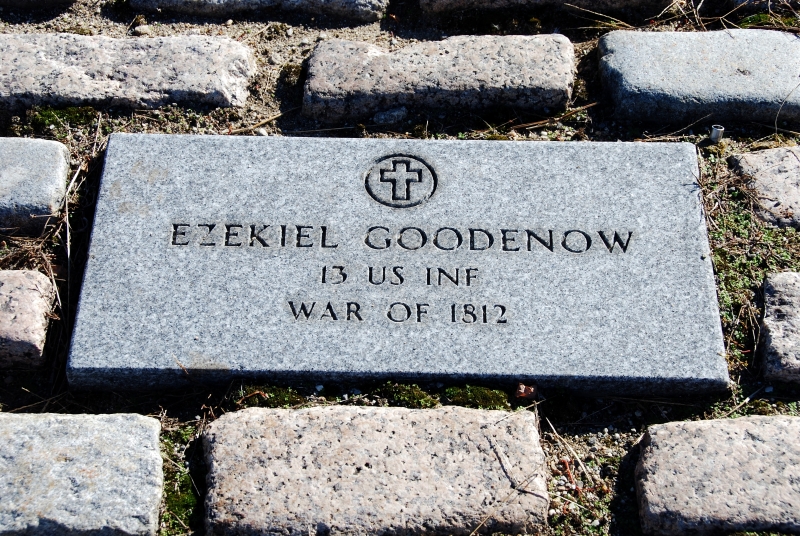
Ezekiel Goodenow
(1774-1813)
PRIVATE
13 US INFANTRY
This soldier was easily located in the NARA File. This roster has him enlisted in June of 1812, immediately prior to the Battle of Queenston, for a period of 5 years in the 13th US Infantry. According to Ancestry records, he was born in 1774, in Princeton, Massachusetts, the third of ten children to Edward Goodnow and Lois Rice. He married Sophia Harrington in 1801, Salem, Massachusetts. He died in January of 1813. I also found his cemetery record, listing him as buried in the 1812 Memorial Cemetery.

Daniel Hewes
PRIVATE
23 US INFANTRY
I found a Daniel Hews in the NARA File, but this one had enlisted in February of 1813, which would be after this veteran's death in December. I also found an Ancestry Tree which shows a Daniel Hewes born in 1776, married twice in Boston, with four children born by 1809, and no death date or military record yet attached. This could be a match. I also found his cemetery record, listing him as buried in the 1812 Memorial Cemetery.

Isaac Hight
PRIVATE
3 US ARTILLERY
I found an Isaac Hight in the NARA File, enlisting for five years in May 1812. I also found his cemetery record, listing him as buried in the 1812 Memorial Cemetery.

Warner Hull
PRIVATE
13 US INFANTRY
I did find one Warren Hull on the NARA File, who had enlisted in June of 1812, but no further information is attached to him. Unfortunately, in online searches, this soldier's name has been eclipsed by the more famous Warren Hull who was a young soldier in the Revolution, and fought later in the War of 1812, and died in 1838 at his estate in Western New York. Now, looking at the POW List, the Nara File, and cemetery records, it appears his name was most certainly WARNER Hull. This is pretty solid evidence of a typo on the above gravestone. I've asked the CIty to correct this as well.

Asa Newton
(1785-1813)
PRIVATE
23 US INFANTRY
This soldier was easily located in the NARA File. This roster has him enlisted in June of 1812, just prior to the Battle of Queenston, for a period of 5 years in the 23rd US Infantry. He is noted to have died 11 Jan 1813 of "St. McCarby's Ditch", whatever that means. The NARA File makes reference to a pension file for this soldier, in which there may be further detail. Ancestry Family Trees show that this soldier was born in Barnard, Vermont, and that he had a son named John T. Newton (1810-1873) who was born in Maryland and died in Missouri, and had three children and four stepchildren. Asa was one of ten children born to John Newton and Lydia Freeman, who settled in Windsor County, Vermont. Asa's ancestor, Richard Newton, arrived in 1640 from Lincolnsire, England (where Sir Isaac Newton also lived, so there was a likely relation). The Heirs of Asa Newton were awarded 160 acres of land for bounty (per the Military Bounty Land Warrants), in "SE Section 1, Township 5S, Range 5W," somewhere in Arkansas, Illinois, or Missouri. It's unclear which Meridian this falls into, though. So far this is the only soldier profiled here who appears to have likely descendants living today.

Sylvanus Sloan
(1796-1813)
PRIVATE
23 US INFANTRY
This soldier was easily located in the NARA File. This roster has him enlisted in June of 1812, just prior to the Battle of Queenston, for a period of 5 years in the 23rd US Infantry. He is noted to have died 19 Jan 1813, making him one of the last bodies to have been placed in the mass grave. Reference in the NARA File was made to a pension case. An Ancestry Family Tree dictates that he was born in 1796 in Rhode Island, and was only 17 when he died. He likely had no descendants.

Alexander Smith
PRIVATE
13 US INFANTRY
This soldier was easily located in the NARA File, and in cemetery records. This roster has him enlisted in July of 1812, just prior to the Battle of Queenston, for a period of 5 years in the 13rd US Infantry. He is noted to have died 15 Jan 1813.

Benjamin Smith
PRIVATE
23 US INFANTRY
This soldier was easily located in the NARA File, and cemetery records. This roster has him enlisted in July of 1812, just prior to the Battle of Queenston, for a period of 5 years in the 23rd US Infantry. He is noted to have died in Jan 1813. I'm not certain whether he is related to Alexander Smith above.

Cornelius Vandermark
PRIVATE
23 US INFANTRY
This soldier was located in the NARA File. Now, in looking at the Cemetery Record, it appears the coronoer mistyped him as Charles Vanderward. This name produces no results, so I believe the stone above is accurate.
***
***
In October 2024, the City placed five new stones in place of Unknown Soldier stones:
Joseph Lord
PRIVATE
23 US INFANTRY
This soldier was easily located in the NARA File, the POW list, and in Cemetery Records. This roster has him enlisted in July of 1812, just prior to the Battle of Queenston, for a period of 18 months in the 23rd US Infantry. He is noted to have died in Portland in Jan 1813. He should be names as one of the former "UNKNOWN".
PRIVATE
23 US INFANTRY
This soldier was easily located in the NARA File, the POW list, and in Cemetery Records. This roster has him enlisted in July of 1812, just prior to the Battle of Queenston, for a period of 18 months in the 23rd US Infantry. He is noted to have died in Portland in Jan 1813. He should be names as one of the former "UNKNOWN".
Ira Witt
PRIVATE
23 US INFANTRY
This soldier was easily located in the NARA File, and in cemetery records which declare him to be buried here. This roster has him enlisted in July of 1812, just prior to the Battle of Queenston, for a period of 5 years in the 23rd US Infantry. He is noted to have died in Portland in Jan 1813.
Anthony Comer
Now, after looking at cemetery records and the NARA List for the remaining men from the POW list, I have some beliefs that the below two are the remainder of the "unknown soldiers".

Thomas F. WoodPRIVATE
PRIVATE
23 US INFANTRY
This soldier was easily located in the NARA File, and in cemetery records which declare him to be buried here. This roster has him enlisted in July of 1812, just prior to the Battle of Queenston, for a period of 5 years in the 23rd US Infantry. He is noted to have died in Portland in Jan 1813.
Anthony Comer
PRIVATE
13TH U.S. INFANTRY
The Cemetery Record misspelled this as Coner, but the stone shows the correct spelling as shown on the NARA File
J. Merrick
6TH US INFANTRY
This soldier appears on the NARA List, but not any other records, not even the POW List. But the NARA List should be seen as definitive here, so it was an excellent catch by the City.
Daniel G. Snow
13TH U.S. INFANTRY
This soldier appears on the NARA List, and the POW List, but doesn't have a cemetery record.
***
Now, after looking at cemetery records and the NARA List for the remaining men from the POW list, I have some beliefs that the below two are the remainder of the "unknown soldiers".

Thomas F. Wood
13TH U.S. INFANTRY
This soldier shows on the NARA List as having died in Portland, so he should also get a stone. The City appears to have missed this one too.

Special thanks to Margaret Colford, who took the photographs featured on this page. Also thanks to Wes Brumbaugh at the City of Portland, who helped organize a rededication ceremony to address these Unknown Soldiers!
Anyone is welcome to view my FindAGrave Memorial Page for this cemetery.

William Rice
PRIVATE
13th US Infantry
The NARA File clearly states he died in Portland in January 1813. I've asked once again for the City to consider correcting this one. It was missed in the October 2024 rededication.
**
Anyone is welcome to view my FindAGrave Memorial Page for this cemetery.


.jpeg)
.jpeg)


.jpg)
.jpg)