Monday, April 19, 2010

Royal English Roots (Murch)

My gram, Lorena Holland Murch had a few royal roots, though not nearly as many as her husband Arthur:


LORD RICHARD RICH
(1496-1567)

Richard Rich, Lord Chancelor of England during Edward IV’s reign, was the great grandson of Richard Rich, Sherriff of London. In the 1966 film, A Man for All Seasons, he was played by John Hurt. The Rich’s are direct ancestors of my great grandmother Lorena Murch Fuller.  Lord Richard Rich is also a 5th generation ancestor to Susannah North Martin, who was hanged during the Salem Witch Trials.

My gram also descends from the Welsh Leonard line from Taunton Massachusetts, who started up the Leonard Forge there.  They descend directly from John of Gaunt, son to Edward III of the Plantagenet line, and more info about this connection can be read here.  

The Mormon Church

FIRST VISION OF JOSEPH SMITH

No genealogical researcher is immune from the work of the Mormon Church. Pretty much ALL records that are available to family researchers have been provided by the Mormons, who have always been rabid genealogists.

Why is this so? Well, one of the tenets of the Church is to keep track of as much of the dead of mankind, in order to have their records available for their frequent "Baptism of the Dead" rituals.

I'm not kidding.

Mormons of today can apply to have a deceased ancestor of theirs "sealed" to the Church, so they will find Jesus in their afterlives. And of course, their ancestors wouldn't otherwise have done so if they weren't Mormon. And Mormonism didn't start until the mid 1800's...so there's a "whole lotta sealing to do!" in the eyes of the Church.

Two of Arthur Fuller's ancestors, Jedediah Osborn (1721-1786) and his father Josiah Osborn (1697-1754) from East Hampton, NY, were "sealed" by the Church to their spouses on 16 Feb 1972, by a descendant of theirs in Manti, Utah.

According to Church doctrine, these two individuals and their spouses can now find the love of Christ in the afterlife.

This process of Mormon Baptism has caused a great deal of conflict within other religions. In 2008, a directive from the Vatican Congregation for the Clergy directed Catholic dioceses to prevent the LDS Church from "microfilming and digitizing information" contained in Catholic sacramental registers so that those whose names were contained therein would not be subjected to vicarious Mormon baptism, even though the Vatican had previously declared that Mormon baptism was invalid. Too late, Pope John Paul II was sealed just after his death, by a proven descendant who had converted to Mormonism.

Even Adolf Hitler has been sealed!

This explains why the Mormon Church is so passionate about genealogy. They want to get the lineages right, so they can seal as many people as possible.

While it's simultaneously strange and laughable, this is indeed a religion taken seriously by about 14 million people. And, they are very generous about letting anyone and everyone use their family history centers to do their own family research, regardless of creed. I've used their ever growing searchable database many times, myself. And I was never spammed by the Church for doing so.

But, come to think of it, maybe I'll be sealed one day...

The Hollands of Central Maine

My 4th great grandparents were Daniel Friedrich Holland (born about 1790), a Bavarian sailor, and his wife Jane Bell (1789-1873) from Nova Scotia.  According to some researchers, his birth name in Bavaria was Hollien, and turned to Holland when he emigrated to Nova Scotia.  Daniel married Jane Bell while living in Canso, Nova Scotia, in 1808.

Daniel and Jane migrated to Monmouth Maine around 1809, where they started their family.  They later moved to other Maine towns: Jay, Plymouth, Brunswick, Bangor, Hampden, then finally Dover.

Below is a brief summary of collected information about each of their children:

1.  Daniel Frederick Holland Jr. (1810-1906) was born in Wales, Maine, January of 1810.  Daniel married Mary A. Finson and had six daughters.  He lived most of his life in Hampden Maine, and worked as a farmer and a cooper.  It's also possible that he worked as a seaman like his father (given the mention of two seaman in the family during the 1840 census of Jay).  As for his family: of his 5 surviving children, 4 of them lived with him for each census until his death at the turn of the century.  None of them ever got married.  Just before their parents' deaths they all moved together to Brookline, Massachusetts, on Davis Avenue.  He was a Naval Landsman in the Civil War, serving on the following ships:  USS Potomac, USS Varuna, USS Oneida, USS Ohio, USS Sabine, and USS North Carolina.  On his wife's pension application, it showed that Daniel was at the lowest rank of Landsman (even after all those ships).  When he lived in Brookline, he worked for George Stetson & Co.  Daniel died in 1906 of a cerebral hemorrhage at his home on "8 Parkdrive Terrace, Brookline, MA", but I don't see an address that matches online, and was buried at Riverview Cemetery in Hampden (gravestone below).  On his death record, he states his mother was born in Scotland...but she was actually born in Nova Scotia.  In his obituary, it was claimed that his father was a Württemberg German, and that his mother was from the Bell & Stuart clans of Scotland.  All of this was true, but the obituary also said that he was part Russian.  Württemberg Germans were not of Russian extraction, but some of them resided in Russia at times.

DANIEL FREDERICK HOLLAND JR.
MARY A. FINSON-HOLLAND
CA. 1890

2. Marie Wurttemberg Holland (1812-before 1852) was born in Jay, and her middle name provides evidence of the connection to the Duchy of Wurttemberg, Germany, home of Daniel's mother, and possibly Jane's mother too. I cannot find any records at all on her. The above was oral history provided by a Holland researcher.

3.  John Christopher Holland (1814-1899) was born in Jay and raised in Hampden, and was my 3rd great grandfather.  He was listed as head of household for the 1840 census of Bangor, wherein two members of the family were 'employed in the Navigation of the Ocean', which would be his father, and likely also his brother Daniel.  John married Dorcas Harvey of Atkinson, and had two daughters, Isabel (who died as a baby), and my 2nd great grandmother, Rosa Bell Holland, who married Charles Murch of Rockland and Unity, Maine.  John started out working on the family farm in Hampden, but later worked as a shoemaker, a sawmill laborer and an insurance salesman in Bangor.  He died in Hampden of heart disease.  His death record states that he fought in the Civil War, although he was 50 at the time, and that his next of kin was Frank Holland of Germany.  This must have been an uncle or cousin, and it was interesting they knew of family living in Germany, but in 1899, John could have named his wife Dorcas, or his daughter Rosa Bell, both of whom were living in Hampden, same town, as his next of kin.  I wonder if there was any bad blood there.  At that point in time, you certainly could name a female as next of kin.  He also had brothers who were still alive at the time (Daniel & George).

4.  Sarah Jane Holland (1816-1883) was born in Jay and raised in Hampden, and married Colonel Oliver Kennard Nason, Civil War patriot from Limington Maine.  They moved to Levant, and later settled in Kenduskeag.  They had six children.

5.  Hannah Holland (1819-??) was born in Jay, raised in Hampden, and married John Griffin in Portland.  They had four children there.  Hannah moved back to Hampden for the 1850 census, and was boarding her brother Moody.  I cannot figure out what happened to her or her four children after that.

6.  Isabel Holland (1819-??) born in Jay, and possible twin sister to Hannah.  No records, so she may have died young.

7.  Margaret Holland (1820-1907) born in Jay, raised in Hampden.  She married her first cousin, Alexander Bell of Dover.  Alexander's father was Henry Bell (brother to Jane).  They had three children, descendants of which are still living in the Dover area today.


8.  Mary Ann Gardner Holland (1825-1895) born in Plymouth.  She was a Civil War nurse who wrote a book called "Our Army Nurses", published in 1895.  In the book she mentions caring for her nephew, William K. Nason, son of Sarah Jane Holland and Oliver K. Nason.  Mary Ann died single in Somerville, Mass of scirrhus cancer at her home on 17 Grove Street, and she's buried at Holy Cross Cemetery.  On her death record it states that her mother's birthplace was Jay, Maine, which was an error.  Mary Ann cared for her mother Jane until Jane's death.  Per Wikipedia, and according to Holland's account, she worked in hospitals for about fourteen months. She would have enlisted earlier, she writes, if she didn't have an aging mother depending upon her.  Ultimately, Holland cared for her mother during the day then worked with the Sanitary Commission on weekday evenings.  I've dedicated a separate blog page to her here.

9.  Nelson Holland (1825-1826) born in Plymouth, possible twin to Mary Ann.  Died young.


10.  William Moody Holland (1830-1865), also known as Moody William Holland, born in Plymouth or Brunswick, grew up in Hampden.  He and his wife Delia had two children, one named George Henry Holland (1860-1939) (who also became a sailor and later moved to Massachusetts, became a reverend, and had six children).  They lived at St. George, Maine.  Moody died of yellow fever at the Island of Inagua in the Bahamas during the Civil War, so young George was raised by his grandfather, George Jackson in Belfast, Maine (not sure whatever became of Delia..).  Moody's death record lists his mother as "Mary Jane"...not just Jane.

11.  George Nelson Holland (1833-1923) born in Brunswick, remained in Hampden all his life. He and his wife Lydia had three daughters:  Mabel, Clara and Nellie.  He worked as a gardener, but enlisted in March of 1865 during the end of the Civil War, as part of the 19th Maine Regiment.  He only served two months and was discharged due to G.O. 77 (the order that allowed for discharge of excess soldiers once the Confederate Army was surrendering in the last year).  After the War, his horticultural talents were recognized regularly, including being in charge of the agricultural exhibits at the Bangor Fair.  After his wife Lydia died, he moved into Togus Hospital for almost a full year from 1919 to 1920, due to hardening of the arteries at age 86, just a few years before his death in Zephyrhills, Florida.

I cannot find the Holland family in the 1810 censuses of either Monmouth or Jay, so it's likely they lived somewhere else just after Daniel Jr. was born.  I did find Daniel's family in Jay for the 1820 Census (under Daniel Holand) and 1830 Census (under "Daniel Hollin").  The 1840 Census shows the whole family living in Bangor, with John being the head of household, but with two elders living with him who were his parents' ages, and two people were listed as being 'employed in the Navigation of the Ocean'.  That would be Daniel Sr., and also Daniel Jr., I believe.  The two of them may have been out to sea at the time of the census, leaving John the head of household, as the eldest son.  I believe Daniel Sr. died sometime afterward in the Bangor area, but the Bangor archives have nothing on his death from 1800-1892.

During the 1850 Census, Jane was living with Daniel Jr. on the farm in Hampden, next door to her son John and his family, and also next door to her daughter Hannah Holland-Griffin's family, who were taking Jane's three youngest children as lodgers (then ages 17-25).  Hannah's children were all born in Portland, but for some reason she moved back to Hampden with the kids (and without her husband John).  

By the 1860 Census, she was head of household at a home in Dover, Maine, along with her daughter, Margaret Holland-Bell and family.

I took a trip to Riverview Cemetery, aka East Hampden Cemetery, in Hampden Maine, and snapped some photos of the gravestones of Daniel Jr., John, and their families:


Below is a pedigree chart for Rosa Bell Holland.  She was 50% colonial English, 25% German, and 25% Scottish.


Cousins Marrying? Why Not!

Poor Arthur Fuller. There were so many instances of his ancestors marrying as cousins, I made a valiant attempt at keeping a geek record of them, although most of them involve his royal ancestry:

1. Welsh sisters Isabel and Maud Marshall had great grandchildren that married, to produce Elizabeth DeBeauchamp, born in 1305.

2. English Roger DeClare's Great Great Grandson married his own Great Great Great Grandaughter, also to produce Elizabeth DeBeauchamp (poor Liz).

3. In the 1460's, John Stewart of Scotland married twice, and one kid from each marriage ended up with grandkids that married, to produce William Sutherland in 1558.

4. William Sutherland and Janet Innes of Scotland had two children, William and Elizabeth. William Jr’s. great granddaughter, Janet Sutherland, married Elizabeth’s great grandson, Henry Sinclair.

5. In the 1540's, George and Elizabeth Sinclair of Scotland had two kids, whose kids married, producing John Sinkler in 1630.

6. Two offspring of King Edward the Elder of England (Edward I the Elder and Elgiva), both half-siblings, got married and gave birth to Edgar the Peaceful. What’s more, Elgiva was a 4th generation maternal descendant, and 3rd generation paternal descendant, of King Ethelwolf of Wessex.

7. Back in 1780, two Osborn brothers from East Hampton NY married two Wyman sisters from Maine. Not an uncommon event, in and of itself, but THEIR grandkids ended up marrying each other to produce...guess who...Arthur Fuller, in 1868!

8. Thomas Perkins, born in 1475 in England had two kids, Alice and Henry, who supposedly married and had a kid, Thomas.

9. Fergus Lord and Elizabeth of England had two children, Gilbert and Margaret DeGalloway. They each had two kids that married, to produce Neil Carrick, born in Scotland, 1202. Neil was father to Margaret Carrick, was father to King Robert I of Scotland.

10. To make matters worse, Margaret DeGalloway was also grandmother to Neil Carrick’s wife, Margaret Stewart.

11. The parents of Alexander Sutherland (born 1534) are each 8th generation descendants of two separate daughters of King Robert the Bruce.

12. English brother and sister Marjory and David DeHuntingdon were each great grandparents to each of King Robert’s parents.

13. Aethelred the Unready had many children. One of them, his daughter Elfgifu, had a granddaughter, Ealdgyth, who married Aethelred’s son, King Edmund, to produce Prince Edward the Exile in 1016.

14.  John MacBean had two wives.  From his first wife, Hannah Lissen, he had a daughter Mary.  From his second wife, Margaret the indentured servant, he had a son Daniel.  Mary and Daniel's grandkids married to produce David Bean, Revolutionary War patriot.


Other Colonists (Murch)

A few other notable colonists who are ancestors of Charles Murch:


SKETCH OF JAMESTOWN (1608)

John Price (1584-1628)

John Price, a Welshman, arrived in Jamestown on the ship Starr in 1611. His son Matthew followed him on the ship George in 1635. Matthew’s daughter, Sarah, was born in Virginia, but later migrated to Maine, where she met and married William Jameson from Scotland.


John Tisdale (1614-1675)
Sarah Walker Tisdale (1618-1676)


Sarah Walker came over from England on the ship Elizabeth in 1635, as a servant. Four years after she arrived in Massachusetts, she married into the noble Tisdale family. Her husband John was a victim of an assault by Stephen Hopkins of the Mayflower (also an ancestor), and later became constable of Taunton. He was killed by Indians in King Phillip’s War. The Indians stole his gun, and when the gun was later recovered, it was used as evidence against the three Indians, who were then sold into slavery and removed from the country.


Richard Higgins (1603-1675)
Nicholas Snow (1599-1676)


Two of Charles Murch’s ancestors, English Richard Higgins & Nicholas Snow, were founding members of the Town of Eastham, Massachusetts in the 1640’s. Eastham is the site of first encounter, where the Mayflower pilgrims first landed and had contact with the Nauset Indians, before deciding to move up the coast to Plymouth to settle. While Richard and Nicholas were not on board the Mayflower, they arrived a couple years afterward on the ship Anne. Richard’s daughter ended up marrying Nicholas’ son. Nicholas married Constance Hopkins, daughter of Stephen Hopkins of the Mayflower. Plaques dedicated to both these Pilgrims are on display as monuments in Eastham Town Hall.


MONUMENT TO FIRST ENCOUNTER
Eastham, Massachusetts


FIRST ENCOUNTER BEACH
Eastham, Massachusetts


Elizabeth Hull (1628-1706)

Another of Charles Murch’s ancestors, English born Elizabeth Hull, who arrived in the New World in 1635, had several personal run-ins with the Indians. One particular story I discovered is where she apparently hid a young Indian in her home (where she and her husband John Heard raised their 15 kids) in Dover, New Hampshire, protecting him from slaughter by her neighbors during the 1676 Massacre, and then aided his escape afterwards. Then in 1688, she ended up a captive of the Indians, and was enabled to escape unharmed by the aid of the same Indian she protected 12 years prior.

Her father, Reverend Joseph Hull (a Cambridge graduate) traveled to the New World with her, and his other children. When they arrived in Boston, they settled in an area that he helped name Weymouth, Massachusetts. In 1639, he and his family moved to the Indian area of “Mattakeese”, and he called the town Barnstable, Massachusetts. He used to preach from a rock to the masses of settlers, many of them armed and ready for battle with the Indians, and also with the Puritans, who didn’t like his style of preaching, as it was too Anglican. The rock is still there, surrounded by the highway. Due to the Civil War in England, there was a dearth of immigration in 1639, and he found himself in a religious minority. He moved north to an Episcopal Colony in what is now York, Maine. But in 1653, Massachusetts took Maine under its jurisdiction, and Hull’s religion was once again under threat. He ended up going back to England for a while, but he eventually came back to York, where he died in 1665.

The Fullers

The surname Fuller, like many other surnames, comes from a profession by the same name. A "fuller" was someone who washed yardage, by scouring and thickening the cloth for pre-shrinking...by beating and trampling the raw cloth while it was soaking in the water, not unlike a "tucker".

My Fuller ancestors come from Norfolk England, and I've traced them to that location as far back as the 1520's.  They arrived on the Mayflower, and successive generations came from Norfolk on separate ships afterwards.  Nutfield Genealogy has a very robust site that talks about these Fullers in much more detail.

The Fullers settled in Barnstable, Massachusetts until about 1680, when they moved to East Haddam, Connecticut.  The Fullers stayed in East Haddam for three generations, when certain of this family migrated further north in 1769 to Campton & Grafton, New Hampshire (including my own).  In the 1820's this branch moved to Lowell, Massachusetts.  In the 1830's they were in Kennebec County, Maine.  In the 1860's, Ottumwa, Iowa.  In the 1880's my Fullers could be found in Chicago, IL, and also Bangor, Maine.  In the 1930's, Portland, Maine, where I was born.  For each of these moves, other Fullers remained in those towns.

Going reverse chronologically, here is the Fuller line my family is associated with:

My paternal grandmother's name was Lorena Bell Fuller, daughter to Arthur William Fuller and Lorena Holland Murch.

Arthur Fuller's father was Charles, whose father was Samuel Bean Fuller from Ottumwa, Iowa. 

Samuel Bean Fuller's father was John Fuller, born in 1773 in Campton, New Hampshire to parents Samuel Fuller III and Lois Andrews.

Samuel's father Samuel Fuller II was born 1733, the eldest of a large family born in East Haddam, Connecticut to Samuel Fuller I & Marcy Price.

Samuel's father Samuel the First was born 1711 in East Haddam, the youngest child born to Timothy Fuller and Sarah Gates, daughter to Haddam town founder George Gates.

Timothy was born 1670 in Barnstable, Massachusetts to Samuel & Mary Fuller of England.  He kept slaves named Salem & Lois, and was the town blacksmith.  All of his children were baptised at the East Haddam First Congregational Church, yet most of his kids' children were not...

Samuel was born 1630 in England to parents Matthew & Frances Fuller of England.  He was an Army lieutentna, and died in 1676, killed by Indians during King Philip's War.  Samuel was a Barnstable town officer.

Matthew was born 1603 in Norfolk, England.  He arrived in America in 1640, after the Mayflower journey, and worked as a surgeon and an Army captain.  He served under Miles Standish in the operations against the Dutch in Manhattan.  He never fought there though, as peace had been established by the time they set off to fight.  He became captain during King Phillip's War.  In the Quaker controversy, Matthew took a noble stand in favor of religious tolerance.  He was friends with many Quakers and helped quell some violence towards them.  He was the first physician established in Barnstable.  He was granted a large amount of land in Massachusetts for his bravery and service.  His estate was valued at almost 1670 pounds, a very large amount at the time.  He left a large amount of his estate to his eldest grandson Thomas Fuller and to his eldest surviving son, John.

Matthew's father was Edward Fuller of the Mayflower journey.  Edward and his brother Samuel, a doctor, were important members of the Mayflower settlement in Plymouth.  I've yet to apply at the Mayflower Society for this, but I have established DNA links to those who have been certified.  More info can be found at my blog post on the Fullers' Mayflower roots.

Mayflower Ancestors (Fuller)


My father's maternal grandfather, Arthur William Fuller, has two Mayflower links. They are John Alden and Edward Fuller.


JOHN & PRISCILLA ALDEN


MAYFLOWER PASSENGERS:
The Aldens & Mullins

JOHN ALDEN (1599-1687)
PRISILLA MULLINS-ALDEN (1602-1680)
WILLIAM MULLINS (1578-1621)
ALICE ATWOOD-MULLINS (1574-1621)

John Alden, a 9th generation ancestor of Arthur Fuller, is said to be the first passenger of The Mayflower to set foot on Plymouth Rock in 1620. There are conflicting theories on his own ancestry.

He was a ship-carpenter by trade and a cooper for The Mayflower, which was usually docked at Southampton. He was also one of the founders of the Plymouth Colony and the seventh signer of the Mayflower Compact. Distinguished for practical wisdom, integrity and decision, he acquired and retained a commanding influence over his associates. Employed in public business he became the Governor's Assistant, the Duxbury Deputy to the General Court of Plymouth, a member under arms of Capt. Miles Standish's Duxbury Company, a member of Council of War, Treasurer of Plymouth Colony, and Commissioner to Yarmouth.

John Alden had settled with the Pilgrims in the Plymouth Colony, though not a pilgrim himself. He was hired to repair The Mayflower while she lay at Southampton, England. Without any religious motives, John decided to journey when she set sail, perhaps with the hope of being prosperous in the New World, or because he wished to follow Priscilla Mullins. John wasn't the only man who had fallen for Priscilla. John's friend, military Captain Miles Standish had come to love the Maiden throughout the long voyage of 1620. A love triangle ensued with the result of John ultimately winning Priscilla's heart. Legend has it that Priscilla was growing impatient with John's lack of assertion in his courtship of her, and was quoted to have said "Why Don't You Speak For Yourself, John". A pewter figurine was created to memorialize this moment in their courtship:


They married on May 12, 1622. Priscilla’s parents, and her little brother, also Mayflower passengers, all had died during the notorious first Plymouth winter. Their son, Joseph Alden, is our direct ancestor.  Their son John Alden Jr. was a sea captain who was accused of witchcraft in Salem.


EDWARD FULLER (1575-1621)

Dr. Samuel Fuller of the Mayflower is a link that I've heard the family speak of since I was a child. I have yet to find the actual link, however. The furthest I was able to trace the Fuller line with actual documentation is to Samuel Bean Fuller ("SBF"), who was born in 1812.

Harold Murch Fuller, my Nana's older brother, was also an avid genealogist, like his mother. He was on a mission to find this link to Dr. Fuller, with actual proof. Shortly before his death, he wrote a typewritten document to his children, asking them to carry the torch, as it were. His children Joyce, Mark and Joel are currently the Murch/Fuller genealogists in the family. After meeting with them, I've learned that they've done a paternal DNA test.  This test yielded the result that the Fuller line goes back to Edward Fuller (Dr. Samuel's brother), who also sailed on the Mayflower, but died that first winter in Plymouth.

Edward's son, Captain Matthew Fuller, MD (who was born in England) arrived in Plymouth in 1640, almost two decades after his father died, and became the surgeon general at Plymouth.  Matthew named his son Samuel, after his uncle.  This Samuel was killed by Indians at age 45 in King Philip's War.  His son Timothy married a woman named Sarah Gates from Haddam, Connecticut, and moved there with her, having seven children.  Timothy's youngest, Samuel Fuller, grew up in East Haddam, and married Marcy Price, having ten children.  Samuel's eldest son, Samuel Jr., (born 1733) left East Haddam for Campton, New Hampshire. 

That is where the Mayflower Families Through Five Generations volumes stop as to my family's direct links to Edward Fuller.  However, many trees online show this last Samuel 1733 to have had a son named John Fuller born 1773 in Campton, NH (birth record bearing the name Jonathan Fuller seems to be the only clue here, but is not proof enough for the Mayflower Society, who has rejected my application).  Joyce, Joel, and I believe that this John is SBF's father and husband to Mary Bean, of the Scottish Beans.  While we don't have any document to link the Fuller line from our John up to the last documented Samuel, the DNA testing seems to confirm our assumptions.

Mayflower Ancestors (Murch)


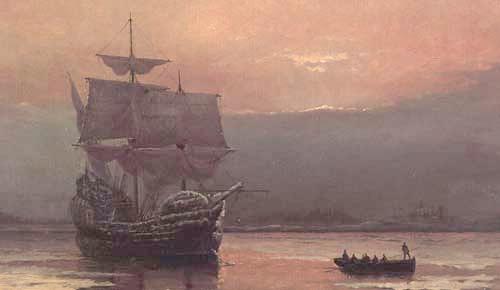
THE MAYFLOWER

There are two established Mayflower links to Charles Murch, my father's maternal great grandfather. They are passengers Stephen Hopkins and Francis Cooke.


STEPHEN HOPKINS OF THE MAYFLOWER

Stephen Hopkins (1581-1644) was a “stranger” from the Mayflower, which was a term given to the passengers who were NOT escaping religious persecution, but were heading to the New World for personal reasons. Hopkins and his family were recruited as planters and he was viewed to be a potential governor of the New World. Upon arrival in Plymouth, Hopkins was elected the first Mayor of Plymouth, and an ambassador to Indian relations, due to his experience in Jamestown.


BERMUDA COAT OF ARMS
(containing image of shipwreck)

Hopkins had earlier sailed to Jamestown on the Sea Venture, an ill-fated voyage that wound up shipwrecked on the shore of Bermuda, marking the first English arrival for that island. He was the force behind a mutiny that thought the authority of the Governor ceased when the ship was wrecked. He was sentenced to death, but pardoned. The story of this voyage inspired Shakespeare’s play The Tempest. Hopkins and the other castaways later fashioned two new ships with Bermuda driftwood and the remains of the shipwreck, and sailed to Jamestown, where he lived for two years before returning to England.

While in Plymouth, Hopkins ran afoul of the law several times, for assault, for not properly regulating other people’s alcohol intake, and for overpricing sales of alcohol to others.

Hopkins was respected for his previous experience with Indians and was elected ambassador for native relations. When Squanto arrived in Plymouth he resided with the Hopkins family. In 1621 Hopkins, Edward Winslow and William Bradford were delegated by their associates to treat with the Indians in the Plymouth vicinity on behalf of the Pilgrims and succeeded in winning the friendship of Chief Massasoit (1580-1661), concluding a peace treaty on 22 March 1621 in the Hopkins home. He later served in the Pequot War of 1637.

He died between 6 June 1644, when his will was made, and 17 July 1644, when the inventory of his estate was taken.


REPLICA OF HOPKINS HOME IN PLYMOUTH

Hopkins’ daughter, Constance, through his first wife Mary (who died prior to the Mayflower voyage), married Nicholas Snow. They are one pair of ancestors of Charles Murch.

GRAVE OF CONSTANCE HOPKINS-SNOW
EASTHAM, MASSACHUSETTS


Hopkins’ 2nd wife, Elizabeth Fisher, had many children prior to the voyage, one on the voyage, and several in Plymouth. Their daughter, Damaris Hopkins, who was one of the first children born in Plymouth Colony, married Jacob Cooke (son of Mayflower passenger Francis Cooke), establishing the second Mayflower link to Charles Murch.


LEIDEN SEPARATISTS ON THE SPEEDWELL

Francis Cooke (1583-1663) sailed on the Mayflower like the others, but was one of the English puritans who were living in Leiden, Netherlands to escape religious persecution, before coming back to England on the Speedwell in time to make the Mayflower voyage.  He and his oldest son, John made the voyage together, leaving behind the rest of the family in Leiden until they could be sent for later on the Anne in 1623.

In addition to his work as the first surveyor if Plymouth, Francis was active in Plymouth civil affairs in the 1630s and 40s - committees to lay out land grants and highways, petit jury, grand jury, coroner's jury. He appears on the 1643 Plymouth list of those able to bear arms. At some point in 1638 or afterward, he settled at Rocky Nook on Jones River, within the limits of Kingston, a few miles from Plymouth. He died at age 80. As mentioned above, Jacob married Damaris Hopkins.


PLYMOUTH LAND LAYOUT

Above is an image of how the first land layout was drawn for each settler. Cooke and Hopkins are shown, as well as Snow (who came over on the Anne, and married Hopkins' daughter Constance). Also showing are Fuller and Alden, ancestors of Arthur Fuller.

The Murch Family of Maine


The Murch name appears after the Norman Conquest of England, 1066. It derives from the name March, which was believed to be a name given to those born in that month. It was also a name given to English people that lived on the borders of Wales and Scotland, as in "the Marches".

The furthest back I've been able to trace my family's Murch line is to fisherman Walter Murch (1681-1730) and Deborah Cornish of Devon, England, who emigrated to York Maine around 1714.  

There does appear to be an old record of land transactions (according to Virginia Spiller of the Old York Historical Society), whereby a Walter Murch received a grant of 20 acres clear on Mar. 8, 1715. He received a grant of 10 acres of swamp clear on Mar. 13, 1715 (where the recorder could find it clear of all former grants).  Therefore, Virginia Spiller thinks that Walter Murch evidently came to York ca. 1714, which was the third migration to York. This seems to be the same Walter Murch of Devon.

Walter's son William Murch, in 1747, was captured at his farm by local Indians and brought to Canada, where he was kept for a year.

William Murch married Tabitha Young, and had their own son, named Walter Murch (1740-1794) after his father. 

NOTE:  There are a number of trees on Ancestry which show this Walter (born 1740) to be son of Walter Murch (1696-1760) and Rebecca Garland, and that this Walter was also son to Walter Murch (1681-1730) and Deborah Cornish of Devon, and finally that this elder Walter is son to John Murch born 1650.  None of this is backed up with records, however, yet the trees persist.  We may never learn the parentage of Walter Murch of Devon, but we do know that Walter (born 1740) is the son of William and Tabitha of York Maine (not Walter and Rebecca).

In 1757 Walter and his brother John bought property in Gorham, and relocated there (joined later by other family) and that's where Walter married Jerusha Brown of Biddeford Maine, who was a descendant of the Edward III Plantagenet line.  When Walter was 20 years old, around 1760, he got into an accident and had to have his leg amputated.  He was said to have a wooden leg the rest of his life.  He was unable to serve in the Revolutionary War due to his disability, but he reputedly did serve as a Gorham town official.  Walter and Jerusha sold the Gorham property in 1804 and moved to Unity to live with their son Simeon.  They are reportedly buried somewhere in an apple orchard on Albion Road in Unity, behind a brick house built by Simeon.

Walter's son Ephraim (1778-1848) was my 4th great grandfather, and an early settler of Hampden Maine in 1794.  His wife was Rebecca Cobb.  They moved in the early 1800s to Castine.  They are buried at Castine's Town Cemetery.

Ephraim made the list of people who had letters waiting for them for several months in 1811:

Castine Eagle
Nov 7, 1811


My third great grandfather, James Murch (1817-1851), was a seaman (according to his son George's death record).  James' was born in Castine on October 14, 1817 to Ephraim and Rebecca Murch.  There are no records I've found which substantiate his parentage, but I've been looking for a long time.  James should not be conflated with Revolutionary War Veteran of the same name, who lived in Buxton, Maine.

Marriage Notice
James Murch and Mary Ann Jameson
Portland Daily Advertiser
Feb 9, 1841


In 1841, James married Mary Ann Jameson (aka "Annie", daughter to cousins Celia Cook and John Jameson of the Cooke Mayflower line, and herself also a descendant of the Taunton Leonards and Edward III Plantagenet) and settled in Rockland (then part of Thomaston) with much of the Jameson clan of Scotch-Irish background.   A notice of their marriage, which was published in the Thomaston Recorder newspaper on January 28, 1841, reads as follows:
Marriages…In St. George by N. Liscomb, Esq., Mr. James Murch to Miss Mary A. Jameson, daughter of Captain John Jameson of S[t. George].  With the above we received a piece of the bride’s cake.  We are glad to record the names of those under this head, in whose minds the good old fashion of remembering the printer, is not entirely oblite [sic].  May their paths through life be strewed with flowers as sweet as their cake.
(Many thanks to Dana Murch for the assistance in digging for this and other records).
Death Notice
James Murch, age 36 (actually 34)
Portland Daily Advertiser
Dec 23, 1851

By Christmas of 1851, James had died in Montville at the young age of 34, leaving Mary Ann a widow with five kids (aged 1-10) at her home on Tea Street in Rockland, which she had acquired in fee as a widow via Knox County Deed 19/502 recorded April 24, 1868.  

James and Mary Ann's five children:

1.  Charles A. Murch (1841-1913) - (My 2nd Great Grandfather) - more on him below.

2.  George Washington Murch (1843-1920) - George fought in the 14th Maine Regiment Infantry in the Civil War, married twice, and had one daughter (Georgia Anna).

3. Andrew James Murch (1846-1893) - Andrew fought in the 14th Regiment alongside his brother George, and later moved to Weare, NH with his wife Irene.

4.  Amariah "George" Murch (1847-1882) -  After James died, Mary Ann gave him up for adoption, looks like first to her brother-in-law's brother-in-law, Abiezer Coombs of Isleboro (an island 20 miles northeast of Mary Ann's home in Rockland), per July 4, 1860 Census, and then later that month, for July 29, 1860 Census, he was living with his uncle Lewis Murch like his sister Ruby, and was going by "George A. Murch", son of Lewis.  He married Lottie Pearson, sister to his brother-in-law, George Pearson.  George Amariah Murch reportedly died at sea.

5. Ruby "Annette" Murch-Pearson (1849-1932) - Mary Ann gave her up for adoption to James' brother Lewis Cobb Murch (and his wife, Lois Coombs), to raise as his own.   Charles' obituary makes reference to his sister anyhow.  This tells me that it was not a family secret.

James & Mary Ann are buried at Achorn Cemetery in Rockland, Maine.

Charles A. Murch, born in Rockland in 1841 (then part of Thomaston).  His middle name is reputed to have been "Arthur", according to family lore, but no records appear to support that.  At the time of his father James's death, Charles went to live and work on the Vickery Farm in Unity, Maine.  He joined the 14th Maine Regiment of the Civil War effort in January of 1862, just as his brothers did (George Washington Murch and Andrew J. Murch).

Charles caught the measles immediately after joining the service, and was discharged three months later.  He battled the side effects of this disease for the rest of his life, losing some of his sight and hearing.

SIGNATURE FROM PENSION RECORD
DECEMBER 7, 1894

Charles married Rosa Bell Holland in 1871.  According to oral history of Joyce Fuller Norton, Charles and Rosa were both from wealthy backgrounds. After marriage, they moved to Salem, Massachusetts for several years, where Charles got a job with the railroad. They happened to be living there during the founding of the Christian Scientist movement in 1879, and became avid followers, and refused to ever see a doctor, as that was a violation of their new religion. They relocated to East Hampden in the late 19th Century, and in 1893 they had two children.  The eldest, Almeda F. Murch, died before her second birthday.  The youngest, my great grandmother, Lorena Holland Murch (born Louisa), who, at 16 years of age, married Arthur Fuller.


ROSA BELL HOLLAND-MURCH
CHARLES ARTHUR MURCH
LORENA HOLLAND MURCH-FULLER
(ca. 1910)

From oral history of Joyce Fuller Norton, Charles and Rosa Murch were the only family in the Hampden/Bangor area that could afford a horse and buggy.

In his later years, Charles worked as a laborer (1900 Census), and a laborer at odd jobs (1910 Census).  In his 1913 death record he was called a mechanic.  His extensive pension file paints a picture of a man who had a lung disease, weak eyes, and other aliments - and we know that he had consistently refused medical treatment for any of it, as per the orders of Christian Science.  According to my father he was also a "horse trader".

The oral history which paints the family as being of some means does conflict a bit with the pension records and lack of work available for Charles, which would indicate that they struggled to some extent.

Obituary of Charles A. Murch
Bangor Daily News
13 Dec 1913

In the late autumn of 1913, at the age of 72, Charles was found dead "sitting on his jigger" as per the above obituary.  Three days after his death, Rosa signed an affidavit as part of her application for a widow's pension, in which she stated that "the soldier was found dead on a lumber wagon in Stearns Lumber Company mill yard in East Hampden Maine."

Another one of Charles Murch's ancestors, Alice Carpenter Southworth, came from England on the ship Anne, in 1623, after her husband died in England. She and her husband were both part of the Puritan movement in Leyden, Holland. Their son, Constant, later moved to Plymouth and is a direct ancestor to Charles Murch. Alice, on the other hand, later in Plymouth, became a second wife to Governor William Bradford of the Mayflower.

After Charles' death, Rosa Bell moved in with her daughter Lorena, where she died a decade later, after a week's illness:


568 Washington Avenue
Portland, Maine

Below is grave of Charles, in East Hampden's "Riverview" Cemetery.  Buried with Charles are his wife Rosa Bell, baby daughter Almeda, son-in-law Arthur Fuller (although not named on stone).  Nearby in the same cemetery are buried Rosa Bell's family, The Hollands, including her sister, parents, and uncle Daniel's family (and potentially more unmarked graves)


Below is pedigree chart for Charles.  He was 12.5% Scottish, through the famous Jameson and McLellan lines, and 87.5% colonial English, and descendant of three Mayflower passengers as well.  His ancestor James Cooke was a descendant of Mayflower passengers Francis Cooke, Stephen Hopkins and Elizabeth Fisher.


SOURCES:

Royal Descents of the Murch Family by Dana Paul Murch, 2013.

Oral History by Joyce Fuller Norton, Mark Fuller and Joel Fuller

Ancestry Family Trees

East Hampden Town Records

Maine Death Records

U.S. Pension Records

Genealogy Bank


Richard Mather


RICHARD MATHER
(1596-1669)


Richard Mather, a direct 10th generation ancestor of Herbert F. Clarke, was a Puritan clergyman and author from Boston, MA. He was born in Lowton, in the parish of Winwick, near Liverpool, England, of a family which was in reduced circumstances but entitled to bear a coat-of-arms. He had a great reputation as a preacher in and about Liverpool; but, advised by letters of John Cotton and Thomas Hooker, he was persuaded to join the company of pilgrims in May 1635 and embarked at Bristol for New England. He arrived at Boston on August 15, 1635, in the midst of one of the most catastrophic hurricanes of the colonial era. He was the pastor of Dorchester until his death in 1669.

Richard's son, Samuel Mather, and my 11th great grandfather, migrated to Lyme, Connecticut, where he would later continue the line that would lead to many of the Clarks of Connecticut.

Richard's other son, Increase Mather, was a Puritan minister from Dorchester, Massachusetts who got involved in the Salem Witch Trials of 1692.  Increase's son, Cotton Mather, was Puritan minister more directly involved in the trials, and was believed to be the mastermind behind the persecution of the purported witches.

I find it interesting that Richard Mather's sons were directly involved in persecuting the witches.  An ancestor on my father's side, Susannah Martin, was hanged for being a witch.

Connecticut Founders

EAST HADDAM


WILLIAM VENTRES (1623-1701)
DANIEL BRAINERD (1641-1715)

William Ventres and his wife Elizabeth emigrated from England and were original founders of the town of Haddam in 1668.

Deacon Daniel Brainerd, also an English immigrant, was another Haddam founding father. He and his father John purportedly came from Braintree, England. Daniel’s grandson, Daniel III, was Grampy Herbert Clarke’s 4th great grandfather.

In 1669, Brainerd, James Wells, and George Gates (listed in the plaque above), together were charged with the task of mapping the lands on the east side of the Connecticut River.  They laid down the first roads in the area, and sold off the lands to a variety of families without ever having seen much of it.  In 1673, Robert Chapman (recent immigrant from Yorkshire and my 8th great grandfather), put the first house down along the river, just to secure his claim on the lands.  In 1685, the first settlers of East Haddam began doing the same.  By 1700, there were 30 families settled in East Haddam.  The family names of Clarke, Chapman, Seldin, Brainerd, Ventres, and Warner, all ancestors to Grampy Clarke, were known as the founding fathers of East Haddam, CT.

These settlers still needed to cross the Connecticut River westerly every Sunday to attend church in Haddam.  Captain John Chapman (Robert's son) built a ferry service for that purpose.  Some controversy arose regarding the need for travel, as the population started to grow.  As early as 1697, the Gates family petitioned the Connecticut Colony General Assembly to form an Ecclesiastical Society separate from Haddam.  There appeared to also be a disagreement on who should be pastor at the Haddam Church.  In 1704, East Haddamites finally got their own church, the First Congregational Church of East Haddam.  One of the very first baptisms performed by the Church was for Susannah Ventres-Brainerd, founder Daniel Brainerd's daughter in law, and my 7th great grandmother.  Many of my Fuller ancestors were also baptised here in the early years, starting with the children of Timothy Fuller, one my 7th great grandmothers on my father's side.


FIRST CONGREGATIONAL CHURCH OF EAST HADDAM
(ESTABLISHED 1704)

In 1734, East Haddam was finally incorporated as its own town.  It then began the process of expansion into the much larger town it's known as today.

HARTFORD & NEW HAVEN


GRAVE OF THOMAS LORD


HARTFORD CITY FOUNDERS PLAQUE
(portion showing ancestor William Parker)


William Parker and Thomas Lord were two of the founders of Hartford, CT, and are both direct ancestors of Niles Clark, Grampy’s father.


GRAVE OF DEACON WILLIAM PECK


WILLIAM PECK (1601-1694), an eighth generation ancestor to Niles M. Clark, was a merchart in London and it is believed that he came to America with his wife, ELIZABETH, and young son, JEREMIAH, on the good ship HECTOR, arriving in Boston on June 26, 1637. He was probably part of the Eaton-Davenport Company who migrated to New Haven in 1638/39. He signed the Fundamental Agreement of Quinnipiack in 1639 and became a freeman on October 29, 1640 in New Haven. From 1659 to his death, he was a deacon of the First Church of New Haven. His homelot was on George Street. Although his estate showed that he was not wealthy, he was highly respected.

He was one of three who inventoried the estate of Sgt. Thomas Jeffrie in 1661. In December of 1662, at a town meeting in New Haven, Deacon Peck informed those present that the town "elders" were not getting enough to eat -- that there was not enough wheat & malt to go around.

Deacon William Peck & another ancestor, ROGER ALLING, were appointed a Committee of Trustees for a trust that totalled £918 being authorized to direct the affairs of the Collegiate Grammer School in New Haven.

After Elizabeth's death in 1683, he married Sarah, widow of William Holt around 1684. While visiting his son, JOSEPH, in Lyme, he died in 1694. Lyme Vital Records gave his age at death as 93, while New Haven record says 90 years. However, his tombstone gives his age at death as 93 years.

STRATFORD

William Hayden (1602-1669) and William Wilcoxson (1601-1652), both eighth generation ancestors to Niles M. Clark, were English settlers who arrived in Connecticut in the 1630's.  They were part of the first families of Stratford Connecticut, formerly known as Cupheag Plantation, and prior to that, Pequonnocke.  Their children, Daniel Hayden and Hannah Wilcoxson (who became stepsiblings when Hayden married Wilcoxson's widow Margaret), settled in Killingworth, CT and later Windsor, CT.  Their daughter Hannah Hayden married William Phelps of Windsor, and had their son Charles Phelps (1708-1745), who was my 6th great grandfather, and was the first Phelps to settle in Lyme, CT.

Keep it in the Family!

There are several instances of the Tookers, Clarks, and Halls intermarrying in the 1800's in Lyme and East Haddam, Connecticut.

To name a few:

• Lizzie Tooker married Niles Clark in 1887. But her elder sister, Francina, had already married Niles’ elder brother, William, in 1869!

• Niles Clark’s elder brother Charles married Harriet Hall, whose father Harvey was married to Lizzie’s aunt Francis Tooker!

• The parents of Nancy Hall (Lizzie’s mother) were Sarah Mott and Harvey Hall. Nancy’s brother Charles Hall married Hattie Clark (Lizzie’s niece through her sister Francina).

• Lizzie Tooker’s father, John, had a sister named Sophia Tooker. She married James A. Clark, son to James Clark (Leonard Clark’s father).

• Leila Belle Clark (granddaughter to Leonard Clark) married Denison Hall, grandson to Harvey Hall and Frances Tooker.

• Rachel Clark and Laura Clark (sisters, and granddaughters to Leonard S. Clark) married Ralph and Arannah Tooker (brothers, and grandsons to John Harvey Tooker).

• Olive Tooker, daughter to John Harvey Tucker (Lizzie Tooker's grandfather), married Joel Clark (unknown parentage).

John Coult, Revolutionary War Patriot

GRAVE OF JOHN COULT
DUCK RIVER CEMETERY
OLD LYME, CONNECTICUT


John Coult (1725-1784), Revolutionary War soldier, was my sixth great grandfather, and an ancestor to my Connecticut Clark family.  His father was Deacon Benjamin Coult, of the Hartford Coults, who had been there since the 1630s...yet I cannot find the colonial migrant ancestor yet (he may be descended from one of the Colture or Coltman colonists).  John's mother was Miriam Harris, whose grandfather Daniel Harris migrated from Gloucestershire, England in the late 1600s.

According to Sons of the American Revolution applications and the Connecticut Military Archives, he was enlisted as a Marine under Captain Hall with 100 men, on September 18, 1775 and was in service for three months.  He also was listed as a conductor of teams for transporting supplies from Connecticut to the Continental Army from 1779 to 1781.

His grave, however, mentions the Lexington Alarm, which was part of the Powder Alarms of the first battle of the Revolution, the Battle of Lexington and Concord, and he apparently loaned money to the Continental Congress. He married his 2nd cousin, Mary Lord. He is buried in Duck River Cemetery in Lyme, CT. 

His entire family were veterans.  His grandfather was army Captain John Coult (1658-1751).  His son, Dr. Amherst Coult, also fought in the Revolution in the 6th Connecticut Regiment, and had enlisted four times total.  Amherst had commanded a post on the Connecticut River.  His other sons, John Jr. and Gardiner, served as a Captain in the Revolution and a Seaman, respectively.  He had a brother, Harris who was a Captain, and a nephew, Peter, who was Commisary of the Eastern Dept.

His daughter Esther Coult was my fifth great grandmother.  She married Mather Peck, also a Revolutionary War patriot.

John Coult’s page on Daughters of American Revolution website

The Morgans of New England

The Morgan surname is Welsh.  Some believe the name to be derived from Celtic for "sea circle", and is derived from the Old Welsh name Morcant.  The surname Morgan traces its origin from the powerful Welsh family established c. 1330 by Morgan ap Llewelyn, (son of Llewelyn ap Ifor, Lord of St. Clere, and Angharad, daughter and heiress of Sir Morgan ap Maredudd (Meredith), Lord of Tredegar), meaning either "great kingdom" or "great hundred". It is a popular family name in Wales, as well as there being a group of Morgans from "Morgund". It is possible that the name was Celtic from the Cornovii Tribe who lived in the North of Scotland and in the Severn Valley near the Wrekin in Shropshire.

My immigrant ancestor (and 8th Great Grandfather) was Robert Morgan (1601-1672) from Tredegar, Monmouthshire Wales.  He migrated to Virginia in 1635, and soon moved north to Salem, Massachusetts.  His son, Samuel, was my direct ancestor, but his eldest son was Sir Henry Morgan, famous privateer which the rum "Captain Morgan" was named for.

But starting from more recent history, and going back to Robert, my 3rd great grandparents were Henry Gray Morgan (1808-1883), originally from Bucksport (just across the Penobscot) & Harriet Holmes (1816-1856) of Frankfort (formerly Winterport), Maine.  Harriet was a member of the extremely large and wealthy Holmes family of Plymouth, Massachusetts who descended from colonial settler John Holmes of Milton Keynes, England.  Many thousands of Americans descend directly from John Holmes.  Harriet's father, Thomas Holmes, was born in Plymouth, Massachusetts, but migrated north to Winterport, Maine in Waldo County.  Harriet's brothers appear in many court records of Waldo County filing claims against many townspeople to whom they had lent money.


HOLMES HOMESTEAD (2011 PICTURE)
WINTERPORT MAINE
(CORNER OF MAIN AND HOLMES STREET)
MORGAN HOMESTEAD
WINTERPORT MAINE
(WILLOW STREET)

HENRY GRAY MORGAN HOUSE
END OF STREET ON THE RIGHT


According to the below Notice of Sheriff's Sale in 1853, certain property conveyed to Henry in 1848 was put up for auction.  It's not totally clear to me whether this was the same property on Willow Street, but I doubt it:

Republican Journal
Jun 17, 1853


According to Winterport Town Records I located on microfilm at the LDS Library, Henry was a wood surveyor and also a juror for Winterport.

Henry & Harriet had five children in Winterport:

1.  Albert H Morgan (1839-1883) fought in the Civil War in 1863, as part of the Maine 16th Regiment.  He and his wife moved to Chicago, where Albert found work as a typesetter.  He died in 1888, leaving behind a wife, Agnes, and two children (James and Nina), who also worked as typesetters.  Agnes went on to be a proprietor of The Gladstone (1888 Chicago Directory), which may have been a bar or hotel.  Her kids each had spouses, but had no children of their own, from available records.


William Sanford Morgan
(About 1910)


2.  My 2nd great grandfather, William Sanford Morgan (1841-1920), also fought in the Civil War, and settled in Portland.  He was the only child of Henry who had any descendants alive, as of 1970.

GRAVE OF LOUISE AND ROGER RUNDLETT
LOUISE'S DEATH DATE UNKNOWN


3.  Louise Maria Morgan (1843-1924) moved to Boston as a young adult, and worked as a tailoress in the home of Robert Hutchinson (a book binder) (1865 Mass. State Census).  She married Roger Sheridan Rundlett of NH in Dec 1865, and lived with Roger in Cambridge Mass. until about 1882, and then settled in the family home on Willow Street in Winterport, with Roger then owned by 1900.  No children.  Roger was a surveyor, along with his brother-in-law Seth Morgan (see below).  Roger also was a Civil War veteran and was listed as a "tuner for H&MO Company" in the 1878 Cambridge Directory.  Also in 1878, Roger lent his brother-in-law, William Sanford Morgan, $200.00 for a mortgage on William's Beech Ridge Road property in Scarborough, Maine.  William paid his brother back within two years.

Louise's obituary:
Mrs. Louise Rundlett died at her home on Willow street on Sunday afternoon. Mrs. Rundlett had been in poor health for several years, but was only confined to her bed for a few days. She was the widow of the late Roger Sherman Rundlett, who died a few years ago. They were prominent in the social affairs of the village for many years, but since his death she has gradually failed in health. She was a member of Cushing Chapter, O.E.S. She left a brother, Seth H. Morgan and a sister, Mrs. Augusta Emery. The funeral services will be held at the M.E. church at 3 PM Wednesday. The services of the Order of the Eastern Star will be used.

The Free Library will be open after the services of Mrs. Louise Rundlett on Wednesday. The hours will be from 3 to 5 PM.

The Bangor Daily News, 16 Apr 1924, Wed Edition, Page 9


GRAVE OF HORACE B. MORGAN
Togus National Cemetery, Augusta, Maine

4.  Horace B. Morgan (1845-1911), a short man like his brothers (5'3") also fought for the last year of the War, as he had just turned 17 at that point.  He and his wife Jennie moved around a lot.  They lived in Peabody Mass, Portland Maine, Boston, and Chelsea, Maine.  He also stayed at Togus hospital, like his brother William.  He had a heart valve problem, and hemiplegia.  He died of a cerebral hemorrhage.  He was survived by his wife, and two sons (Henry & Horace Edward).  His son Henry had no children, but Horace had one daughter, Jennie Carroll, born in NJ, who had no children of her own.  Interesting side note, from reviewing various census records, Jennie's husband Raymond, as well as Horace's son Henry (and his 2nd wife Ida), worked together at the Singer Sewing Machine company (Henry as a machinist and Raymond as a salesman). This might explain how Jennie met her husband (through her uncle Henry).

5. Harriet Augusta Morgan (1849-after 1924) went by her middle name "Augusta". She married twice - briefly to Alfred Rand, and then later to Charles Emery, who pre-deceased her in 1914. As a widow, she lived with her sister Louise and brother Seth on Willow Street. Augusta had no children..

Soon after little Harriet was born, Henry & Harriet divorced.  Henry kept the kids, married his 2nd wife, Abigail ("Abbie") Pratt Harding from Bucksport, and had two more boys, Seth Morgan (1858-1924), who never married, but took care of his ailing half-brother Horace, and Irving Morgan (1859-1861), who died as a baby.  Seth and his brother-in-law, Roger Rundlett, worked as surveyors, and according to the book An Old River Town by Ada Douglas Littlefield, they surveyed the icy width of the Penobscot River in 1904 and measured it to be 1/4 mile wide.  Seth worked as a plumber for his final years.

When Henry died in February of 1883, his Estate transferred the property to Abbie, who died 16 years later.  Henry was apparently a Mason, according to the funeral notice in the local paper:

Republican Journal - Belfast
Feb 15, 1883

The below obituary for Abbie Morgan declares her to have been a person of note in the community:

Obituary - Abbie Pratt Harding-Morgan
Republican Journal of Belfast
Aug 3, 1899


As for Henry Gray's ancestry, below he is included on the birth listing for Bucksport (formerly Buckstown), Maine, to William and Rachel Morgan, and he was one of 8 children:


William Morgan and Rachel (Page) Morgan were from Bucksport, Maine, and yet it appears that many family researchers conflate them William Morgan and Rachel (Sheldon) Morgan of Pittsford, Vermont.

William (1775-1852) and Rachel (1779-1848) both had settled in Winterport along with their son Henry, and are all buried there together in Oak Hill Cemetery. 

Here are the Winterport graves of this family:

MORGAN FAMILY PLOT
Oak Hill Cemetery
Winterport, Maine


Grave of two of Henry's children:
Adelaide Morgan (daughter of Henry & Harriett)
Seth Morgan (son of Henry & Abigail)

Grave of Baby Irving
Son to Henry & Abigail Morgan

Grave of William's son Henry Gray Morgan
and both wives Harriet Holmes & Abigail Harding


Grave of Elders
William Morgan & Rachel Sheldon


Graves of Parents of Harriet Holmes (and baby John)
Oak Hill Cemetery
Winterport, ME

William's parents, Israel & Sarah Jackson-Morgan, were originally from Spencer, Worcester, Massachusetts.